Show full transcriptHide transcript
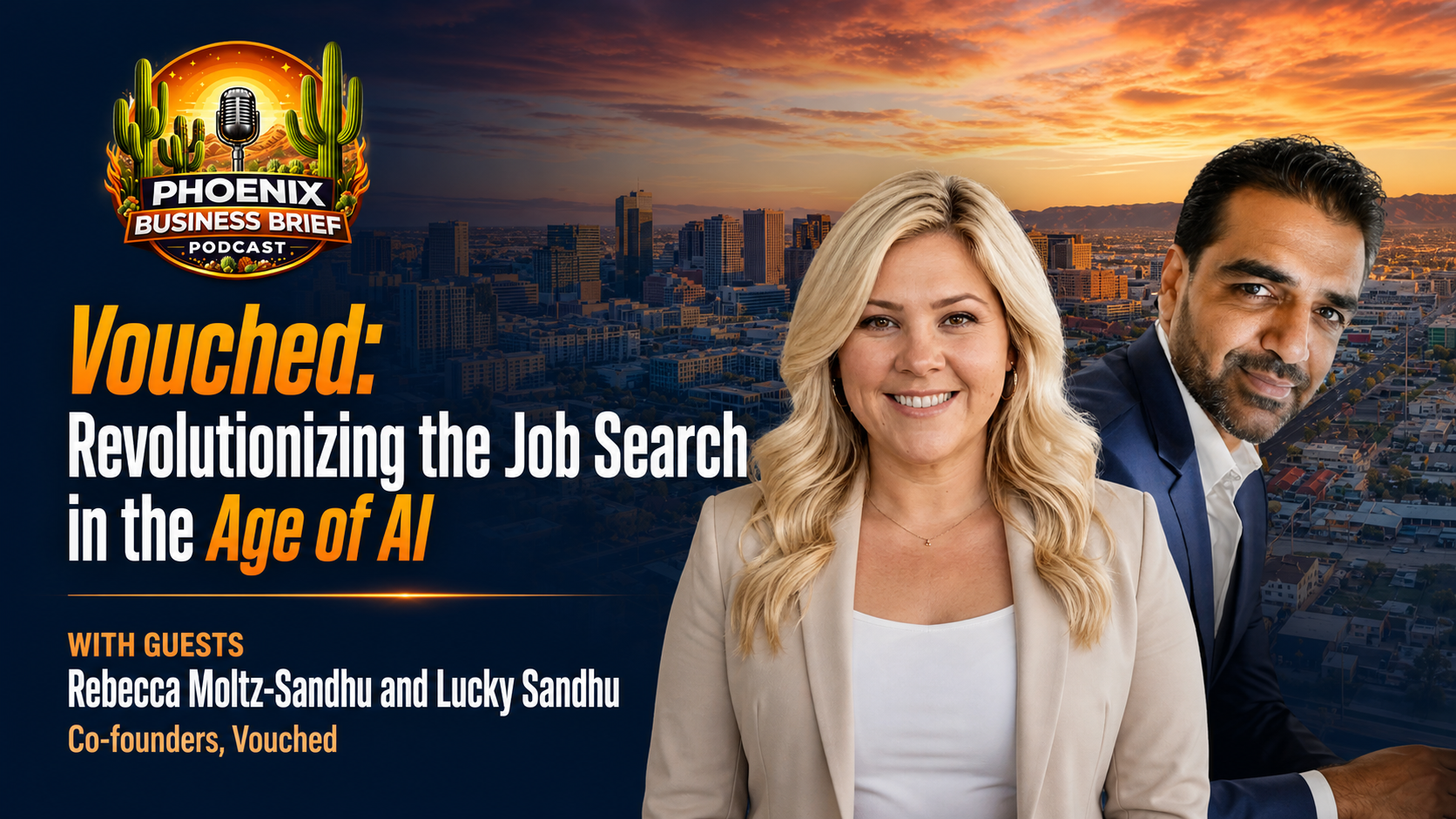
[00:00] Bryan Hyde: Welcome to the Phoenix Business Brief podcast. I'm Bryan Hyde, and today I'm joined by Rebecca Moltz-Sandhu, the co-founder of Vouched. And Rebecca, you've got— is this the other co-founder with you, Lucky?
[00:11] Rebecca Moltz-Sandhu: Yes, my husband and CTO. We— I call him my PLF, my partner for life. So, yes.
[00:18] Bryan Hyde: So before we dive into your business, I'd like each of you to take just a moment, if you would, to tell us just a little bit about who you are and what you do. And Rebecca, let's, let's start with you.
[00:29] Rebecca Moltz-Sandhu: Sure. Well, I guess I've been in evolution of becoming a co-founder for quite some time. This is not the field I started in. I never intended on being in tech, but I found myself asking a lot of questions as AI started impacting people that are my age and how this is going to look. So a lot of my SaaS background, I've always done demos, I've always sold software for someone else. Started turning over, but I'm not a tech person. I knew how to convey a message. I know how to, to connect with people, but the actual technical piece of it, that's where conversations at home started actually breathing life into something that was, I guess, more of a product. Yeah.
[01:13] Bryan Hyde: Okay. And Lucky, same question for you. Tell us a little bit about who you are and what you do.
[01:18] Lucky Sandhu: My name is Lucky Sandhu, and I'm the technology officer with Rebecca, co-founding it. I'm actually a realtor during the daytime. So that's my full-time gig. And I have a background in development and IT. So this came to me naturally to partner up with her as she— I do some workflows and stuff for realtors. So this just became a natural evolution for me to help her out.
[01:46] Bryan Hyde: Okay, and now the $64,000 question. And that is, Rebecca, what exactly is vouched?
[01:54] Rebecca Moltz-Sandhu: So Vouch is filling a void. So if you've applied for a job recently or you've been laid off recently or you're in that bubble, you know, essentially there are 2 options. You can go to Indeed or you can go to LinkedIn. That's kind of, you know, or you network your way through things. But for the most part, both of those platforms are falling vastly short of what people actually need. They have stayed in this very one-dimensional aspect of submit resume, submit application, and then it's It's the battle of the bots. It's whose bot-written resume can come up against somebody's bot system and how do you get around them. And all of that's not working for a market that's desperate to connect. I think we've lost the idea of a job seeker and employer actually finding each other and then starting from a solid place to move forward. You have all this noise in between, you have recruiters in between. And so when we looked at all these issues that we needed to solve for, there was a way to create a user profile that had depth and breadth and meaning and, and that allowed somebody to really display who they are and their talents and to have someone vouched for them on the other end of that. So we have a peer vouch system that's built in where people that you've worked with can contribute to who you say you are and can actually back that up. So Vouch solves for a job seeker issue, but it also solves for the employer side. So if you are not a massive company or you can't afford an ATS, I mean, it's just a tracking system that they use for applications. Sometimes those can run $30,000 or more a year. And if you are a small business, and we've got about, you know, 230,000 of them here in Arizona, you may not also have an HR department, but that doesn't mean the function isn't needed. So we started looking at how do we fill this need where they need to be able to find qualified candidates, they need a quick way of scoring. They also need a way to stay engaged. They also need a way to say, I did not discriminate based off of anything. So we have a blind merit feature built into this. So we're trying to solve for 2 sides of a market right now that desperately need to find each other, but no, nothing seemed to fit that. And it's kind of odd that we're the ones that feel like we've just been tapped on the shoulder, like, you go do it then. And here we are.
[04:23] Bryan Hyde: Lucky, I wanna ask you, it sounds like AI is, you know, I was warned AI is going to change things a lot. And I've heard that, you know, especially it's affecting people's jobs and some people see that negatively, some people see it positively. Can we ascribe a lot of the need for Vouched to the impact that AI and its advent is having?
[04:44] Lucky Sandhu: Yeah, absolutely. You know, AI, it's not a scary thing. I think if you start to understand it, what it can really use as a really great tool for people who are really thoughtful and being able to really articulate an idea, it just helps you sharpen that idea really, really well and to be not afraid of it. So certain things we've incorporated into the features is a library of curated content that helps a job seeker to say, hey, you know what, these tools, These these skills that are out there, I don't have to go filter through such a noise that's on YouTube or any social platform. So we brought it down to where it's vetted out. It is through top people who are in their industry well know it very well. So we figured you know what we can curate this and present it in a way to it's benefiting and adding value to the job seeker and having them a better understanding. And then also from the job on the employer side of things, we were like you know what the employer needs to. understand, like, they need to adapt these to their businesses. And many of them that I've spoken to, they do want to adapt this technology into their business, but they have no idea where to even begin. So a lot of this is more like education on both parts so they're not scared.
[06:06] Bryan Hyde: This sounds like a really exciting place to be. I mean, like, you are on the cusp of what's coming next. Tell us a little bit about the The process of pre-verifying job candidates?
[06:18] Lucky Sandhu: Want to take that one? Pre-verifying is actually pretty simple because, you know, we took a standard one-dimensional resume and we added depth and dimensions to it. So being able to take a technology that we have incorporated into this platform, it can actually take your resume, grab all the skills that it needs, and then also start now matching with the employer sides, what they need. And, and there, there's a score matching that it says, you know what, if I'm going through 100 applicants through Indeed, there's no way for me to even know where that person's gonna fit unless I read through the resumes or understand it or comprehend it. But we created filters and tools within the employer side to help them gauge where this resume actually fits and can help them assess a better outcome.
[07:11] Rebecca Moltz-Sandhu: Yeah, and I think, you know, the resume, because it is one-dimensional, we knew that there are things you can't get on that piece of paper, things about you that would absolutely qualify you for some of these jobs. So what we've also included is a preset grouping of questions. It's about 19 questions that we encourage every profile builder to go through and answer because There is no limitation of how many characters you can fit in that box. If you want to answer that question with your entire history of how you've led teams or what projects you have led and what's been successful for you in the past, you can create a profile that has a lot of meaning so that when someone is trying to match you, they're not just looking at your resume and what you're able to fit on an A/B side piece of paper. You're dealing with a depth and a breadth that we have the technology to do it, but we haven't seen a platform that says, Bring your portfolio, bring your URLs, bring all of your talent and put it in here so that when someone is taking a read on whether you're gonna fit into their culture or your character, you can actually show them. So yeah, it is very exciting. Yeah.
[08:20] Bryan Hyde: You know, it, it, it's been a while since I walked into a business with a resume and, you know, hopeful for— hopefully I can land this job. That really sounds quaint and old-fashioned compared to what the two of you are describing.
[08:33] Rebecca Moltz-Sandhu: Yes, yes. And we, you know, we were children of the '80s, but we remember classified ads. And so part of what we realized was, yes, if you're living in the vouched ecosystem, you can find each other, but there's also going to have to be a place where somebody that's outside our ecosystem can see the jobs that are posted. And so we have created, it's kind of a classifieds page. It's exactly how the classified ads used to be laid out, and employers can buy a block And then they can, they can highlight their block just like you used to be able to bold out a block and that cost you a little bit extra. But same purpose where you can go through the classified ads digitally and see the jobs that are posted. And if you see a job that rings your bell and you're like, I think that that may be a fit, you can click into it and you'll be prompted to create a profile. And now that employer has a chance to find you. So yeah, very quaint, but there was a point in time where that was really valued and I think it's still is. It's just gotten muted by all the, the social clutter that's out there. We don't need the social media on top of it. We really need 2 people to meet each other's needs, and we think we, we're creating that environment.
[09:44] Bryan Hyde: I know you, you've touched on these before, but I, I would like to just kind of reiterate the biggest challenges. Let's start with the person who's seeking a job. Let's just suppose someone, uh, someone has experienced a shift and whoops, now I am out there looking for employment. What's the biggest challenge that they face as they go out there to find Yeah, we're seeing this in a couple of different groupings of people.
[10:07] Rebecca Moltz-Sandhu: We see this in middle-aged professionals like us, where they may have 20 years in a particular field. We also see this in early graduates, where they can't quite get entry-level positions because a lot of that's been automated. There are not a lot of entry-level positions anymore. So, there's 2 groups here that I think this fits for. But I think the challenge, especially for people that are middle-aged like us, that find themselves eliminated from an org chart because of technology or because of AI. They're looking around at the jobs that are available and they also require AI literacy. Well, typically, if we need to upskill ourselves, we will go back to university or go to some course that we can take. The challenge with that is if you've already got a mortgage and kids, taking on student loan debt doesn't make a lot of sense. Neither does dedicating 20 or 30 hours a week into university courses. And then you've got the challenge of the university themselves not being able to keep up with the technology. They're not approving curriculums fast enough for people to be actually trained in what's happening. So that— those are all challenges that, you know, yes, you got laid off due to AI, but yes, you have to have AI to move forward. So how do you— how do you fill that gap? And that is the curated library. So when you take some of these courses, you will earn badges. You have to have a certain passing grade. We put it at an 80% passing grade. But if that can explain or reflect your willingness to learn, grow, develop your skill set to an employer, we want that to be part of your profile. That I had to self-teach myself, but I've taken these classes that someone has put before me, and now it's gonna show as completed.
[11:51] Lucky Sandhu: Yeah.
[11:52] Rebecca Moltz-Sandhu: So yeah.
[11:53] Bryan Hyde: Lucky, is there anything you'd like to add to that?
[11:56] Lucky Sandhu: You know, I think the transparency part of this is really crucial. So when we did the framework, we wanted to make sure it was transparent on both ends. So the job seeker being able to communicate directly with the employer— I'm sorry, the employee— and vice versa. So like being able to know where exactly was my resume even viewed? Was I even considered? And, you know, being able to show that to the job seeker side, it gives a little hope and that twinkle of light at the end of the tunnel that, you know what, somebody did actually physically look at it. It's not going through an ATS filtration. So again, bringing a new— I mean, it's an old concept of classifieds, just bringing it back into hands where it's full transparency to both sides and being able to have a foundation where it's trust.
[12:50] Rebecca Moltz-Sandhu: Yeah.
[12:51] Bryan Hyde: Now, let's look at the other side of the coin too. For the employer, there are challenges as well as opportunities. Let's start with what's the biggest challenge that someone who's looking to hire is facing?
[13:01] Rebecca Moltz-Sandhu: Well, you know, this idea, we call it ghosting, and we used to think of it as like in the dating world, but now it's become part of the professional world too. They're looking at candidates the same way. Are these real people? Or, you know, or if I've moved somebody all the way through the process, why would they not show up for their first day of work? Like, There's a lot of mistrust that's been broke down over that way too. And then we've got a lot of— and we've got lawsuits moving through our court system right now for discrimination and how an ATS, it has these features in there that they didn't intend to keep certain people out, but then the employer is being held liable for the filtration there. They're saying that if you enabled an AI feature, that's an extension of your HR department and you are responsible for whatever it does. Well, now, like, some of these companies don't have a way of doing it properly, doing it with this blind merit idea or actually being able to protect themselves. And so building in some criteria. The other thing that is very important, and it's state-specific, is salary disclosures, being able to put out an honest salary range where, you know, you used to see, you know, this job is $65,000 to $80,000 a year. That's a legitimate range. But if you look on some of the jobs right now, it's you know, $20,000 to $250,000, and you're not quite sure what kind of— what does that mean? And so that is a state-specific, you know, Colorado's got different laws than California. But having a system where if you are loading a job into our system, it's going to say, hey, you've got some state-specific guidelines. And when you think about a small business that doesn't have an HR department or somebody full-time trying to keep up with all of the HR laws across the country. These are just little tweaks that we were like, how can we help you get there? And then we also think like, if you are going to be posting a job, let's help you get there quicker. If your goal is to really fill a position, we've put a 14-day quantifier on everything. So, if you're serious about posting a job, going through, we hope to have a very deep set of candidates that people can choose from that get matched with them.
[15:16] Bryan Hyde: Yeah.
[15:18] Rebecca Moltz-Sandhu: Within 14 days, you should be able to collect enough candidate information for that job to come down and you actually to start moving forward with interviews and moving them through a hiring process. And all of that together, it starts to save them a lot of money because again, if you are paying to post your job on LinkedIn in particularly and you want to promote your job, you have to pay for every click that comes across. So you don't really know how much that end bill is going to be for. You may get a bill at the end of 30 days that's way more than you budgeted for that job posting, but you don't know. And we don't believe business should be so— you should be able to predict that. You should be able to put it as a line item and a consideration. And so we're very transparent in our pricing and our pricing tiers, and we think that will also help a small business get quality candidates without paying thousands and thousands of dollars, whether it's to a recruiter or if it's to a software system.
[16:14] Bryan Hyde: What I hear you describing sounds like a way to rebuild the trust that has kind of faded away from the process. You know, you're helping these employers find the right candidates. They're pre-verified, and it's saving both of them time. And hopefully, you know, as you just mentioned, they know where they stand. It's not just a matter of, well, I sent out this many resumes and now the waiting game begins, right?
[16:44] Rebecca Moltz-Sandhu: Yeah, yeah, we think people deserve better.
[16:46] Lucky Sandhu: Yeah, and I think we've both been on that side of the fence, uh, you know, in our pre— you know, when looking for a job. We know that experience and that frustration and the anxiety of bills just piling up with no answers in sight. Uh, so being able to help both parties, you know, like, we know you're looking for quality candidate. You know, this is the nice part also is that we don't charge the candidate anything. This is not a job seeker, doesn't pay for the training, doesn't pay for anything. This is free for the job seeker to come and say, you know what, I am looking and I do genuinely want to grow my skills. And then for the employer, we're like, you know, you can bear the burden. It's a write-off for you. It's an expense item for you at the end of the year. And we're going to make it nominal where it's affordable and it's transparent. And I've had experiences in the past with, you know, talking to HR and where they— I've seen them being on the call with Indeed and just fighting for like, what am I being charged for? So like just those type of things that kind of were early on discussed, what the mantra was going to be for Vouch and what our values were.
[17:51] Bryan Hyde: 2 quick questions as we come to the end of the segment here. Number one, how far is your reach? Is it beyond, you know, Phoenix employers and job seekers? And the last one is, Where do people find you? Where do they go online to access Vouched?
[18:08] Rebecca Moltz-Sandhu: Yeah, we started all of this on the 101. We started this here in Phoenix. So we are trying to serve our Phoenix market and our Phoenix neighbors. But this is meant to be coast to coast. This is the United States. We're not, we're not serving Canada or around the globe. Could it go that far? Maybe one day. But right now we have a lot of people we need to take care of right here at home. So yeah, we're taking care of our neighbors first. And then you can find us at vouched.fyi. That is where you can go if whether you're an employer or a job seeker, you can create a free profile right away and start perusing through these courses. And yeah, we are looking to connect. We are looking to build some hope and be a foundation of restoring that job seeker to employer connecting.
[18:57] Bryan Hyde: Man, you gotta love an idea whose time has come, and this sure sounds like one.
[19:01] Rebecca Moltz-Sandhu: Again, thank you so much, Brian.
[19:03] Bryan Hyde: We're visiting with Rebecca Mold Sandhu and her husband Lucky, and they're the founders of Vouched. Um, thanks again for joining us here on the Phoenix Business Brief podcast.
[19:12] Rebecca Moltz-Sandhu: Thanks for having us.