
2026-09-30 · Arizona State University
Data Centers and AI: Insights from Domenico Ferraro on Future Value
with Domenico Ferraro, Associated Professor, Department of Economics — Arizona State University
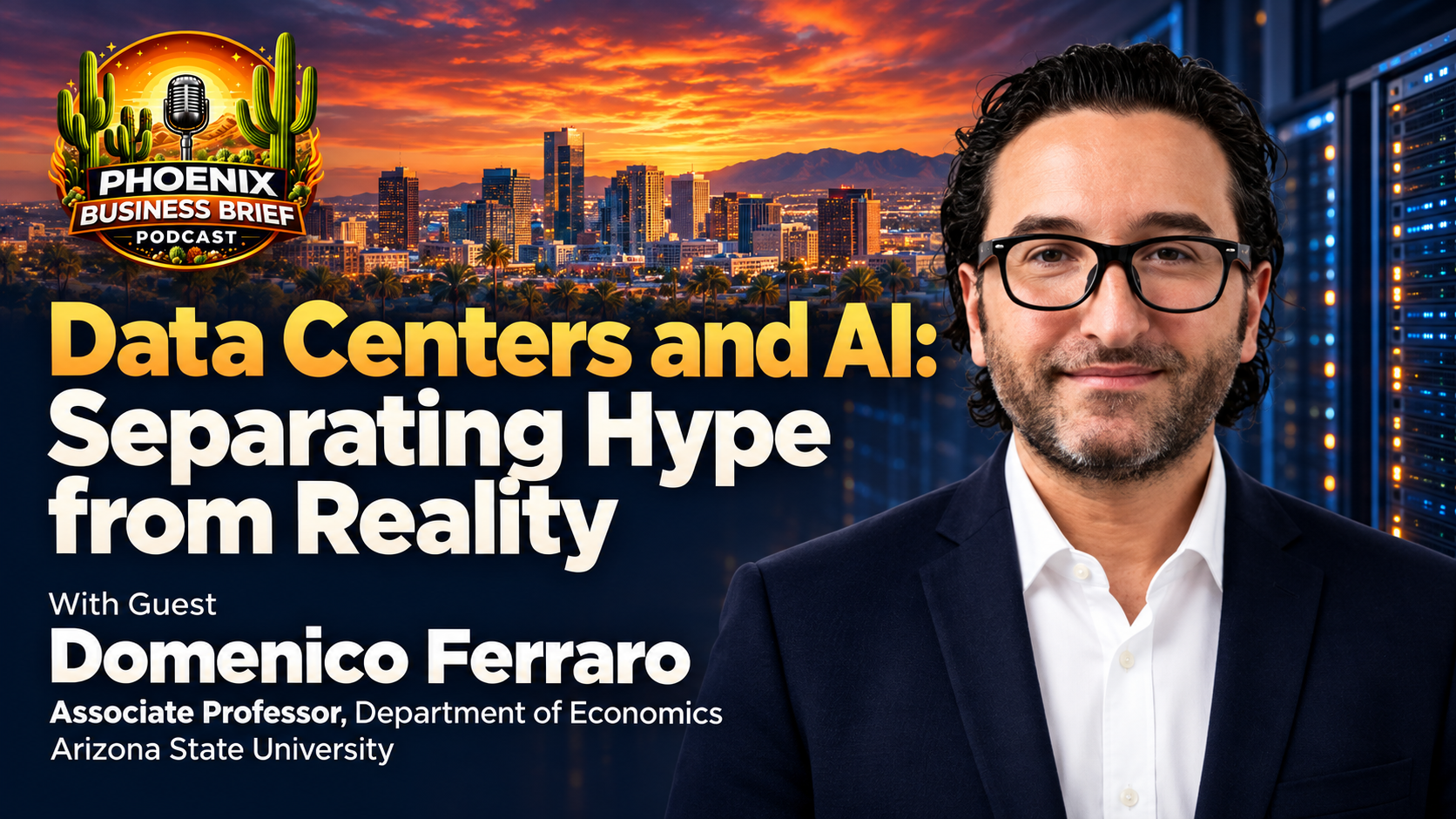
In the latest episode of the Phoenix Business Brief podcast, Bryan Hyde interviews Domenico Ferraro, an associate professor at Arizona State University's W.P. Carey School of Business. Ferraro discusses the intersection of data centers and artificial intelligence, emphasizing the economic implications, potential disruptions in the labor market, and the necessity for increased electricity generation to support growing demand from data centers. He highlights the importance of coordinated investment and policy considerations for the responsible deployment of AI technologies.
Data Centers and AI: Separating Hype from Reality with Domenico Ferraro
Data Centers and AI: Analyzing Economic Impact and Future Prospects
Domenico Ferraro, an associate professor in the Department of Economics at Arizona State University's W.P. Carey School of Business, discussed the implications of data centers and artificial intelligence (AI) during a recent episode of the "Phoenix Business Brief" podcast. Ferraro, who has focused on economic growth and labor markets, shared insights from three reports he authored for the Goldwater Institute, examining the costs and benefits associated with these technologies.
Ferraro emphasized the dual nature of technological advancements, noting that while they can drive economic growth, they can also lead to disruptions in the labor market. "Historically, this type of reaction has been the norm," he said, referring to societal concerns about new technologies. He acknowledged that while fears surrounding data centers and AI are valid, it is essential to consider the potential benefits these technologies can bring.
According to Ferraro, data centers serve as the physical infrastructure necessary for powering AI and other computing technologies. He explained that as demand for computing power grows, so does the need for energy, which data centers consume in significant quantities. "If there is an asset, if there is value, most likely in order for us to grab this value, we need to incur a cost," he said.
Ferraro's reports outline the value of AI and the role of data centers in enhancing productivity in both the workplace and at home. He pointed out that while many discussions focus on the impact of AI on jobs, there is also considerable value generated in non-market activities, such as home production. Ferraro illustrated this with examples, including how AI tools can assist individuals with tasks like cooking.
Despite the potential for job displacement due to AI, Ferraro noted that current data does not indicate significant disruptions in the labor market. He stated, "If you look at the data now, there seems to be no major disruption in the labor market." However, he acknowledged that concerns about future job losses are valid and warrant attention.
The second and third reports Ferraro authored delve into the costs associated with data centers and the electricity required to operate them. He highlighted the need for increased investment in electricity generation to meet the growing demand from data centers. Ferraro explained that the transition to a new energy regime, which accommodates this demand, requires significant coordination among various stakeholders, including data center operators, energy producers, and regulators.
Ferraro also addressed the potential economic implications of rising electricity costs. He warned that increased demand for electricity could lead to higher prices, which might disproportionately affect smaller consumers. He argued for a pricing system that reflects the willingness to pay, suggesting that large data centers should bear a larger share of the costs associated with increased demand.
In conclusion, Ferraro advocates for a balanced approach to the deployment of AI and data centers, recognizing the need for substantial investment and careful consideration of economic impacts. He emphasized that while there are challenges ahead, the transformative potential of AI and the associated data infrastructure should not be overlooked. "There is enormous value ahead of us," he said, underscoring the importance of navigating the complexities of this technological landscape responsibly.
Interview Q&A
Q&A: Data Centers and AI: Separating Hype from Reality with Domenico Ferraro
Data Centers and AI: Separating Hype from Reality
Q: Who is Domenico Ferraro?
A: Domenico Ferraro is an associate professor at the W.P. Carey School of Business at Arizona State University. He focuses on economic growth and the U.S. labor market.
Q: What sparked Ferraro's interest in data centers?
A: Ferraro became interested in data centers over the past year, particularly in the context of their relationship with artificial intelligence. He has written three reports for the Goldwater Institute on this topic.
Q: What concerns does Ferraro have regarding data centers and AI?
A: Ferraro acknowledges valid concerns about potential disruptions in the labor market due to technological advancements. He emphasizes the need for society to navigate these changes thoughtfully to avoid social conflict.
Q: What is the primary value of data centers and AI according to Ferraro?
A: Ferraro believes that data centers and AI will provide enormous value to society, particularly in transforming various aspects of life over the next five to ten years.
Q: What costs are associated with the value of AI and data centers?
A: Ferraro highlights that to harness the value of AI and data centers, there are costs involved, including investments in equipment, retraining, and the need for electricity to power these technologies.
Q: How do data centers contribute to electricity demand?
A: Data centers are essential for providing the computing power needed for AI and other digital technologies, which significantly increases electricity demand.
Q: What challenges exist in expanding electricity capacity in the U.S.?
A: Ferraro points out that expanding electricity capacity requires substantial investment and coordination among stakeholders, including data centers, electricity producers, and regulators.
Q: What are the implications of increased electricity demand on pricing?
A: Ferraro warns that increased demand for electricity may lead to higher prices, which could disproportionately affect smaller consumers who may not have the same willingness to pay as larger data centers.
Q: What policy objectives does Ferraro suggest for responsible AI deployment?
A: Ferraro emphasizes the need for clear pricing systems based on willingness to pay, coordination among stakeholders, and investment in electricity generation to ensure that increased demand does not unfairly burden small consumers.
Q: How does Ferraro view the current impact of AI on the labor market?
A: Ferraro notes that, based on current data, there is no major disruption in the labor market due to AI. He believes that while concerns about job displacement are valid, the immediate evidence does not support a doomsday scenario.
Q: What is the significance of home production in the context of AI?
A: Ferraro mentions that AI also adds value in home production, where individuals can use technology for tasks like cooking, thereby enhancing their daily lives.
Q: What is Ferraro's overall perspective on the future of AI and data centers?
A: Ferraro is optimistic about the transformative potential of AI and data centers, believing that while there are challenges to address, the overall value they will bring is substantial.
Key takeaways
- “I'm very skeptical of doomsday scenarios, but I also am aware that historically this type of reaction has been the norm.”
- “Concerns are valid because historically it remains true that technology can create winners and losers.”
- “Artificial intelligence has the power to transform our lives, in the workplace and at home.”
- “If there is an investment opportunity, if there is a technology that has the transformative power as artificial intelligence, then we need to do something in order to grab those benefits.”
- “The risk that I envision here is that the price is going to go up for everybody, and this is not good economics.”
About the guest
Associated Professor, Department of Economics — Arizona State University
Full transcript
Show full transcriptHide transcript
Filed under
Related episodes

FloorJack Auto Repair: Honesty, Care & Growth in Phoenix Auto Service
with Javen Coughlin & Brady Gibson

AZ Lt. Gov. Candidate Sine Kerr on Arizona Politics, Agriculture, and Water Challenges
with Sine Kerr

From Dating App to Dynamic Duo: The Alpine Electric Story
with Isaac Williams & Lish Cook

From Refugee to Practice Owner: Building a Mission-Driven Dental Startup
with Dr. Monzer Shakally