Phoenix Business Brief Podcast logo
← Phoenix Business Brief

2026-11-04 · Hire Capacity.

Unlocking Hiring Success: Harry Lakin on Behavioral Science & AI

with Harry Lakin, Founder — Hire Capacity.
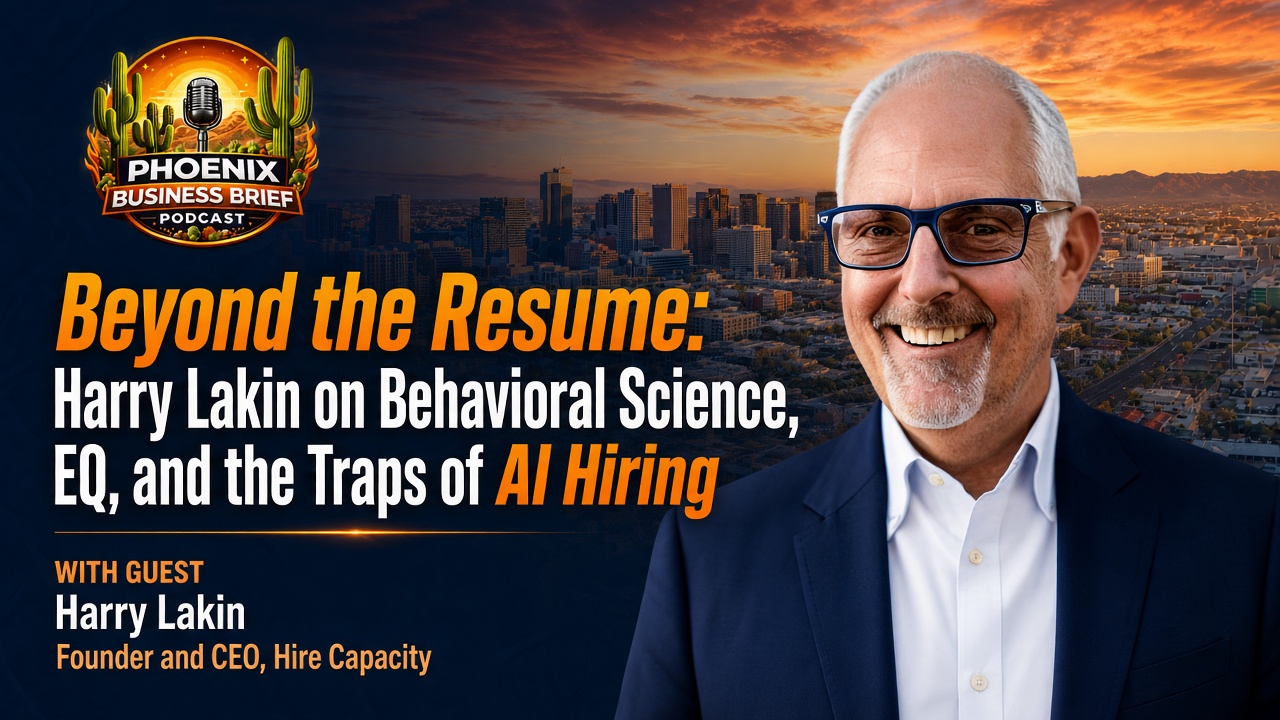
Beyond the Resume: Harry Lakin on Behavioral Science, EQ, and the Traps of AI Hiring

In the Phoenix Business Brief podcast episode titled "Beyond the Resume," Harry Lakin, founder of Hire Capacity, discusses the importance of behavioral assessments in hiring. Lakin emphasizes that understanding a candidate's behavioral traits, rather than just their resume, can lead to better job fits and employee engagement. He also addresses the limitations of AI in hiring processes and the significance of emotional intelligence in the workplace.

Beyond the Resume: Harry Lakin on Behavioral Science, EQ, and the Traps of AI Hiring

0:00 / 0:00

Beyond the Resume: Harry Lakin on Behavioral Science, EQ, and the Traps of AI Hiring

Behavioral Science in Hiring: Harry Lakin's Approach to Employee Assessment

In a recent episode of the Phoenix Business Brief podcast, Harry Lakin, founder of Hire Capacity, discussed the importance of behavioral assessments in hiring practices. Lakin's company specializes in evaluating candidates based on behavioral traits rather than traditional metrics like education or intelligence. This approach aims to enhance employee engagement and overall organizational success.

Lakin's journey into behavioral science began after a career in sales and marketing. He previously served as the sales and marketing director for Arizona's largest moving company. In 2012, he and his wife relocated to Austin, Texas, where she encouraged him to explore the field of behavioral assessments. This led to the establishment of Hire Capacity, which focuses on understanding employee behaviors to improve hiring outcomes.

The Importance of Behavioral Fit

Lakin emphasized the significance of placing the right individuals in suitable roles within a company. He noted that many employees fail to thrive in their positions due to a lack of behavioral fit. "People end up in the wrong seat and they fire themselves," he said. To combat this, Hire Capacity works with business owners to create benchmarks for successful behaviors associated with specific roles.

Once these benchmarks are established, candidates are assessed and compared to the ideal behavioral profile. This process helps employers identify how closely a candidate aligns with the desired traits for a position. Lakin explained that while not every candidate will perfectly match the benchmark, the assessment can guide employers on how to coach and develop employees in their roles.

Key Behavioral Traits

Hire Capacity's assessment, known as the Organizational Management System (OMS), evaluates seven key behavioral traits. These include assertiveness, sociability, patience, discipline, adaptability, emotional containment, and creativity. Lakin highlighted the importance of understanding these traits to ensure a good fit for both the employee and the organization.

For example, the assessment measures whether a candidate is more proactive or patient, which can influence their effectiveness in various roles. Lakin pointed out that individuals with high levels of creativity may not be suitable for positions requiring strict adherence to protocols, such as in a call center environment.

The Role of Emotional Intelligence

Lakin also discussed the growing emphasis on emotional intelligence in the workplace. He follows the model developed by Daniel Goleman, which includes self-awareness, self-regulation, empathy, and social skills. "Learning emotional intelligence is not hard, but it's the hardest thing you'll ever do," he said. The assessment process can serve as a foundation for developing these skills, ultimately leading to a more engaged workforce.

The Impact of Artificial Intelligence

As artificial intelligence (AI) becomes increasingly integrated into hiring processes, Lakin cautioned against relying solely on technology for candidate selection. He stated that AI lacks the human qualities necessary for effective hiring decisions. "AI is never human," he said. Lakin emphasized the importance of validated assessments over AI-driven evaluations, particularly in high-stakes roles.

He noted that while AI can mimic emotional intelligence, it does not possess genuine understanding or empathy. Lakin argued that hiring decisions should be based on validated assessments that provide a comprehensive view of a candidate's behavioral traits.

Personal Connection to Behavioral Assessments

Lakin's personal experience with behavioral assessments adds a unique dimension to his professional insights. He recounted how he met his wife through a mutual connection who encouraged him to take a behavioral assessment as part of their budding relationship. This assessment confirmed their compatibility, leading to a successful marriage. "It actually works," he said, underscoring the practical applications of behavioral assessments beyond the workplace.

Conclusion

Harry Lakin's insights into behavioral assessments highlight the importance of understanding employee behaviors in the hiring process. By focusing on behavioral fit, organizations can enhance employee engagement and overall success. As AI continues to play a role in recruitment, Lakin advocates for the use of validated assessments to ensure effective hiring practices. For more information about Hire Capacity, visit their website at hirecapacity.com.

Interview Q&A

Q&A: Beyond the Resume: Harry Lakin on Behavioral Science, EQ, and the Traps of AI Hiring

Beyond the Resume: Harry Lakin on Behavioral Science, EQ, and the Traps of AI Hiring

Q: Can you tell us about your background and how you started Hire Capacity?

A: I come from a sales and marketing background. I was the sales and marketing director for the largest moving company in Arizona. In 2012, my wife suggested I consider forming a company focused on behavioral assessments, which led to the creation of Hire Capacity.

Q: What does Hire Capacity do?

A: Hire Capacity started as a behavioral assessment company. We help organizations assess employees and potential hires to understand them at a behavioral level, focusing on how their behaviors impact workplace success.

Q: How does your company ensure the right people are hired?

A: We work with business owners to create a benchmark of behaviors for successful candidates in specific roles. We assess candidates against this benchmark to determine their fit and help managers understand how to coach them effectively.

Q: What traits do you evaluate in potential candidates?

A: We measure seven traits: assertiveness, sociability, patience, discipline, behavioral adaptability, emotional containment, and creativity. Each trait helps determine how well a candidate will fit in a specific role.

Q: Why is it important to use the right behavioral assessment tools?

A: It is crucial to use validated normative assessments for hiring. Many popular tools, like Myers-Briggs and DiSC, are better suited for team-building and not for hiring decisions. Validated assessments ensure accurate and reliable results.

Q: What impact does hiring the right person have on a business?

A: When the right person is in the right role, they are more engaged and satisfied. This leads to better performance and productivity, as employees thrive in roles that suit their behavioral traits.

Q: How does AI play a role in the hiring process?

A: AI can assist in the hiring process, but it is important to remember that AI is not human. It lacks emotional intelligence and can make errors, such as "hallucinations" in decision-making. Human judgment remains essential in hiring.

Q: What is the process for training leadership in emotional intelligence?

A: Training in emotional intelligence involves understanding self-awareness, self-regulation, empathy, and social skills. The process starts with a behavioral assessment and follows the Daniel Goleman model, which emphasizes these key areas.

Q: Can you share a personal story related to behavioral assessments?

A: In 2008, after losing a job, I met my wife at a Girl Scout cookie booth. She asked me to take a behavioral assessment to ensure I was not like her previous partners. The assessment confirmed I was a good fit, and we have been happily married for 17 years.

Q: How does emotional intelligence relate to the workplace?

A: Emotional intelligence is crucial for leaders, especially as workplaces evolve with fewer employees. Leaders need to be emotionally intelligent to help their teams thrive and adapt to changes, including the integration of AI.

Q: Where can people find more information about Hire Capacity?

A: You can visit our website at hirecapacity.com or my personal site at harrylakin.com for more information about our services and insights.

Key takeaways

  • “This isn't— doesn't really have anything to do with their intelligence, you know, where they went to school, none of that.”
  • “I can't tell you how many times people end up in the wrong seat and they fire themselves.”
  • “No matter what AI does, an AI is never human, period, full stop.”
  • “Learning emotional intelligence is not— I'm going to say it's not hard, but it's the hardest thing you'll ever do.”
  • “If somebody has mental health challenges, for instance, they might be a great behavioral fit on paper, but if they can't bring themselves to be who they should be in the office, it's just not going to work.”
  • “I want to make sure you're behaviorally not what I had previously.”

About the guest

Harry Lakin headshot

Harry Lakin

Founder — Hire Capacity.

Harry Lakin is a Phoenix-based talent strategist and keynote speaker, and the founder of Hire Capacity. For nearly 15 years he’s worked at the intersection of behavioral science and organizational leadership, helping companies make senior and executive hires with validated behavioral assessments (OMS), EQ training (EQi-2.0 / EQ360), and decision frameworks rather than gut feel alone. He’s a graduate of Arizona State University’s Hugh Downs School of Human Communication, a certified OMS partner, and speaks on emotional intelligence and multi-generational communication. Clients have included Fortune 500 divisions, PE-backed growth companies, and regional firms.

Full transcript

Show full transcript
[00:00] Bryan Hyde: Welcome to the Phoenix Business Brief podcast. I'm Bryan Hyde, and today I'm joined by Harry Lakin. He is the owner and founder of Hire Capacity, and that's H-I-R-E, just to make sure that people understand the spelling here. Harry, welcome to the program. Take a moment, if you would. Tell us a little bit about who you are and what you do. [00:21] Harry Lakin: Thank you, Bryan. It's great to be with you today. I really appreciate you wanting to learn a little bit more about me and and some of the things that I do. Higher Capacity basically started as a behavioral assessment company, helping organizations assess existing employees, potential future employees, to understand them at a behavioral level. This isn't— doesn't really have anything to do with their their intelligence, you know, you know, where they went to school, none of that. This is, this is not cognitive at all. It's behavioral. And your behaviors in the workplace, believe it or not, make up a huge part of who you are and how successful ultimately you might be. [01:16] Bryan Hyde: Tell me a little bit about your background. Was this, was this something that you gravitated toward throughout your education? [01:25] Harry Lakin: No, no. I come out of the sales and marketing field. I was the sales and marketing director for the largest moving company in Arizona for many years. And in 2012, my wife and I had an opportunity to move to Austin, Texas, and I decided I wanted to get out of the moving business. The moving business is kind of like Shawshank. Once you're in, you're in and you get institutionalized. And I took that as my escape hatch to kind of be like Bobby Dufresne and swim through that sewer, if you will, to get out. And so I was contemplating different options in Austin, and my wife suggested that I consider this behavioral assessment. And we have a joint history, she and I, on this behavioral assessment. We can get into that if you want. But she suggested, why don't I consider forming a company and maybe selling that and consulting on that with clients? [02:40] Bryan Hyde: I'm going to stick a pin in the reference you said about you and your wife and this behavioral assessment. We are going to come back to that. It's relevant to what we're talking about today. Let's talk about this from the standpoint of A business owner or someone who is running a business and has to hire people, you know, to work within that business. Talk to me about what your company does to make sure they get the right people in the right place. [03:05] Harry Lakin: That's so important, Brian. I can't tell you, you know, how many times people end up in the wrong seat and they fire themselves. or they're asked to leave just because they're not a behavioral fit. So the process really starts working with the business owner or the sales manager or whatever level that they're hiring for and creating a benchmark. We have a way, a process to create a benchmark of behaviors that someone who should be successful in that role will possess. And then, once we have that benchmark target, if you will, we can assess candidates and then compare the candidate to the benchmark, gauge how far or how close they are to the ideal target, if you will. And it doesn't mean that you're gonna hire somebody who is spot on every time. In fact, sometimes you may not even have a candidate that is even close to the benchmark, but it also will help the owner or the manager or the leadership understand how to coach or how to best implement that person to get the most out of them in that role. Basically, how to try and coach them to be what you need. And some people ultimately can't. But, you know, the closer you can get, the better off you'll be. [04:49] Bryan Hyde: Okay, Harry, walk us through just, you know, the basics of what it takes to evaluate someone on a behavioral level. As let's just, we'll just use, for instance, in a hiring situation. What are some of the things that a potential employer needs to know about that potential employee? [05:09] Harry Lakin: Well, they need to know a lot of things about the potential employee. The first thing they need to know, Brian, is that they're using the right instrument to make sure that they're getting the results they need to make that hiring decision. There are multiple— there are thousands of behavioral assessments available. I mean, some people have heard of Myers-Briggs. Or DiSC. Those are 2 very popular assessments. The problem is too many people don't know what they don't know. And those instruments, while they're great team-building tools, should not be used in hiring and selection for technical reasons. What you need is what is called a normative assessment that has been validated by an independent third party, a psychometrician. And once you have a great instrument, then you can begin using it to hire, you know, the right people. So, what— give me your question again. I just wanted to make sure people understand they need to use the right instrument for what they're trying to accomplish. [06:20] Bryan Hyde: Let's— well, let's talk about what are some of the things that the traits or qualities that you are looking to either categorize or uncover in, you know, potential candidates for a job. I guess I'm wondering what is evaluated so that you have that good fit? [06:41] Harry Lakin: Sure. Some people may have heard of the Big 5, which are the big 5 traits. My assessment, which is called Organizational Management System, OMS for short, We actually measure 7 basic traits of an individual, their level of assertiveness, their sociability, the friendly factor, if you will, their degree of patience or proactiveness. Are they going to be more of a get it done right now, get it off my plate, or are they going to be, I can let the grass grow on this? And neither is good or bad. It's just role dependent. We measure discipline or structure, the need for structure and rules versus somebody who can operate with ambiguity. We measure behavioral adaptability, which is actually a measure of 2 things. It's a measure of how far and for how long someone can sustain behavioral change outside of who they actually are. And then the other is a measure of mental stamina. So how, you know, some people only have the ability to kind of concentrate full tilt for a couple of hours, and then they need to take a mental pause. And people need to be aware of themselves about this and honor it and say, okay, I can't sit in a 6-hour meeting. Every 2 hours, I've got to go take a little mental energy pause and refill the mental gas tank. We measure emotional containment, which isn't emotional intelligence, but in our world, emotional containment means, is somebody a logic-based thinker or does somebody wear their heart on their sleeve and they're more empathetic and connective? And some people can be like Mr. Spock on the old Star Trek show, right? Everything's logical and makes sense or it doesn't. And then other people are very emotional and can bring a highly charged emotional person to the workplace. And then the last thing we measure is creativity, is originality of thought. And you might say, why do we need that? Well, some people, For instance, I have a client, a call center. They have a very scripted process, and people that are too creative tend to go off the script. They start making stuff up and start saying things that the client doesn't want them to say. And so people with lower levels of creativity tend to do better in that role. So those are the 7 constructs that, that we measure. [09:38] Bryan Hyde: That's fascinating to me. I mean, when I, when I hear about recruiting and, and, and hiring, um, I, I've always tended to kind of look at it as it's kind of like, you know, a black and white thing, a selection for the Special Forces. You either make it or you don't. But there's so much more nuance and so many more facets to what will make a person a good fit in a given position. Talk to me about what this means to Employers, when they get the right person in the right position, what does that mean to their success? [10:07] Harry Lakin: Well, generally, it means that the employee, A, is engaged. We hear a lot about employee engagement these days. If somebody is a true fit for a role, they're going to feel really good about it. They're going to kind of be hitting on all cylinders on Sunday night when it's, you know, it's 8 o'clock and they're thinking about their day, they're going to be, cool, I got another day in the office tomorrow of doing what I love to do, versus, I got to go back there again. And everybody's been there on one side of that or the other. So yeah, it means that an employee should thrive in the role. Now, there are certain things that will prevent an employee from thriving in a role. If somebody has mental health challenges, for instance, they might be a great behavioral fit on paper, but if they can't bring themselves to, how should I say, be who they should be in the office, it's just not going to work. So it's not perfect. We don't bat 1,000, but I think we do bat in probably the high .600s. And I think if I was a baseball player hitting .600, I'd probably, you know, be worth $80, $90, $100 million a year, maybe more. So. [11:49] Bryan Hyde: You know, it so hits home when you talk about that, that person who just dreads going to work versus the person who has purpose in it. And, you know, they, they find satisfaction in what they're doing. I mean, it's the difference between toil And, you know, actual productive work where they feel like I'm actually making the world a better place through what I'm doing. Now, I know when it comes to recruiting, AI is beginning to play a role. And, you know, when you submit a resume or you are being considered for a job, often AI will play part of a role in selecting which candidates are going to advance. Talk to me about why is it more important than ever to have a human [12:35] Harry Lakin: So, the first thing I would say to that is no matter what AI does, an AI is never human, period, full stop. It's code. And it's kind of ironic. I was thinking about questions you might ask me before we got together today, and I asked Claude, Just that. I said, can you tell me about the emotional intelligence of AI? And it basically said, I can be and act emotionally intelligent. I can give you the right answers, but basically I'm not sentient. And no matter what happens, it's just never going to be a human being. The second problem with AI as it relates to assessments Is who's validating it? Okay, well, I know that the assessment test— and by the way, we can call it whatever you want. It's an assessment, it's a test. The EEO says it's a test. And by the way, it is perfectly legal to assess people for different roles. The courts have ruled on it, and so long as it is relative to the role, it's legal to do. Griggs versus Duke Power is the seminal case. But AI is just a machine. We've seen how AI hallucinates. Do you want it hallucinating on your next VP of marketing? Likely not. That's too important a role to get wrong with an AI hallucination. So there's no validation there yet. Who knows? Maybe someday some agency will say, we have validated this for use in hiring and selection. But right now, it's just the wild, wild west. Only assessments that have really been validated should be used in, at least at this point in time in history, in hiring and selection. [14:59] Bryan Hyde: So, when your company is— when Higher Capacity is providing emotional intelligence training, what kind of a process is that? Does it take a long time to train leadership within an organization in that? Or is it something pretty straightforward? [15:17] Harry Lakin: Well, learning emotional intelligence is not— I'm going to say it's not hard, but it's the hardest thing you'll ever do. Okay? It's kind of like that old thing where you walk halfway to a wall, you keep taking that half step to the wall, you never quite get there. Okay? But the point is to be cognizant of it and to to really try and display emotional intelligence with other people. And this is where a behavioral assessment starts the— a good behavioral assessment starts the process off on the right foot. I follow the Daniel Goleman model of emotional intelligence, and that's what I train people in. I don't know if you're familiar with Daniel Goleman. He wrote the book Emotional Intelligence, which became a New York Times bestseller, I think, in the mid-'90s. Anyhow, he's kind of the godfather of emotional intelligence. And there are levels that you have to kind of master, if you will. It's like a pyramid. And the base of the pyramid is self-awareness. Okay? Most people think they're self-aware. A lot of times, in fact, it's crazy how often when I'm working with a team and we say, Brian, you're just an impatient guy. You can't get things done fast enough. And Brian goes, I'm not impatient. I can take things in stride. And everybody is shaking their head no. And Brian is getting this— This light bulb moment that maybe I'm not as patient as I think I am. Okay, so we have the ability to help people become more self-aware, and that is the first blank, if you will, in the behavioral emotional intelligence equation. The second plank is self-regulation or self-control. Okay? If you know that Brian gets really upset when things aren't happening fast enough, he can make that change. He can say, okay, take a step back. It's not happening fast enough for me, but it's happening at the speed that Harry needs to do it at. So, you know, maybe I can prod him a little bit, you know, in a very nice and emotionally intelligent way. But, you know, it allows you those first 2 legs of the emotional intelligence stool. The 3rd is displaying empathy, understanding empathy, and really displaying it. And then the last in the Goleman model is social skills. And this is where Once we are fully emotionally intelligent savvy, we can start having real meaningful conversation where it's not manipulative, where, you know, we can disagree in, in ways that are not harmful to the relationship. You know, we can have real one-on-one or one-on-group conversations. So that's kind of how emotional intelligence rolls into this. It's just a natural byproduct, at least the beginning stages of it, of the assessment process. So several years ago, I read an article, interestingly enough, in Harvard Business Review. It was called— What was it called? The Rise of AI in Emotional Intelligence. So basically the article said, hey, as fewer people— this is in 2017, mind you, well before we were really talking daily about emotional intelligence. I mean, it was on the radar, but it was like one of those things that was way out there. It wasn't anywhere close to happening yet. And basically, as more— fewer people are in the workplace, leaders are going to have to be more emotionally intelligent to help the people that remain thrive as employees and thrive working with the AI. [20:08] Bryan Hyde: Harry, as I hear you describe this, I can see the practical applications for everything you have just described. I want to take a step back though. To, uh, to you and your wife. And there, there are applications outside of the workplace for, for this kind of assessment. Tell me about, about your story. [20:23] Harry Lakin: Well, so I, I, my story begins in 2008, February of 2008. Um, I shared with you earlier I was in the moving and storage business. I had left a job, um, with the largest United Van Lines agent in Arizona for an opportunity to go to a very major Mayflower Van Lines agency. And, you know, big step up, gonna do a whole bunch of great initiatives. You know, I'm ready, I'm there ready to do it. Well, if you think back to what was going on in early 2008, the world was crumbling. The financial crisis was just beginning to start. And by February of 2008, this national Mayflower agent made a decision. It wasn't a decision that was favorable to me, but they made a decision. They said, Harry, you're kind of a higher-paid guy. The initiatives we brought you here to implement were not going to probably do those for a while. So good luck and thanks. And I was kind of crushed. I had left a job I could have had for the foreseeable future for this great new opportunity. This just proves the grass isn't always greener. And anyhow, now I'm in a job search. So one day I'm at a Girl Scout cookie booth with my daughter, And I'm talking to one of the other dads and I'm saying, I left that job, I did the new job, it's not going to work out. And one of the fathers says, hey, I've got these 2 recruiters you should talk to. And I called them both. You know, I'm in a job search, right? I called them both and met with them both. And one of them I found very interesting. So I sent her an email the night that I met her and I said, hey, I don't know. I'm a sales guy at heart. I don't know if you mix business with pleasure, but I thought you were interesting. Don't even know what your situation is, but I noticed you weren't wearing a ring, yada, yada. Maybe we could grab a drink or grab dinner or something. And she types back, I do not do that. I am a professional, blah, blah, blah. Anyhow, long story short, I kept after her for months. And by this time, we're becoming very friendly. We're texting probably, oh, I don't know, 10 times a day back and forth. I mean, there's obviously a spark, but, but she still won't go out with me. So, uh, I said, what's it gonna take? And she said, I need you to take this test. [23:31] Bryan Hyde: Okay. [23:33] Harry Lakin: And I, and I said, okay, I'm happy to do that. Can I ask why? She said, well, I want to make sure you're behaviorally not what I had previously. And so I took the OMS assessment. I was who she was looking for. It worked. In a partner. And we will be married 17 years in December. We were together a couple years prior to that, but it actually works. And the reality is, I'm not going to seek— I know it's validated for the workplace, but I'm not going to say, hey, I've got the next eHarmony or OkCupid or whatever. I don't even know. It shows you my age, right? I'm out of the market for 20 years. But what the new dating apps are. But she had used OMS as a recruiter at a company. And her story was that the— well, when we take on a new client, we do a training with them and we help them understand how to interpret the results of the test. And between day 1 and day 2, well, the evening of day 1, we would send out links to friends, family members, whatever. So, we could just have a bunch of patterns the next day to review. And, you know, tell me about this person. Tell me about that person. [25:14] Bryan Hyde: Harry, I'm gonna stop you here. We are coming up on the end of our segment. But again, I want people to know where they can find your business, Hire, H-I-R-E, Capacity. You have a website, I take it? [25:26] Harry Lakin: I do, uh, highercapacity.com. You can also find me at harrylakin.com, H-A-R-R-Y-L-A-K-I-N dot com. Anyhow, bottom line, I'll cut to the end of the story: we're married and we're happy. [25:41] Bryan Hyde: All right, this— I mean, this, this shows you the stuff, it works. And he had a working knowledge of it before he ever built a business around it. Again, talking [25:50] Harry Lakin: with [25:50] Bryan Hyde: Harry Lakin, founder of Higher Capacity. And Harry, thanks for joining us on the Phoenix Business Brief podcast. [25:56] Harry Lakin: Thank you, Brian. Appreciate you having me.

Share this

Guest share kit

  • “This isn't— doesn't really have anything to do with their intelligence, you know, where they went to school, none of that.”
  • “I can't tell you how many times people end up in the wrong seat and they fire themselves.”
  • “No matter what AI does, an AI is never human, period, full stop.”
  • “Learning emotional intelligence is not— I'm going to say it's not hard, but it's the hardest thing you'll ever do.”
  • “If somebody has mental health challenges, for instance, they might be a great behavioral fit on paper, but if they can't bring themselves to be who they should be in the office, it's just not going to work.”
  • “I want to make sure you're behaviorally not what I had previously.”

Filed under

Related episodes