Show full transcriptHide transcript
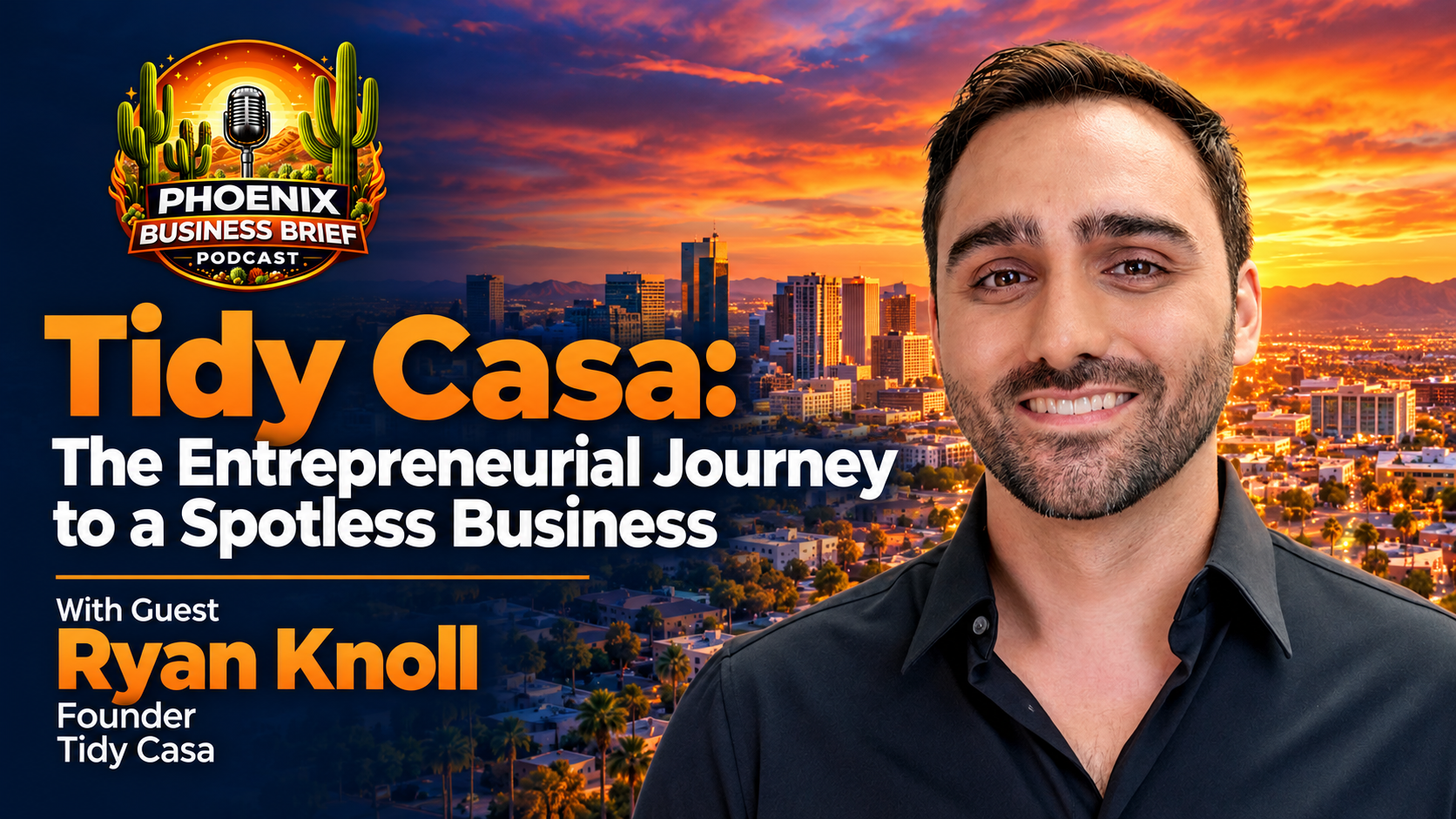
[00:00] Bryan Hyde: Welcome to the Phoenix Business Brief podcast. I'm Brian Hyde, and today I'm joined by Ryan Knoll, who is the founder of Tiny Casa. Ryan, welcome to the program. First of all, let's get a little bit of background on who you are and what you do.
[00:12] Ryan Knoll: Yes, sir. Yeah, I'm the owner of Tiny Casa. Been doing this for like 11 years now, maybe going on 12. Kind of lost track after about a decade, stopped counting. Yeah, we clean houses. Nothing more than that, residential house cleaning, and we're, uh, dedicated to being the best house cleaning company in Phoenix.
[00:33] Bryan Hyde: So tell me a little bit about your background. I mean, this, this sounds like— obviously anybody who lives under a roof, um, knows that cleaning is a part of, of life. It's also a part of life that a lot of us like to procrastinate, or maybe we don't really thoroughly enjoy. So tell me, what, what made you zero in on, on this particular entrepreneurial pursuit to launch Tiny Casa, or Tidy Casa rather?
[00:58] Ryan Knoll: Tidy Casa, yes, sir. Um, there, I always wanted to be an entrepreneur. I mean, I'm just going to start there, um, because it kind of came out of, came out of left field here. But I remember, uh, my uncle, back when I was like 15, I was going to babysit my cousin. And he came to pick me up and he was a very rich entrepreneur guy. And I didn't really kind of realize how rich he was. I didn't really have a concept of this. I just kind of knew like, oh, that's my rich uncle. And he comes to pick me up and he picks me up in this silver convertible Porsche, top down. And he's going to just take me from my mom's house to babysitting my cousin at his house. And I just remember he's getting on the freeway and he just guns it and this car just takes off like a rocket ship, tops down, wind's in my hair. I've never experienced anything like this. It was just absolutely amazing. And I just had this perspective of life up to that point of driving in the backseat of my mom's minivan. My parents were always arguing about money. And I remember at that moment just being like, I need to not live the life that my parents are living. I want to go pursue entrepreneurship. So I had this on my radar for forever. And the reason I landed on house cleaning is because I couldn't find a good house cleaner for myself. I was really, really struggling. I remember I was early 20s, because I started this business, I think when I was like about 23, 24. And living with a roommate, we wanted to get a house cleaner for us because we were both neat freaks and having trouble keeping the house clean with the two of us. So we, we started looking for somebody and I think it took us like 3 months to find a good house cleaner. And kind of while I was going through that journey, I read somebody's blog post, this guy Rohan, who had written about how if you want to get into entrepreneurship, you don't have to reinvent Facebook or start, you know, launching rockets to the moon, do something crazy that nobody's ever done. In fact, it's a lot better. to do things that you know exist. You know, all entrepreneurs do this, like, oh, you gotta have your 30-minute or your 30-second elevator pitch. Like, what do you actually do? And if you're, you know, a plumber, you do, you're a plumber. People know what that is. That's your elevator pitch. You don't need to, you know, reinvent the wheel. So, you know, I kind of had that in the back of my mind and decided to just launch the website. Hired a cleaner that I knew and trusted. She was looking for more work. She was really, really talented. Uh, so, you know, I, I really— my background is in marketing, so I started, you know, putting the, the word out and started getting calls. And before you know it, after a couple weeks, she was completely full and super happy with all this work that we were sending her. Um, and just hired another one and kept going.
[04:04] Bryan Hyde: So I, I know this sounds really elementary, but explain to me what it is about, uh, about cleaning, cleaning properly That, that people will pay for it to have it done right, that they will hire your company to come in and, and clean their home? In other words, what, what constitutes a good proper cleaning?
[04:26] Ryan Knoll: It's really attention to detail. And so this is one of the big things. So we actually asked every single customer that we've worked with for the past 10 years, what could we do to be the best cleaning company ever? And they always give you 3 answers. It's, and this is what became our core values as a company. It's to be on time, to be thorough, and to be honest. They always give you some version of this. It's like, hey, don't miss that spot over there. Hey, make sure you show up when you say you're gonna show up. If you break something, just tell me. Timely, thorough, honest. So we really adopted those as our core values because that's it. When we get a complaint, It's like maybe like 1% of people will, you know, something didn't go right. We work with a lot of human beings. Human beings have bad days, right? We're all, we're all there. So if we do 1,000 cleanings, we'll have, you know, 10 of them will, will say, ah, you missed a spot. Um, and it's never anything big. It's never, oh, you missed cleaning my kitchen. It was, hey, there's still a smudge on the, on the, on the microwave. So it's really that, that little attention to detail, the little tiny spots. Um, which also makes it really hard to hire good cleaners. I tell you, we'll, we'll put out a job ad, we'll have about 300 people apply before we hire one because we have to look for the just the finest attention to detail people that also have really good customer service, that show up on time. Um, and man, they're unicorns. We got, we got a really great team right now. It's— I'm having fun.
[05:59] Bryan Hyde: You mentioned honesty being one of the things that, uh, that is always of importance to, to clients. Um, I mean, the cleaner's coming in there and it's— I mean, it's— it is full access. If they're going to clean the house, they've got, uh, you know, almost unlimited access. And, um, yeah, so how, how do you find the, the people who have the character to go with the job?
[06:19] Ryan Knoll: Yeah, I mean, yeah, it's like you said, it's a very intimate service. It's not like anything else because even if you're in a home hanging drywall, you're kind of— you're in and out, you're working in that one area. We're literally going to be picking up your chonies, right? Very intimate. So we have a very long process. Before I started this business, I got hired at a Fortune 500 company, and they were not as thorough as I am with the house cleaners. So first, they apply online. We gotta make sure that they've got all the things that, you know, kinda check off all the boxes. Once they sort of make it through that, if they qualify on the very basic level, we do a Zoom interview, a lot like you and I are talking now. Get to know them. We ask them a series of questions, just make sure they're they kind of have that character fit. After that, they go through a background check, and then I actually have them clean my house. And that's probably the most important piece that I think a lot of cleaning companies miss or they don't want to do because you know I'm going to be vulnerable and open with this person before I send them out to take care of clients. So they're actually come to my house, spend some time with me, and then I'll I'll stay there for as long as they need to answer questions, make sure they're comfortable. And at that point. you know, they're really, really great. And we're just trying to, you know, make sure that they love us as much as we love them. Because, you know, that's maybe 1% of people that make it that far.
[07:42] Bryan Hyde: Let's talk a little bit about the cleaning industry. How high is the demand for the type of service that you offer?
[07:49] Ryan Knoll: Yeah, so cleaning in general is what I like to call supply constrained. So there's 2 types of business, there's demand constrained businesses, there's supply constrained businesses. Cleaning is supply constrained, meaning there's more people that want to have their houses cleaned than want to clean houses. So that puts us in a really good position where if we can find those cleaners, which is really, I think, our competitive advantage is we got really, really good at finding these great cleaners. There's plenty of work out there. At least there used to be. What we've been noticing in the last couple of years since Around COVID 2020, there's been a ton of competition popping up. So we recently did a pricing study that we, you know, we do this about every year. We look at all of our competitors. We call them, text them, go on their website, do anything we can to get a price from everybody, which turns out is really, really difficult because most cleaning companies aren't super transparent about their pricing. We've actually been hearing some horror stories from clients lately. Anyway, we can get into that later. Um, but what we found most recently was it was the first year that the prices have actually gone down. And that's in part driven by how much competition there is out there. So we're— our prices were going up and up and up and up pretty steep until just this year, the price of deep cleanings and move-ins, move-outs dropped by 7%, which is also Pretty big drop. And you would think given the price of gas and everything else, it would be going, um, going the other direction. But, you know, I think it's getting really, really competitive right now. So what's the cleaning company's gotta step it up?
[09:36] Bryan Hyde: What's the number one reason that people give for why they hire, you know, a cleaning service such as, as yours?
[09:42] Ryan Knoll: Yeah, hands down, it's time. You know, the biggest thing that people are looking for isn't necessarily, you know, I need somebody to come put a hand in my toilet and swish it around till it's clean, right? It's, I don't want to do that. I don't want to spend the time to do that. Our customers, I think there's a misconception that our customers are super, super wealthy people. Like once you're a billionaire, then you can have a house cleaner. But the truth is most of our customers are usually 2 people in a household that both work full time, and you just don't have time to clean. And it, it'll get to you, you know, if you're, if you're both doing 40 hours a week. Yeah. Come Friday, last thing I want to be doing is the dishes, you know what I mean? So, um, that's the biggest thing. I— it's not that I want my house clean, it's more I want my time back.
[10:33] Bryan Hyde: And let's talk about some of the different, uh, the different levels of cleaning. When we talk about house cleaning, for some people that could mean, well, I, I arranged the pile of clothes on the floor, you know, by color coordination, and it's done. Um, but, but help me understand When you send in your, your, I'm gonna call them technicians cuz I, I think they really know what they're doing there. Sure. What kind of things are they going to be doing?
[10:58] Ryan Knoll: Hey, I appreciate you calling 'em technicians. We actually do the same. I, I feel like cleaners, it's like you guys are doing way more than just cleaning. You're, you're, you know, taking care of the animals and doing all this other stuff. Sorry, ask me one more time. I went on a tangent.
[11:12] Bryan Hyde: So let's, let's kind of walk through some of, some of the different cleaning services.
[11:16] Ryan Knoll: Different types of cleanings. Sure. Yeah.
[11:17] Bryan Hyde: You say clean, they, they clean, you know, houses tight. Tidy Casa will, will come and clean your house. What all might that entail?
[11:23] Ryan Knoll: Yeah, it's, it's, it's relatively complicated, which is kind of crazy because, you know, I remember talking to a customer once when I was like, maybe I was year 2 in this, didn't fully understand everything yet. Uh, he was like, yeah, clean's clean. But there's a whole spectrum of what people would consider clean. You've got, you know, people on one end of the spectrum that are hoarders and have a problem that they're working with. And if you ask them if they feel like their house is clean, they will tell you yes. I mean, this is true for everybody. If you say, hey, do you live in a clean house? Nobody's gonna say no. And then on the other side, you've got people who have OCD and are really, really particular about stuff. So there's a whole spectrum and we've gotta appeal to everybody. We can't have somebody telling us the house wasn't clean when we were done. So we really have to clean to that. that OCD level, right? So in terms of what services we have to cover that and how we kind of get through that is we've got 3 main services that we offer. What we call our care clean, which is sort of our standard level upkeep and maintenance. It's kind of, we did the deep cleaning already. We're just gonna make sure the dust is not picking up anymore and keep it up in between stuff. The deep cleaning, which adds a little bit more detail work for us. That's, you know, baseboards, blinds, ceiling fans. door handles, door frames, just the type of stuff that, you know, if you got to get it every like 3 to 6 months, not necessarily every time. And then there's move-out cleanings, which is the other kind of piece where the house is completely empty, we're handing over keys. And we— the way we kind of get to whatever level the customer needs is by offering add-ons. So, you know, a lot of people have different preferences, and we have to appeal to all that. So on our website, we offer, you know, doing the laundry, doing the baseboards, doing the inside of the oven, inside of the refrigerator, all as extra services. So people can basically buy what they are comfortable with, what they need, what they want. And it can be a little overwhelming to look at sometimes. But that's why, you know, our staff are trained on how to sell exactly what people need and nothing more, because that also backfires. You don't want to overclean.
[13:45] Bryan Hyde: Well, and, and this is the thing that I find amazing is, um, what, what we consider, you know, clean— and, you know, I'm being a typical guy— if my wife says, honey, would you clean up the kitchen? Um,
[13:56] Ryan Knoll: yeah,
[13:56] Bryan Hyde: her, her definition of clean is probably different than mine because I know there are things that I'm going to miss. I didn't pull the knobs off the stove and, you know, polish around them where there might have been some food spatters or something. 'Cause that never would occur to me. What's the most common mistake people make, you know, when they're doing their own cleaning? What do you find that they overlook the most? What's the easiest thing to forget?
[14:18] Ryan Knoll: And that's a great question. The thing that comes to my mind first is, 'cause this is like a hard thing to do, so a lot of people just skip it. But changing the mop water is a really, really big upgrade in people's level of cleaning. Because what happens a lot of times is, you know, most people when they're mopping really start from the back of the house, work your way to the front. For us in the cleaning service, it's like the last thing we do and we mop. We do what's called mopping out. So we'll mop and then we'll get to the door and then we'll leave. Um, When you don't change the mop water, what happens is you end up mopping in the bathroom, and then whatever was on the floor in the bathroom kind of comes with you through the rest of the house. So really, you need to take the time to, if you're mopping the bathroom in particular, or the kitchen where you might have oils and things like that on the floor, just dump the mop water out, start fresh before you start moving on to the other rooms. It's time consuming. It feels annoying to do, but a lot of people skip that piece. Um, Yeah, so I would definitely say make sure you're, you're swapping out that mop water. Um, in Arizona in particular, the other thing that I think gets missed a lot is ceiling fans. I feel like we have them running year-round because it's so hot, so you just want to have some air blowing on you and you don't stop to look at the ceiling fans. I remember that house that I was telling you about where I was living with my roommate in my 20s. We had lived there for like 4 years together. And there's this one ceiling fan in this kind of like lofted ceiling that we had in the schwenky downtown apartment of ours. And at some point I was just like finding dust at weird spots in my living room. And I was like, what, where is this dust coming from? I remember calling the leasing office and being like, hey, what, like, do we need to clean the ducts? Like, what's going on? She's like, no, the ducts are fine. We clean them every couple years. Like, it's probably not your ducts. And then at some point we turned off the ceiling fan and it was just caked in dust on the top, even though it was moving. It had just been collecting dust for like 3 or 4 years, and eventually they would just start flinging off in our living room, and I had no idea where they were coming from because I just forgot to clean that for years. So that, that's another big piece, especially in Arizona. Turn off the ceiling fans, take a look at them, give them a little dust. There's like a really fancy tool that's just a A duster on a stick you can get at most places for like $3. Just extend that little guy, give it a wipe, your life will be better.
[16:55] Bryan Hyde: So it sounds like you have assembled the right people with the right skills, the right tools, and, and processes to, to really affect cleaning, um, for, for people who don't have time to do it themselves. Let's talk about the area that you serve and how people can, can access Tidy Casa And, and book, you know, an appointment for themselves?
[17:16] Ryan Knoll: Yeah, super easy. You can, you can book right online, tidykasa.com. Uh, takes about 60 seconds to fill out the form, and we'll show up, take care of business. And we have a 200% happiness guarantee as well, so you know you're going to be spending your money wisely. We will take care of you 100% of the time. Um, in terms of where we serve, we are all over Phoenix, all over— we also go to Tucson. We've got a handful of cleaners out there. So we cover 80% of Arizona, at least 80% of the population of Arizona. We don't go out to Flagstaff and Sedona, unfortunately. I'd like to spend more time there, especially this time of year. The weather's really nice. But yeah, most of central Phoenix, we clean really within the 101 and within the 202. And then we cover most of Tucson, Arizona as well. So we don't go super far South Valley to like You know, but
[18:08] Bryan Hyde: given the— I mean, you, you had mentioned, you know, that the competition kind of stepped up, you know, following, following COVID. Um, do you see your, your business expanding? Are there, are there still some great opportunities for you to, to grow this business even further?
[18:20] Ryan Knoll: Yeah, there's still opportunities to grow the business. Um, so the trick with house cleaning and the house cleaning world is those deep cleanings, those move-in, move-out cleanings that we do, we make basically no money on them. The only way these cleaning businesses grow is through the recurring cleanings. And I think the whole industry is starting to realize this, that like we really only make money if we're cleaning your house every 2 weeks, every 4 weeks, because the cost to get a new customer has gone through the roof. We used to pay maybe $20 to Google to get somebody to call us to, you know, go try to do a deep cleaning for them. We could make money paying that. Yeah. And now, even with my background in marketing, we're paying like $70, $80 to get a client. And that seems to be pretty consistent with everybody that I talked to in home service industry, even outside of house cleaning in general. I was talking to a carpet cleaner the other day that's like, man, there's so much competition now. It feels like everybody kind of wanted to start a home service business in the last couple of years. You know, which makes sense. They're, they're good businesses. Uh, so is there opportunity for growth? Absolutely. But we as a company really have had to step up our game and make sure that we're performing 100%. What I, what I realized really early on is there's— when you're working with cleaners, we're very, very selective with who we hire. Every now and then we'll get somebody who maybe just isn't a good fit for the company. And, and there's a There's types of people that you bring on that are like, obviously not a good fit. They gotta go, we gotta get rid of them. They're showing up late, they're, you know, whatever. That— those are usually pretty obvious. We gotta, we gotta go our separate ways. But the okay-ish people who are kind of okay at cleaning were really, really hard to realize and recognize that they weren't doing a good job and keeping customers happy. Because they weren't really making anybody mad. They were just okay-ish. So we had to put together some really serious systems to make sure we're tracking like when people are showing up, how happy our customers, and really, really make sure that when you're getting a service from Tidy Casa, we're sticking to that 200% happiness guarantee, you are going to be 200% happy. And we're going to take care of you because we need you to come back for that second cleaning. And if we don't have— those right people. The test that I started doing, so we've got this whole system. There's literally like a book around here that's got it all written out for how we kind of track all this stuff. But the ultimate test is the grandma test. Would I send this person to clean my grandma's house? If I wouldn't, they gotta go. So we're at a point right now where we've got everybody passing the grandma test. I love all of our cleaners. They're doing a really, really great job. So as long as we maintain that and keep that happening, We're seeing customers stick around for a really, really long time, and that makes it really easy to grow. It's kind of inevitable that you're going to grow as long as you've got really good people working for you. So
[21:32] Bryan Hyde: again, we are talking with Ryan Knoll. He is the founder of Tidy Casa. And Ryan, thank you again for joining us here on the Phoenix Business Brief podcast.
[21:40] Ryan Knoll: Brian, it's been a pleasure.