Show full transcriptHide transcript
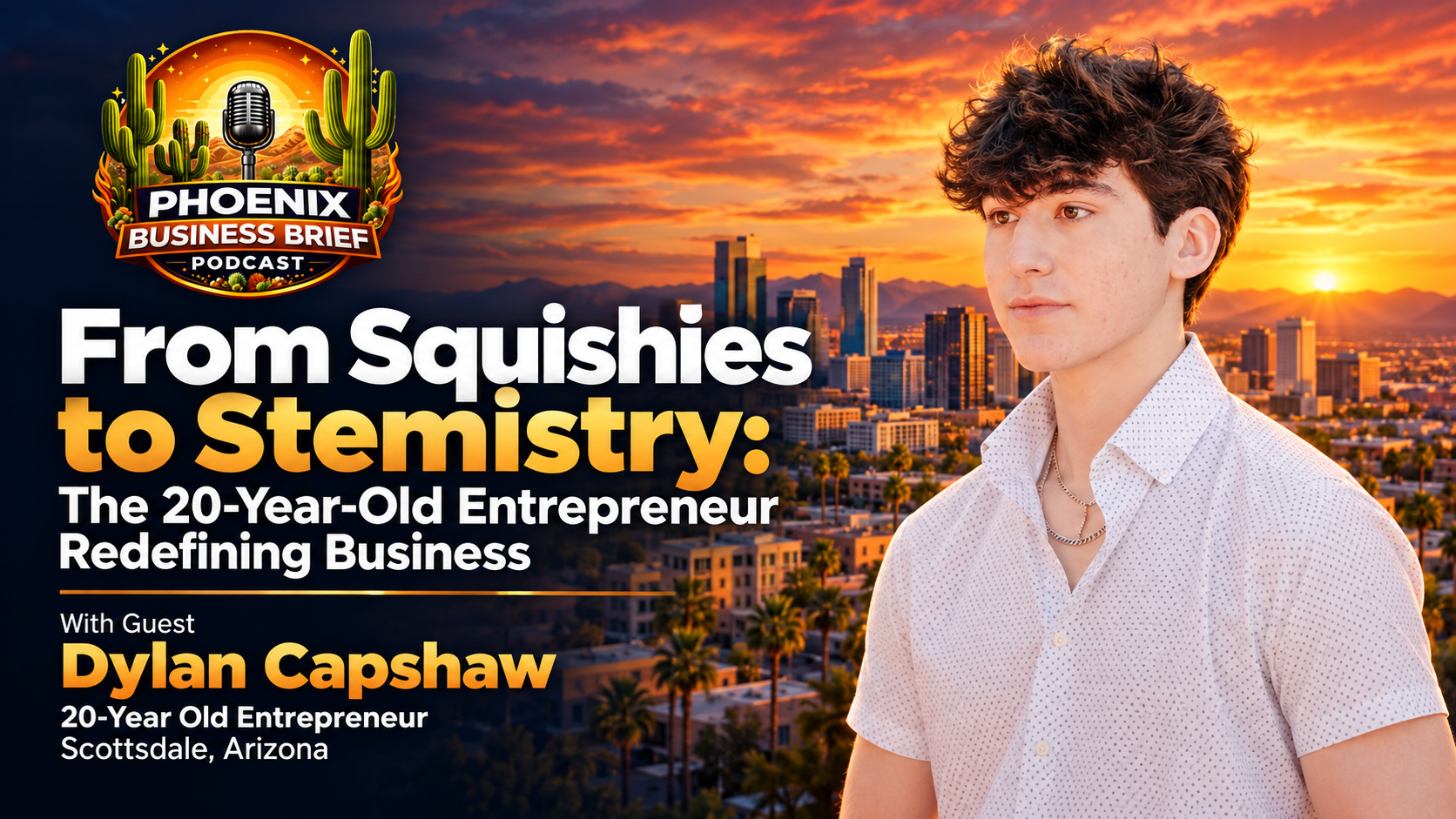
[00:00] Bryan Hyde: Welcome to the Phoenix Business Brief podcast. I'm Bryan Hyde, and today I am joined by Dylan Capshaw. And Dylan is an entrepreneur and founder of Stemistry, a flower bar and coffee lab, as well as Wild West Party Bus. This is only the tip of the iceberg, though. His ventures span hospitality, transportation, consumer apps, and philanthropy. And Dylan, before we go any further, I want you to tell us your age so that people can understand that we're dealing with a force of nature here.
[00:26] Dylan Capshaw: I appreciate it. I'm 20 years old. Okay.
[00:30] Bryan Hyde: He has been a busy young man. And actually, I'm going to ask you, take a moment here to tell us just a little bit about yourself and about what you do. Because like I say, I'm sure I just scratched the surface in what I used to describe you to our listeners.
[00:42] Dylan Capshaw: Thank you. Yeah, I'll keep it brief. I've definitely been an entrepreneur for quite a while, even though I've not been around for quite a while. But when I was 15, I signed my first lease for Stemistry, which is a coffee shop and flower shop all in one. Um, for a couple years I was opening one new location a year, um, and then that finally caught up with me. So now I'm just cruising with what I have. Um, I have a party bus business that I launched my freshman year in college in 2024. Um, and then besides that, I have some apps that I run. I've had some nonprofits over the years. Um, definitely staying busy.
[01:13] Bryan Hyde: Okay. And, and we're going to take some time to explore some of these, these businesses that you currently are, are running, but I want to go back for just a little bit because You got a very early start, and, and I'd like to know a little bit about your entrepreneurial roots. And, and if you could just walk us through the, the thumbnail sketch of how early did you start at your entrepreneurial efforts?
[01:34] Dylan Capshaw: Yeah, definitely. As far back as I can remember, um, I know that I was, uh, selling— they were called squishies. They were super popular when I was in, uh, elementary school. But 5th grade, I was selling, uh, squishies. I would get these giant boxes in that I'd order from overseas, um, and then flip them to my classmates. And I had a pretty solid operation going for a while until the school caught on, um, and my parents were called in and, and that was, uh, quickly shut down. But I think that's really the first kind of side hustle that I had started up. Um, my first legitimate one was in 2017. I started a wildlife rescue, um, and I grew that up until I started college in 2024. And that was really interesting learning how business works, even though it was a nonprofit, still setting up that infrastructure and learning how to grow and market network, all that.
[02:16] Bryan Hyde: So what turned the switch in I, I ask that because it seems like the vast majority of the public kind of grows up with this understanding of, well, go to school, get good grades, and you'll get a good job working for somebody. You took a very different path at a very early age. What was it that opened your mind to the possibilities?
[02:34] Dylan Capshaw: You know, I'm not entirely sure. I think I've always loved, um, working for myself. I've loved the idea of not necessarily having a, a set schedule that I had to commit to. with somebody else calling the shots. And that's just always been something that stuck with me as far back as I can remember. And everything that I've done has been to kind of maintain that expectation of always being able to control what I do and when I do it. And I really think that some people are born entrepreneurs, some people become entrepreneurs, everybody finds their way into entrepreneurship. I definitely was just born that way. It's something that's been ingrained in me. I've always looked at life and business and economics with just that lens of an entrepreneur, and it's helped me grow the way I have.
[03:14] Bryan Hyde: So the businesses that you've started, I'm assuming there's something in there that sparked a very personal interest in you that got you, you know, to start moving your feet and working and building and creating. Talk to me a little bit about where the decision comes from to pick a particular venture to go after. And then let's talk about some of your ventures that you're working on today.
[03:38] Dylan Capshaw: Definitely. Yeah. At the end of the day, I just, I love to be busy. So I'm always moving. I'm always thinking of new things and I'll jump on different ideas. A few of them will be successful. Most of them are not, but I love to learn. So in any venture that I start that's not successful, I walk away with a ton of lessons and therefore it is successful in my eyes, even if it wasn't necessarily profitable or something that I'll continue doing. So most of the businesses I run today purely came out of chance. or opportunity that I took, and I've continued to grow. But I've always just kind of followed the motto of trusting my gut. I'll come up with a million ideas a day and I'll see what's realistic, build out business plans, and kind of go from there. And that's what's led me here.
[04:21] Bryan Hyde: And it's a very broad kind of entrepreneurial pedigree that you've created here. I mean, you're not a one-note symphony or a one-trick pony. You have gone a whole bunch of different directions. Is there a Natural curiosity that kind of sparks you? Hey, I wonder what would happen if we tried this?
[04:40] Dylan Capshaw: Yeah, I love to push myself for sure. Um, I love to, uh, not be in my comfort zone, you know, push myself outside of that. So I definitely span entrepreneurship from, um, a wide spectrum. I'm all over the place. Um, and it's, it's great in the sense that it forces me to learn and adapt in new industries, but it also forces me to constantly be working, um, and learning lessons the hard way. But, you know, I've been a student for a long time now. I'm currently in college, so I, I really appreciate the hands-on learning. I think it's so much easier to learn lessons and understand outside of a classroom and by actually failing yourself or experiencing these in day-to-day. So I throw myself into the transportation industry. It's a whole new world I have to learn. But when you boil it all down, entrepreneurship across any industry really comes down to the same fundamentals and basics. And that's what's helped me just build the initial company and then kind of learn and go from there.
[05:29] Bryan Hyde: What's the biggest difference between running a physical business versus, you know, creating and promoting an app or software?
[05:37] Dylan Capshaw: Yeah, definitely. So Stemistry, my coffee shop, it actually was an e-commerce store where I sold flowers from 2020 to about 2022. So primarily during COVID I think what really lit that store on fire and set it off was people were stuck at home and maybe trying to brighten up their space. So they were ordering fresh flowers to their doorstep. That was very time-consuming for me in the sense that it was just a one-man show. I was doing everything— customer service, logistics. actually packing the orders, placing the orders, all of that. And then when I eventually opened up into a physical store, I thought, if I can do that, this is going to be a breeze. And it was a million times harder. All of a sudden I'm dealing with leases and construction and contractors and employees beyond anything that I had done before. So it's definitely different. I love working with people. It was fun being behind the scenes. My overhead was a million times lower, which I miss. But, um, I, but I like having, uh, being able to come into an office or a store and talk to the staff and being able to build that. I think building's a ton of fun. Um, so same principles, but a lot different. It, it goes from, um, being able to control the whole business yourself to having to delegate and, and trust that you have a team that will continue building in the direction you're wanting to go.
[06:48] Bryan Hyde: And, and I just wanna make this clear or give you the chance to make this clear to our listeners. When, when a person decides to be an entrepreneur, there's something more than money that drives that decision. Uh, there's, there's a desire to, to basically solve problems for people. And, and I'm curious, how do you, uh, how do you find problems to solve?
[07:08] Dylan Capshaw: Yeah, I, I just by living my day-to-day, um, every couple hours I'll think to myself, this could be better, um, or here's a problem that, that could definitely be fixed, or there's an opportunity for, uh, for this niche to take off, whatever it might be. Um, and then conducting market research is crucial. Um, for me, that means calling my mom and saying, what do you think of this? Um, 10 times a day. And I think that that's really important. But for sure, entrepreneurs, um, at least for the most They just enjoy building or solving problems. The money is a byproduct, and most of the times, the money might not even come at all. My businesses have costed me more than they've made me, but I've been able to build and learn and solve, and that's what makes it all worth it in the end.
[07:46] Bryan Hyde: And speaking of learning, talk to me about the role that customer feedback plays in helping you, you know, fine-tune the product or, you know, the venture that you're working on.
[07:56] Dylan Capshaw: It's huge. I mean, customers are everything. If you don't have customers, you don't have a business. So, at least in my coffee shops and with my bus, I am very big on feedback. I welcome all kinds of feedback. I know some people push for positive feedback, leave us a 5-star review and you'll get some sort of incentive. I'm really big on just honest, real-world feedback. Tell me what's broken. I'm more interested in that than what's working. If it's working, let it be. But I love to fix and improve. I think that that's huge. So I personally, every time I have a ride, for example, on my party bus business, I will call the guests and say, how was everything? What can we improve? What could be better? And then I'll talk to my team and try and actually fix that because Nobody's perfect no matter how many years you've been doing it. And that's something that everybody just has to understand and, and know you can always be better. And I think that complacency kills. So I try to never stay complacent. I, I know that none of my businesses are even close to where I want them to be. And that helps me push every day to get better and better. And it, it keeps me building, which is what I truly enjoy doing in entrepreneurship.
[08:54] Bryan Hyde: You know, I know people love to complain, or at least what I see online leads me to believe there are a lot of people love to complain. But when it comes to getting useful feedback from your customers, what's the most useful kind of information that, that they can give you that actually helps you, you know, fine-tune what you're doing?
[09:10] Dylan Capshaw: Definitely. I would say specifics. If somebody's so broad where they just say, oh, it was bad, I had a bad experience, or this coffee sucked, there's not much I can do there, right? I think my coffee's pretty good. I think the bus is pretty good. But specific feedback, oh, it, it was ice cold, or it was way too hot, or the staff wasn't friendly, or the bus was too bumpy, abrupt stops. So I think if you can get a customer to boil down into specifics, it gets much easier. Broad feedback, it can be helpful, but it's much more helpful when you as the, the person behind the scenes don't have to kind of decipher and figure out what might be wrong in such a broad picture. So anytime I'm talking to a customer or whenever I get a, just a 1-star review with no feedback, you know, I'll reply and say, this is our customer service email, please shoot us an email and tell me what was wrong. And the more specific they can be, the easier it is to improve.
[09:53] Bryan Hyde: I'm sure it's nice to get the accolades too, but I'm guessing the accolades probably aren't as helpful as the constructive criticism.
[10:02] Dylan Capshaw: Oh, for sure. Absolutely. Constructive criticism is everything, and I, I always welcome it. Even with my team, I now have a lot of employees working under me, and, um, I'm huge on letting me know anytime. Tell me how I can be better. Um, tell me how your job could be better. It's, it's huge. So I, I love to— as, as long as I'm in entrepreneurship, I hope that I, um, never get to the point where I feel like, you know, I, I know better. I, I try to only hire people smarter than me. I love to learn. Um, and I hope that my staff feels the same way.
[10:27] Bryan Hyde: Let's talk about some of your your specific businesses. Now, you mentioned Stemistry to start out with. Would you like to flesh that out for us a little bit?
[10:34] Dylan Capshaw: Sure. Yeah. So, Stemistry is a coffee shop and flower shop. At our peak, we had 3 locations, 2 in Scottsdale, 1 in Phoenix. Since then, I have my lease on the first ran up and I've absorbed it into the others to kind of fine-tune ops. And it's been so much fun growing. It started off as an online flower shop. I started it with $0 during COVID I was stuck at home. thinking, how do I make a little bit of money? How do I start a business to keep me busy when I'm outside of online school? And I started trimming my landscaping and the post office gives free boxes. I'd order free boxes to my door and post them online. And I marketed it as aromatherapy. I would tie them into bundles you hang on your showerhead and shockingly they were selling. I did that for a couple months and my parents quickly said, if you cut another branch from our yard, you're outta here. So I reached out to a wholesaler and I got a big catalog of flowers that I could purchase in bulk. And that was the start of Stemistry. I would meet the flower truck at the end of the day when I got home from school, sit in the garage for 5, 6 hours boxing orders and ship. We shipped to all 50 states, 6 different countries, and I built up a very substantial savings from nothing. And from that, I said, I want to go all in on a brick-and-mortar concept. I want to tie in coffee. There's so many coffee shops and so many flower shops, but the two together not only are very synergetic, but they help kind of keep the brand unique. And ever since then, I've been building and refining. Um, and that was really the start of my entrepreneurial journey. It was the first time I was working with a team and leases, um, and actually having to advertise and, and kind of be out in the real world, not just behind a computer.
[12:00] Bryan Hyde: And did I hear you correctly? You have multiple locations of Stamistry?
[12:03] Dylan Capshaw: Yes. Yeah. So I'm upstairs in our little headquarters now in downtown Phoenix at one of our shops. We have another currently, uh, just outside Old Town Scottsdale.
[12:12] Bryan Hyde: Very nice. Okay. The Wild West Party Bus. As soon as I, as soon as I saw that, I went, okay, I gotta know the story here. What prompted this one?
[12:21] Dylan Capshaw: Yeah, so I started college at ASU. I rushed a fraternity and I realized that they were calling party buses nonstop, nonstop. There were big buses lining up and driving students to events or parties, whatever it might be. And they were all very basic. None had a niche, none had a theme. And I started thinking this could be better, identifying a problem. So I did some research on themed buses. all of them were catered towards women and only women, whether they were bright pink or just clearly labeled for bachelorette parties. And that's about it. And I thought, you know, there's potential here. We're in the Wild West. So Scottsdale's motto is the West's most Western town. And I found and built out a bus. It already was started by an amazing entrepreneur who was looking for someone to take over the business. And I kind of took, I took over where it was at and built it up. And it's got big bullhorns on it. It's Western inside and out. It's painted bright orange. And I launched that. I had no idea. idea the first thing about anything to do with transportation. I applied to get my own CDL and started enrolling in trucker schools before I found out I couldn't even drive the bus at my age. No insurance company would insure me. So hired drivers, went through all of that and got it live. But now we operate primarily out of Old Town. Customers can book through our app or website, and we partner with all kinds of local businesses for fun different packages. But it's basically a party bus. You could easily have a bachelor party on there. It could easily be bachelorette. And it's a fun-themed bus.
[13:44] Bryan Hyde: What about Peptify?
[13:47] Dylan Capshaw: Yeah. So another problem that I saw being in college is peptides are huge right now. I would see a lot of my peers concerningly injecting things that they might not fully understand.
[13:59] Bryan Hyde: Can I ask, for those who aren't familiar with peptides, can we just give them a quick explanation? What are the peptides?
[14:05] Dylan Capshaw: Yeah. So peptides could be anything from insulin or Ozempic or tirzepatide to new research ones that some have human studies, some don't, such as BPC-1. C-157 or KPV. And these are basically proteins that your body produces that you can externally inject to help with different things such as collagen production, hair growth, healing tendon ligament issues. So they're very fascinating, and I definitely think that there's a whole world to come with them. But the way that it's being done right now is a little all over the place. So I thought there's got to be an opportunity for some structure here. Um, for people that are taking these peptides, they're relying on certain research that they might be seeing on the internet, but they're not necessarily following it to a T. So, I had the idea to build out some sort of peptide tracker where you could educate yourself on different compounds. You could input your height, weight, upload blood work, any body scans like DEXA or InBody, and then you could have the app kind of process those stats and tell you community benchmarks, what the feedback is with the research that has been conducted on proper dosages or timelines. And then, the app would remind you how to do it and teach you about sterility and injecting because there's so much that goes into that when you're injecting compound into yourself. You want to make sure you're doing your due diligence there. So I had that idea, I built it out, and basically Peptify is an all-in-one tracker available on iOS and Android. Um, and then I started pushing it to all my friends saying, you need to have some sort of, um, regulation or structure to what you're doing, so use this.
[15:30] Bryan Hyde: So let's— based on that, and we can talk about some of your other businesses as well, but with what you've been describing with Peptify, um, it sounds like there's, there's quite an opportunity here. connecting, you know, technology with personal service. Talk to me about how that looks to you.
[15:48] Dylan Capshaw: Definitely. With AI, I think the future is software and hardware, right? People rely just on apps or computer programs, whatever it might be, but we still have a real world out here. So one effort I've been making lately in my business is with Stemistry. I built out an app for online ordering, and we have a cool feature where you can build your own bouquet, which is something you can do in our shops, but you can do so on the app, like dragging floral icons in an arrangement, and then we'll duplicate the exact arrangement in a store for pickup. With the Wild West Party Bus, I built out an app where we have a concierge service where we can help plan your ride. But additionally, you can track the bus in live time during one of your rides. You can plan out your route, talk to the driver. With Peptify, I've been talking to all sorts of different peptide companies, med spas around Arizona, seeing where there could be some synergy for partnerships. So I think that technology is growing, and it's huge. And it can be a crutch for real-world products, but not necessarily a substitution for the industries that I'm in, at least. And it's been interesting kind of finding that middle ground and building it out. But the world is definitely changing with the influx of AI. So it's good to adapt while you can, because it's going to be everywhere soon.
[16:54] Bryan Hyde: I can only imagine, you know, the entrepreneurial possibilities that are coming. Because I remember when the internet came Online, you know, when, when it became a part of our daily lives about 30 years ago. And, and it changed everything. And, and AI, I believe, has, has potential to do that and more. And it sounds like you are right on the cusp of the wave there, um, to, to take advantage of that. Any other businesses that you'd like to tell us about?
[17:18] Dylan Capshaw: You know, I've had a lot over the years, um, but none that are currently going. I, I've sold some, I've closed some. So those 3 are the big ones at the moment. But every day I'll, I'll have an idea. And with AI now, a fun feature is kind of plugging in part of an idea and saying, complete the picture for me. And then I shelf it for one day when I have more capital and I can actually expand on that. So none at the moment.
[17:40] Bryan Hyde: Okay. So let's connect up our listeners with you. Where can, where can they tap into what you are doing and learn more about you, or for that matter, you know, patronize your businesses?
[17:51] Dylan Capshaw: Yeah, absolutely. So anybody could read more about me and kind of follow my journey on my personal website, which is dylan.capshaw.com. If anybody wants to check out Stemistry and grab a cup of coffee or some flowers, we have one location on Scottsdale and McDowell, and then one in downtown Phoenix right by Chase Field. The Wild West Party Bus can be booked at wildwestpartybus.com. And then all my socials are dylan.capshaw.
[18:13] Bryan Hyde: Again, we're talking with Dylan Capshaw, entrepreneur and founder of Stemistry and Wild West Party Bus, as well as Peptify. Dylan, very inspiring, and keep up the great work. Thanks again for joining us on the Phoenix Business Brief podcast.
[18:27] Dylan Capshaw: Thanks for having me on.