Phoenix Business Brief Podcast logo
← Phoenix Business Brief

2026-07-22 · Savage Social

Arina Tannenbaum on Modern Branding and the AI Search Revolution

with Arina Tannenbaum, Founder, Marketing & Ads Creator — Savage Social
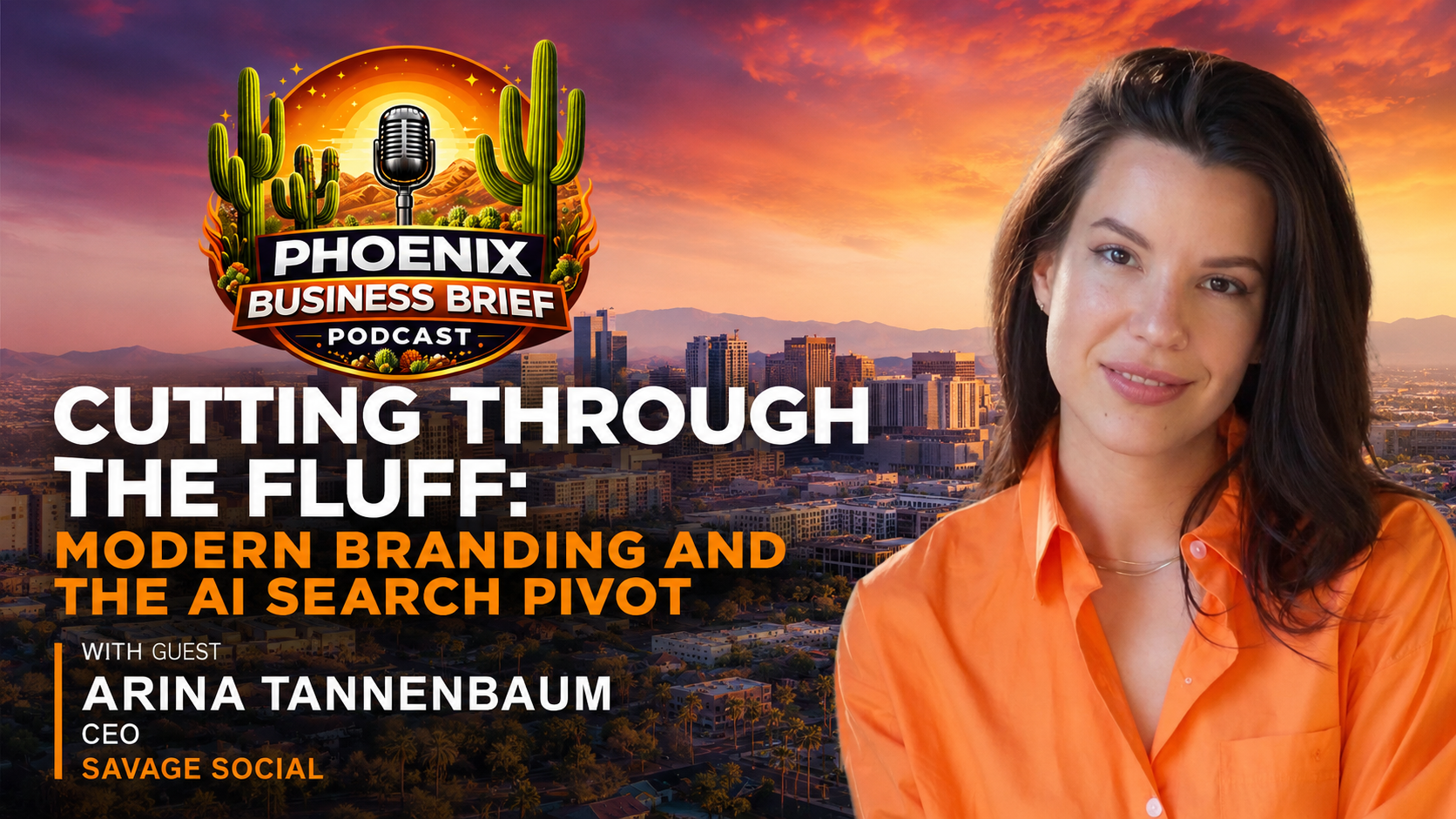
Phoenix Business Brief Podcast episode featuring Arina Tannenbaum discussing Arina Tannenbaum on Modern Branding and the AI Search Revolution

In this Phoenix Business Brief podcast episode titled "Cutting Through the Fluff: Modern Branding and the AI Search Pivot," host Bryan Hyde interviews Arina Tannenbaum, founder of Savage Social. Tannenbaum discusses the evolution of branding from traditional methods to modern strategies, emphasizing the importance of personal branding and the impact of AI on marketing. She highlights the need for businesses to adapt to AI-driven search trends and the significance of authenticity in content creation to connect with audiences effectively.

Cutting Through the Fluff: Modern Branding and the AI Search Pivot

0:00 / 0:00

Cutting Through the Fluff: Modern Branding and the AI Search Pivot

Phoenix Business Brief Podcast Explores Modern Branding and AI in Marketing

In a recent episode of the Phoenix Business Brief podcast, host Bryan Hyde interviewed Arina Tannenbaum, founder of Savage Social, a marketing and advertising firm based in Arizona. Tannenbaum discussed the evolution of branding and marketing strategies in the age of artificial intelligence (AI) and social media. She emphasized the importance of personal branding for small businesses and the impact of AI on consumer behavior.

Tannenbaum explained that while traditional marketing methods, such as newspaper and radio advertising, remain effective for some businesses, the landscape has shifted dramatically. “People are forming opinions about you and your business, whether you are actively promoting yourself or not,” she said. This underscores the necessity for businesses to engage in online marketing to shape public perception.

When asked about common branding mistakes, Tannenbaum identified two primary pitfalls. First, some business owners dismiss social media as a viable marketing tool. “If that’s something that’s working for you, keep going,” she advised. However, she noted that neglecting social media can lead to missed opportunities.

The second mistake involves business owners overwhelming themselves with content creation. “That just breaks my heart,” Tannenbaum said. She emphasized that attempting to manage all aspects of marketing can lead to burnout, detracting from the core focus of running a business.

As AI technology continues to evolve, Tannenbaum highlighted its dual nature. While she views AI as a valuable tool for organizing and streamlining marketing efforts, she cautioned against over-reliance on it. “You can’t just give your whole life away to AI and hope that it will do the right thing for you,” she said. Tannenbaum stressed the importance of understanding one’s business and audience, as AI lacks the nuanced understanding that human marketers possess.

The conversation also touched on the changing dynamics of search engines due to AI advancements. Tannenbaum noted that platforms like Google are now providing AI-generated answers directly in search results, which can reduce traffic to individual business websites. “If you’re not within that overview, if you’re not the top three match, then you’re missing out on a lot of traffic,” she explained. She encouraged businesses to optimize their websites to align with AI expectations to maintain visibility.

Tannenbaum pointed out that authenticity is crucial in a crowded marketplace. “What’s going to be really trending and really important is human-to-human connection,” she said. She advised businesses to share genuine stories and insights, as this fosters trust and engagement with potential customers.

For small business owners looking to enhance their marketing strategies, Tannenbaum recommended leveraging platforms like Reddit. She described it as a valuable tool for building connections and gaining referrals. “Just being genuinely helpful on Reddit is super important,” she said, emphasizing the platform’s role in shaping AI learning.

As the discussion wrapped up, Tannenbaum reiterated the significance of building a personal brand and collaborating with others in the industry. She encouraged business owners to focus on providing value to their audience and to stay informed about AI developments in marketing.

Tannenbaum concluded by stating that the future of marketing will heavily involve AI and personal branding. “You want to be the answer,” she said, highlighting the need for businesses to adapt to the changing landscape.

The full interview with Arina Tannenbaum is available on the Phoenix Business Brief podcast, where she shares further insights into effective branding strategies and the role of AI in modern marketing.

Interview Q&A

Q&A: Cutting Through the Fluff: Modern Branding and the AI Search Pivot

Phoenix Business Brief: Q&A with Arina Tannenbaum on Branding and AI

Q: Can you introduce yourself and describe what you do?
A: I am Arina Tannenbaum, founder and marketing and ads creator at Savage Social. I focus on content and ads for small businesses in Arizona and am now navigating my own social media presence.

Q: How has traditional advertising changed in recent years?
A: The difference between traditional advertising and modern methods is significant. Traditional methods still work for some businesses, but social media and personal branding are crucial. People form opinions about businesses regardless of whether they are actively marketed.

Q: What is branding?
A: Branding is the opinions people form about you or your business, whether online or offline. You can influence this perception through various channels like social media, ads, and email marketing.

Q: What common mistakes do small businesses make in branding?
A: One mistake is not engaging with social media or modern marketing methods, which can lead to missed opportunities. Another is overwhelming themselves by trying to manage everything, leading to burnout.

Q: How is AI impacting marketing strategies?
A: AI is changing how businesses approach marketing. While it can help organize and streamline tasks, relying solely on AI without understanding your business needs can result in ineffective content.

Q: How has AI changed search behavior?
A: AI tools are becoming the primary source for information instead of traditional search engines. Businesses need to adapt to this shift to ensure they are visible in AI-generated responses.

Q: What should businesses focus on to remain competitive?
A: Businesses should focus on being in the top results for AI-generated answers. This requires optimizing their websites to align with AI expectations.

Q: What are some effective marketing strategies for small businesses?
A: Effective strategies include leveraging Reddit for genuine engagement, utilizing Google My Business, and maintaining a strong social media presence. These can provide long-term traffic and visibility.

Q: How can businesses create authentic connections with their audience?
A: Authenticity is key. Sharing personal stories and being vulnerable can build trust. Businesses should focus on genuinely helping their audience rather than just promoting products.

Q: What initial steps should a small business owner take to improve their marketing?
A: Business owners should identify the quickest way to help their customers and create content that addresses their needs. This can involve sharing warnings or helpful tips related to their services.

Q: What short-term trends do you see as promising for the future?
A: Building a personal brand, collaborating with others in the industry, and staying updated on AI and search trends are crucial. Collaboration can open new opportunities and enhance visibility.

Q: How can listeners contact you for more information?
A: You can find me on social media as Irina Tan, including LinkedIn.

Key takeaways

  • People are forming opinions about you and your business, whether you are tooting your horns or not.
  • You can influence the opinions that people form about you through channels like website, social media, ads, and email marketing.
  • If you're not within that overview, if you're not the top 3 match, then you're missing out on a lot of traffic.
  • Being who you are, but also sharing your very vulnerable stories, nothing's going to beat that because AI cannot come up with that.
  • If you have an account, you have to use it as a social platform. Just being genuinely helpful on Reddit is super important.

About the guest

Arina Tannenbaum

Founder, Marketing & Ads CreatorSavage Social

Arina Tannenbaum is a Phoenix-based marketing and ads creator. She runs content and paid ads for businesses, and teaches small business owners and creators how to do it themselves. Her recent LinkedIn video hit 4.4M views and she has reached over 2 million people in the last 90 days, breaking down what's actually working in marketing right now without the agency fluff.

Full transcript

Show full transcript
[00:00] Bryan Hyde: Welcome to the Phoenix Business Brief podcast. I'm Bryan Hyde, and today I'm joined by Irina Tannenbaum. She is the founder and marketing and ads creator for Savage Social. And Irina, it's very good to have you on the program. Would you mind just walking us through who you are and what you do? [00:18] Arina Tannenbaum: Of course. Hi, thanks so much for having me. Okay, so I do a lot of stuff, but most of it is content and ads for small businesses in Arizona. And also navigating my own, uh, social media presence and now stepping into that role where I, I am filming content for myself and now I feel what everybody feels about it because usually I'm behind the camera and I help businesses do this. [00:43] Bryan Hyde: So, you know, when it comes to, to getting the word out for a business, I'm just gonna, I'm gonna quote something I heard many, many years ago, and this is from somebody who was, was advertising in radio at that time. Uh, if you don't toot your horn, Nobody's ever going to know you're there. But the horn has changed a bit over the last few years. Talk to me a little bit about the difference between traditional advertising or traditional marketing for businesses. And let's, I mean, let's go back to the dark ages, you know, newspaper, television, radio versus how it's done today. [01:15] Arina Tannenbaum: Well, obviously the difference is huge. However, I do see that traditional methods are working now just because of how much social media and ads we are bombarded with. Started with every day. Um, so I wouldn't— like, if that's something that's working for you, for your business, I would say keep, keep going. Like, don't change it if it's working. Um, but the thing with social media and personal brand is that whether you are like tooting your horns or not, people are forming opinions about you and your business. So you can be completely silent and you don't have to say anything, but people are thinking of, or they have a certain understanding of what it is that you do, who you're serving, who you are as a person. And posting or using ads or using any sorts of online marketing is basically creating your own propaganda for how you want to be perceived as a business and as a person. And that's where personal branding comes in. Like when you form that under, like, I want to be perceived a certain way and this is the message that I am conveying. And unless you do, like, if you don't do that, then people still will form an opinion about you. And that's kind of like something that I feel I find fascinating because it is human psychology. And I guess, yeah, you don't— sometimes you're like absolutely silent and not known by anybody and maybe like you exist on a map somewhere, but it still forms an opinion. Like when you look at a blank, I don't know, like a website from 1973 and you like, that's, that's already some sort of personal branding. Do you want to be perceived that way? I don't know, maybe you do, but that's the whole game. [02:59] Bryan Hyde: Let me, okay, I'm gonna step back here and just, you know, display my own ignorance. But if someone asked me to define what is meant by branding, I don't know that I could give them a satisfactory answer, but I'm betting you could. What do we mean when we say branding? [03:14] Arina Tannenbaum: I would say that's the opinions that people form about you, whether that's online, whether that's in their head, whether that's on paper, like, what they tell other people about you, about your business. And again, the beauty of it is that you can influence it. Like if you know how to create this certain propaganda that you want to create about yourself or your business, that's, that's how you do it through all these channels like website, social media, ads, email marketing, anything you want. But that's the, you know, it's happening either you want it or not. It's already happening. [03:52] Bryan Hyde: Irina, let's, let's take a small business, for example. I'm curious, what are some of the more common mistakes that you see when a small business sets out to brand itself? Are there some mistakes that seem to pop up more often than others? [04:07] Arina Tannenbaum: Well, there's like several strategies that people use. One is people who just don't believe in social or in the way that social is being done right now. For example, oh, I'm not going to be running ads or I'm not going to be posting videos online. And that's that's a choice. However, again, like the branding part is still happening. And it's kind of like missing out on a bunch of opportunities that otherwise you would absolutely have gotten. And another strategy is just, I find it super overwhelming when a business owner just takes on everything themselves, like you're running a business on top of that, you're creating content, you're trying to figure out these trends, you're maybe even dancing to trending audios, I don't know. And that just breaks my heart, because that's not what works, and it's so overwhelming, and this leads to burnout, and that's not a good strategy if you own a business. [05:05] Bryan Hyde: It seems that a lot is changing all around us too, and I don't mean that in a bad sense, but I mean, look, I remember when the internet really kind of came into being a daily part of our lives, and, uh, that sure changed how most of us do business or how we shop and so forth, how we bank. What about AI? Talk to me about what is happening now that AI has entered the picture, and how, how does that apply to the way that people go about their marketing? [05:30] Arina Tannenbaum: You know, again, two different— people are reacting to it differently. That's what I'm seeing on the market. I'm a big fan. I love it. And I think it can organize and structure a lot of your work and delegate. There is a strategy where people go overboard with it. And now, like, I don't know if you see those posts, but marketers are dead. AI took over. You don't need— you need to fire your whole, I don't know, content team. And now AI will do everything for you. The problem with that is Yes, we can tell you, you're doing your old content through AI and nobody— that's why nobody watches it and that nobody wants to deal with it. There is— I feel like it's super trending right now and I think it can be super helpful, but you still need to know what you're doing. You can't just give your whole life away to Claude or ChatGPT and just hope that it will do the right thing for you. You won't. It's a machine. It doesn't know the strategies. It doesn't know you. It doesn't know your business. It can It can be helpful, but again, you know, if you do it wisely and if you have somebody running it who understands what's going on. [06:40] Bryan Hyde: And, you know, for example, it used to be, hey, if you're going to put content out there, you got to make sure that it's SEO, you know, search engine optimized to make sure that the search engines find it easiest or they find it first. But AI has kind of brought a new reality. My kids, I see this the most with them. If they want to know about something, they don't go to a search engine. They go to AI. [07:03] Arina Tannenbaum: Mm-hmm. Yes. It's actually happening like as we speak, like right now within a few months. So now with the most fascinating thing for me is that Google rolled out this AI Answers. So whenever you search for whatever is the best, I don't know, matcha near me, you like people won't be clicking on the links of your restaurant, your cafe. They're going to be looking at what AI overview is telling them. So yes, the The answer that the machine is going to give you is now going to take 0.5 seconds when they used to— you have to— you used to put some effort in search. But what business owners are seeing now and my clients are seeing now is that clicks to websites are very low because of it. So because if you're not within that overview, if you're not the top 3 match, med spa, dentist, lawyer, then you're missing out on an lots of, lots of traffic. And the trick is to get into that overview and show AI what it wants to see on your website. And that's how you get that traffic. And one of my clients is actually seeing the results right now. And it's fascinating because nobody's using it. It's, it's, if you're doing it right now, you are going to be set for the next 5 years. And if you're not going to miss out. [08:22] Bryan Hyde: Oh, that's, I like to hear stuff like that though. That's to me that, that's that gives some of the urgency that people need to pay attention to this and not just, you know, ah, it's just another fad that's going to blow over. AI is here to stay, isn't it? [08:37] Arina Tannenbaum: Oh, for sure. Yeah, 100%. It's basically like, you know, people didn't believe in Google or they didn't believe in optimizing their website. Like, sure, you don't have to believe in it. It's just going to happen to you whether you want it or not. It is very fast. And this is why It's good to have somebody on your side, like running this thing for you and staying on top of those trends or somewhere close to the top, please, because it's hard. There is, there is an update every day. [09:07] Bryan Hyde: And when you're teaching businesses or you're teaching content creators how to, uh, how to get out there and how to market themselves, this is a path that you have walked yourself. Tell us a little bit about your journey and some of the lessons that you have picked up along the way about what works versus what doesn't. [09:24] Arina Tannenbaum: You know, it's actually kind of vice versa. So I have done lots and lots of marketing for my clients, but I haven't done that much for myself personally because I've just always gotten around by word of mouth. And I never— I was like, I'm good. You know, people are just recommending me. But I see how important it is to get on this right now, especially with AI and the SEO, like with what's happening right now with SEO, with social. So you just have to stay on top. I guess that's— sorry, it's vague, but it's the best advice I can give you. If I were to share like top 3 things that I see working right now that have this incredible ROI, like in 5 to 3 years, that's definitely Reddit. That's AI, what we just talked about, AI overview, and it's Google My Business and social. It's kind of like together. It's like, especially if you're a service-based or local business, like, this is super important. You can be running ads and maybe you should if you want clients tomorrow. But this is what will guarantee you like free traffic for years and years to come. [10:42] Bryan Hyde: So I know this is going to sound a little bit vague, but for people who want to have impact, for businesses that really want to reach people, what are some of the things that they have to know that will set them apart from all the other competing voices and all the other information and static out there competing for other people's attention? [11:04] Arina Tannenbaum: I think you always have to look for, like, what's trending now and kind of do the opposite at the same time. So do what's trending, but also do the opposite. So AI SEO and regular SEO is pretty quiet right now. It's not that sexy. It's not that trendy. Like people talk about it, but it's like, eh, that's website. What's really cute is social media and how to make a viral reel or how to, you know, like run an ad. I feel like you kind of have to do both. So again, what I found has been performing incredible is Reddit, which is an absolutely free tool. You just need your brain and like probably 15 minutes of your time per day. And I'm seeing the return on the investment already. Like if you have an account, you have to use it as a social platform. So were you sharing? Were you commenting? You're recommending something. So you're responding to those threads. You just not just saying, hey, buy this from my business. It's not— that's never worked on any platform, by the way. But just being genuinely helpful on Reddit is super important because ChatGPT and all these AI platforms are learning on Reddit. So they're literally— their learning system is going into Reddit and scanning for those answers and responses. They— it sees how people are responding, what they're recommending. So a bunch of that AI overview and AI search is coming from Reddit, from actual, like, people's recommendation, because probably that's the most sincere platform there is. People are not really trying to promote their businesses unless they're smart. Like you and I, you know, unless they do it on purpose. But that's probably the best life hack that I've— I'm seeing working like right now. Like, I literally got a referral yesterday from Reddit, which is amazing. [13:03] Bryan Hyde: So you mentioned, you know, it's sincere. And that sparks the question in my mind. I know some people read stuff and they're like, ah, I can totally see this is total AI, you know, generated. And It sounds like authenticity is, is just a huge factor in connecting to the people that you're trying to reach. Can you speak to that and, and how to, how to break through the, you know, the AI, you know, tsunami out there, um, so that they, they can see, hey, this is, this is a real person. [13:36] Arina Tannenbaum: Yeah. Yeah, for sure. I think that's the biggest part. Like, this is the real person part. Um, we can see all these AI avatars and it's, the technology is amazing, but What's going to be really trending and really important is like human-to-human connection and actual, like what you actually mean, like saying what you actually mean is, yeah, it's pretty rare. Even now, I think first people don't want to be like, it's kind of like vulnerable to show who you really are, especially when it comes to like social media. But I find that those pieces of content perform the best, whether that's like blog posts or YouTube or social media. Yeah, like being who you are, but also sharing your very vulnerable stories, like the actual shit you went through. Nothing's going to beat that because AI cannot come up with that. Like, that's not, you know, it can't. So I feel like that's the— that's what creates that trust too, right? Like you want to, you want to talk to a real person. You don't want to be fake. You don't want to, you know, hang out with a machine and just be like— there's a fine line, I would say, between like sharing everything that's going on in your life online versus actually being helpful. And I always think of and I always recommend to my clients to think of themselves in the past. Um, or their favorite client, like one or the other, and just, just pretending you're talking to them. If you're speaking to the camera, that's who you're talking to. If you're writing a post, that's who you're trying to help, and you're trying to save them as much time as possible. You just wanna get them to that level where they're happy and happy and peaceful and wealthy and all of that. [15:33] Bryan Hyde: No, that, that sounds like very sound advice. Um, So, so tell me this, for let's just suppose that there's a small business owner right now in the Phoenix area who's like, okay, this makes sense. How do I start? And let's start with, first of all, how do they get ahold of you? [15:50] Arina Tannenbaum: Well, I am on social. I'm, you know, doing what I preach. I am Irina Tan on social pretty much everywhere, including LinkedIn. But I guess one advice is figuring out, again, like the quickest way for you to help somebody. Um, and I don't care if you're a law firm, if you're a dental practice, if you are a personal brand, a coach, what's the quickest, easiest solution that you can provide right now? Um, and what are some things around it? Like for example, like I've worked with lots of medical professionals and dentists. I would say like warning people about certain things is the content that performs like I see it performs amazing, especially in ads, like literally genuinely helping people. Like, I'm sorry, you know, I'm not the kind of marketer who will tell you just push their, you know, your offer down their throat. No, like actually help. Like what can you warn people about? What can you like, what's the shortest path to the goal that they want? Like, actually, seriously, if it was your best friend, what would you recommend? And sharing that type of content, whether that's written, whether that's video, being sincere, being you, putting out ads. I'm a big fan of ads still, even though saying what I've just said about SEO and all that. Just figuring out your strategy, figuring out what works for you, and just doubling down on that. [17:26] Bryan Hyde: And one final question for you, and that is, obviously, things are moving quickly, particularly with AI. But as you look to the future, are there any short-term trends that you see that you find particularly promising? [17:40] Arina Tannenbaum: Good question. Building a personal brand. Sorry, same story. Again, forming the opinion that you want to be formed, whether that's your social media accounts, whether that's ads, whether that's, again, Reddit or blog posts, collaborating a lot. I feel like that's where also like people trying to kind of compete and be there just for themselves, even like collaborating with your competitors, seeing what are the like, because there's a market for everyone. And if your offer is genuinely good, you shouldn't be afraid of, you know, working together with somebody who is in a similar niche. I see a lot of collaboration opportunities. I see a lot of like influencer campaigns and opportunities there if you have a budget for that. And of course, just staying on top of AI and especially search, like I cannot stress this enough. The search is— it's not going anywhere. It's just going to change the format and we're going to ask the phone what's the best whatever in my area and You want to be the answer. [18:51] Bryan Hyde: Again, we are talking with Irina Tannenbaum. She is the founder of Savage Social as well as a marketing and ads creator. And thank you so much for joining us today on the Phoenix Business Brief podcast. [19:02] Arina Tannenbaum: Thanks so much, Brian.

Filed under

Related episodes