Phoenix Business Brief Podcast logo
← Phoenix Business Brief

2026-06-24 · 7355 E. Thompson Peak Pkwy Scottsdale, Arizona 85255

Unlock Effective Communication with ShaRon Rea of C.O.R.E. Communication Lab

with ShaRon Rea — 7355 E. Thompson Peak Pkwy Scottsdale, Arizona 85255

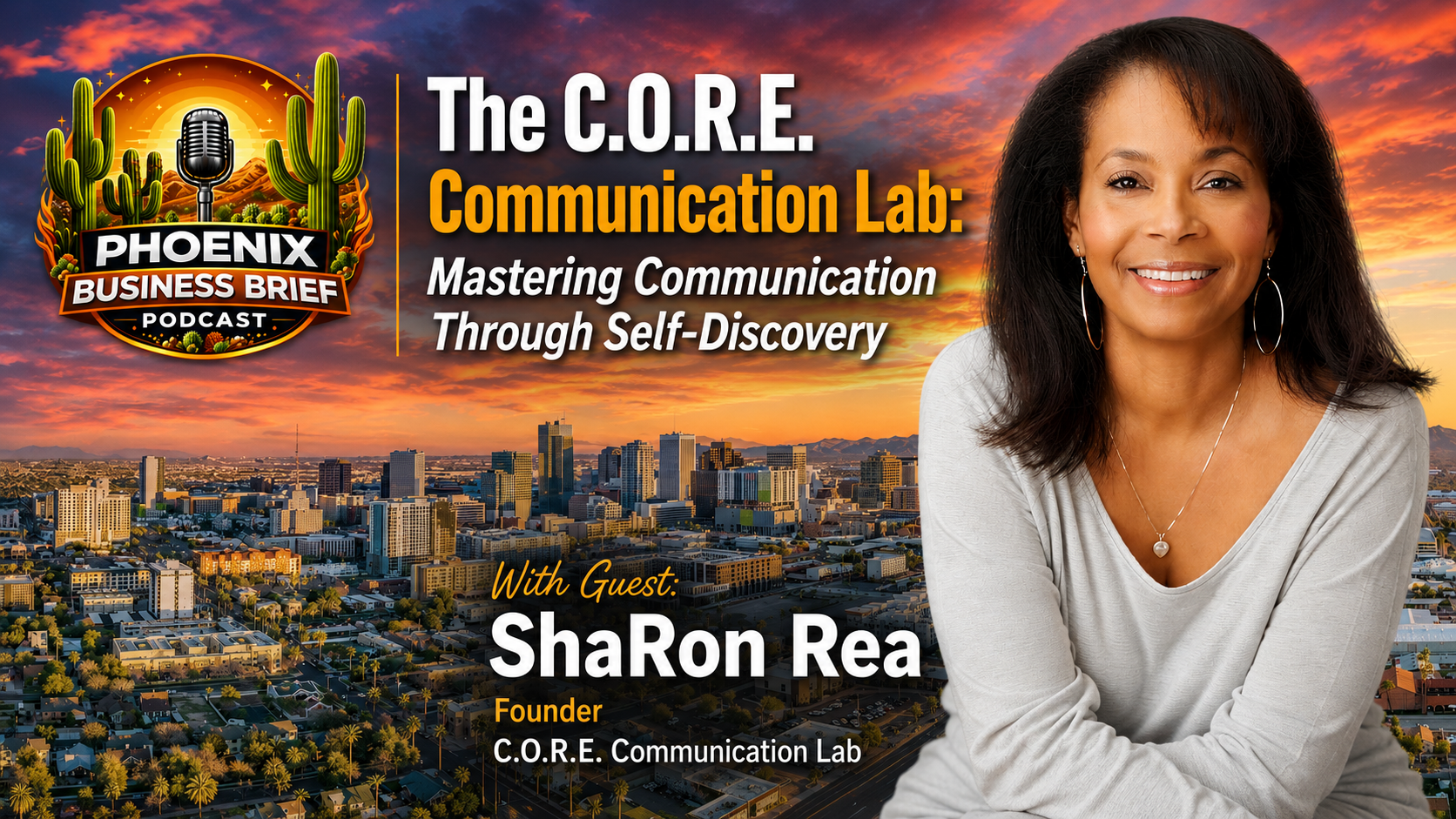
Phoenix Business Brief Podcast episode featuring ShaRon Rea discussing Unlock Effective Communication with ShaRon Rea of C.O.R.E. Communication Lab

In this episode of the Phoenix Business Brief podcast, host Brian Hyde interviews ShaRon Rea, founder of C.O.R.E. Communication Lab in Scottsdale, Arizona. Rea discusses her background as a communication strategist and coach, emphasizing the importance of effective communication in personal and professional settings. She introduces her C.O.R.E. framework, which focuses on creating connection, owning one's voice, respecting differences, and engaging new communication patterns. Rea also shares insights on various communication styles, the significance of pausing in conversations, and her upcoming project aimed at empowering women through understanding their feminine archetypes.

ShaRon Rea on the C.O.R.E. Communication Lab: Mastering Communication Through Self-Discovery

0:00 / 0:00

(untitled)

C.O.R.E. Communication Lab Founder Discusses Effective Communication Strategies

SCOTTSDALE, Ariz. (AP) — ShaRon Rea, founder of C.O.R.E. Communication Lab, emphasizes the importance of effective communication in personal and professional settings. In a recent episode of the Phoenix Business Brief podcast, Rea shared insights on her approach to enhancing communication skills and the impact of understanding different communication styles.

Rea, who has over 15 years of experience as a life, family, and communications coach, founded C.O.R.E. Communication Lab to help individuals improve their communication abilities. The lab serves as a "laboratory" where participants can explore their communication styles and learn to express themselves more effectively.

"Communication starts with you," Rea said, highlighting that many individuals develop their communication styles based on their upbringing and experiences. She encourages people to reflect on their fears, trust levels, and boundaries to improve their interactions.

The acronym C.O.R.E. stands for Create connection, Own your voice, Respect differences, and Engage new patterns. Rea explained that understanding personality and generational differences is crucial for effective communication. She noted that many people struggle to communicate effectively due to their backgrounds and the environments they find themselves in.

"People try their best, but we just don't know how to communicate with each other very well," Rea said. She believes that by learning about oneself and adapting to different communication styles, individuals can improve their interactions in various settings.

Rea also discussed the concept of communication capacity, which refers to an individual's ability to navigate different environments and situations confidently. She emphasized the importance of being aware of one's own communication style and adjusting it according to the context.

In addition to face-to-face communication, Rea addressed the challenges of digital communication. She noted that online interactions often lack the emotional cues present in in-person conversations. "The pause is golden," she advised, suggesting that taking a moment to reflect before responding can lead to more thoughtful and effective communication.

Difficult conversations pose another challenge, and Rea shared her approach to handling them. She introduced the SAFE acronym, which stands for Set the stage, Observe, Frame, and Engage. This method encourages individuals to assess their readiness for a conversation and to listen actively, focusing on areas of agreement rather than conflict.

Rea highlighted the importance of pausing before responding, especially in emotionally charged situations. "The pause gives you a breath to engage your discernment," she said, emphasizing that emotions should not be ignored in communication.

C.O.R.E. Communication Lab differentiates itself from traditional communication training by focusing on the integration of logic and emotion. Rea believes that effective communication requires both intellectual understanding and emotional connection. "If you're only talking from your brain, then you miss the moment of connection," she explained.

Rea also discussed her upcoming project, "Communicating Through Your Feminine Archetypes," which aims to empower women in their communication. She emphasized the need for collaboration between genders and the importance of women finding their voices in various settings.

For those interested in learning more about C.O.R.E. Communication Lab or Rea's upcoming projects, she can be reached via email at sharonriaz@gmail.com or through her website, sharonria.com. Rea is also active on social media platforms, including LinkedIn, Facebook, and Instagram.

As communication continues to evolve in today's fast-paced world, Rea's insights offer valuable guidance for individuals seeking to enhance their communication skills and build stronger connections with others.

Interview Q&A

Q&A: (untitled)

Phoenix Business Brief Q&A with ShaRon Rea

Q: Can you introduce yourself and explain what you do?

A: My name is ShaRon Rea, and I am the founder of C.O.R.E. Communication Lab. I have been a life, family, and communications coach for 15 years, working with families raising teens and those going through divorce. I started Core Communication Lab to help people learn about themselves and improve their communication skills.

Q: What does C.O.R.E. stand for in Core Communication Lab?

A: C.O.R.E. stands for Create connection, Own your voice, Respect differences, and Engage new patterns. It emphasizes personal communication control and understanding personality and generational differences.

Q: What common communication problems do you help people address?

A: I help individuals understand their communication styles, fears, trust levels, and boundaries. Many people develop their styles based on upbringing or workplace culture, which may not always be effective.

Q: Can you explain the concept of communication capacity?

A: Communication capacity refers to the ability to adapt your communication style based on the environment and situation. It involves being aware of how to present yourself confidently, whether in a familiar or uncomfortable setting.

Q: What are some basic communication styles?

A: There are various communication styles, including those identified by Myers-Briggs and Strength Finders. I use True Colors and Personality Lingo, which categorize individuals into four types. Understanding these styles helps improve interactions, especially in family and business settings.

Q: How do communication principles apply in digital communication?

A: Digital communication lacks the immediate feedback of face-to-face interactions. It's important to pause before responding to ensure a thoughtful reply. This pause can help filter emotions and lead to more effective communication.

Q: What makes difficult conversations challenging?

A: Difficult conversations often arise from the fear of conflict or the need for correction. It's essential to recognize that you have control over your engagement in these conversations. Using the SAFE acronym—Set the stage, Observe, Frame—can help navigate these discussions.

Q: How can pausing before responding be beneficial?

A: Pausing allows for reflection and helps engage discernment. It creates space to process feelings and thoughts, leading to more thoughtful responses, especially in emotionally charged situations.

Q: What distinguishes Core Communication Lab from traditional communication training?

A: C.O.R.E. Communication Lab combines logical and emotional intelligence, focusing on personal connection. Participants engage in experiments to discover what works for them, rather than receiving prescriptive advice.

Q: What outcomes do you see when people learn to communicate differently?

A: I often see joy and confidence in individuals who learn to communicate effectively. They feel satisfied with their conversations and develop a better ability to listen and engage with others.

Q: Is it harder for intelligent people to evaluate their communication styles?

A: Yes, individuals who rely heavily on logic may struggle with connecting emotionally. It's important to encourage them to explore new ways of communicating to achieve different results.

Q: Can you explain your project on Communicating Through Your Feminine Archetypes?

A: This project aims to help women find their voice and power without competing with men. It focuses on understanding and embracing feminine archetypes to improve communication and self-love across generations.

Q: How can listeners connect with you?

A: Listeners can reach me via email at sharonriaz@gmail.com or visit my website at sharonria.com. I am also active on social media platforms like LinkedIn, Facebook, and Instagram.

Key takeaways

  • Communication is in your control.
  • The pause gives you a breath to engage your discernment, to engage your logic, to center into how you feel.
  • When we can agree more rather than do the battle, the difficulty kind of dissipates a little bit.
  • If we could all love ourselves more, our communication would be a whole lot different.
  • It's important for you to learn who you are and how you communicate with the people around you.

About the guest

ShaRon Rea

7355 E. Thompson Peak Pkwy Scottsdale, Arizona 85255

Full transcript

Show full transcript
[00:00] Speaker A: Welcome to the Phoenix Business Brief podcast. I'm Brian Hyde. Today I'm joined by Sharon Rea, and she is— well, actually, you, you wear a number of different hats here. You're the communication strategist as well as the founder of Core Communication Lab. And I'm going to ask you, Sharon, to please pick it up from there and talk to me a little bit about who you are and what you do. Help, help us understand. [00:24] Speaker B: Okay, thank you and good morning. My name is Sharon Rea, and I am the founder of the Core Communication Lab. My brief history is For 15 years, I've been a life, family, and communications coach working with families who were raising teens, a little bit of a transition there, and families going through divorce, which I was doing at the same time as I'm learning this business. And what I found is, is that people try their best, but we just don't know how to communicate with each other very well. And over time of facilitating and writing programs and working with businesses, nonprofits, and families, I started the Core Communication Lab. And my goal is to make it a laboratory. So I'm not delivering a workshop. You actually come into the lab, virtual or in person, and you learn about yourself because you are in control of your communication. [01:20] Speaker A: Now, I have to ask, because CORE is spelled out like, like an acronym, can you break that down for me and tell me what does that stand for? [01:28] Speaker B: Yes, thank you, Brian. CORE stands for C Create connection. O is own your voice. R is respect differences. And my two differences, it's not a global, so it's not cultural, it's personality and generational. And then engage new patterns so that you, all that information you've gleaned from the C, O, and R, you now change the way you communicate. [01:57] Speaker A: So let's talk about where, where communication is going to come in handy. I have a feeling this is going to encompass most areas of our life, but, um, you are the expert here, Sharon. Um, when it comes to communication problems, what are some of the more common things that you help people deal with? [02:14] Speaker B: I help them know, like I said, communication starts with you, and often we develop our communication style from either our parents what we've been taught in college, what we've adapted to in a business environment. And it may work for you or it may not. And so what I invite people to do is learn about yourself, baby. Um, what are your fears? What is your trust level with yourself and other people? Where are your healthy or unhealthy boundaries? What do you do for self-care? Because when we are not in a calmer place, or at least an aware place that we're stressed or we're distracted, then our communication often goes off the rails. [03:01] Speaker A: So talk to me about communication capacity. What does that mean, and where does it apply? [03:07] Speaker B: It relates to what I just shared— the capacity to be able to be in any environment, any situation, and know from your own exploration that you've done about yourself how to show up there. And so if you're in a business environment where you are uncomfortable or you're new, you'll know how to present yourself with a different level of confidence and not shy away. Rather, if you were in a business environment where you're very confident and you're boastful or you're speaking more, you want to cut back a little less, whatever works for your personal way to interact in the environment that you're in. Okay. [03:47] Speaker A: And talk to me maybe a little bit about some of the different communication styles. I'm sure we've encountered them, but we probably don't think about them unless we find ourselves struggling to get something across or to understand what someone else is trying to get across. What are some of the basics when it comes to the communication styles? [04:04] Speaker B: You know, it's interesting. Thank you for asking that question because there are a lot of them. There's Myers-Briggs with your personality. There's Strength Finders. There's so many. I use— when I worked with parents and teens and in divorce, I used a personality identifier called True Colors and Personality Lingo. It's just 4 different types. In my family, we have the dad, me, and my two daughters, and we're all four different. So it behooves every person— you learn how to work your phone, you learn how to do your job, you learn how to drive a car. It's important for you to learn who you are and how you communicate with the people around you. So four of the basic types are my type. I'm very, you know, I speak a lot. I'm intuitive. I'm not emotional, but I speak from my feelings as well as my logic. My daughter is a scientist, and she's in her head. So the road between her logic and her heart is a little disconnected sometimes. So she's not able to read the room real well. She's slow to speak because she's constantly thinking about how to deliver her message. My former husband, those, uh, that is, uh, Tay is a lawyer. And he's very logical. Things have to make sense. They have to be in order. There's no interrupting him when he speaks, and he's usually perceiving himself as being right and you are not. And then there's my younger daughter who's just, the world is free and my information is coming out how it's coming out, but she's also connected to her heart and her emotion. So when you're aware of your own delivery of your words, I now know that when I'm speaking to my older daughter, I have to pause more because I'm from New York. I just— but she can't, she can't answer even a simple question in the time frame that I think, which is, Lindsay, how are you doing? It really is that long apart. [06:03] Speaker A: She has to think about it. [06:04] Speaker B: Yes, because she wants to deliver the exact logical, for her space, truth of her answer. Me is pretty quick. I feel fine, I don't feel fine, it comes out So that cadence of delivering your message is a valuable tool to know in business and when you're interacting in sales, when you're just interacting with your family. [06:25] Speaker A: So I have to ask, what you're describing sounds like it's very applicable in face-to-face communication. We do so much of our communication though digitally, whether it's text or email or phone calls and things like that. Talk to me about how the principles apply in being a better communicator when we're not face-to-face? [06:45] Speaker B: I think what trips us up when we're not face-to-face is we don't get to feel the mood or energy as well online as we do in person. You can walk in a room and go, "Mm-mm, that per— I think I'm gonna stay away from that person today. They're not looking kind of right. I don't feel so good." But when you're online, you're more in a performative space, meaning that you've presented yourself in this little tiny box. Who knows what's going on underneath? And you're really trying to not give too much away of your feeling. It's mostly a business conversation. But if we remember, you know, dial-up, you had to wait a minute before you got connected. So when you come in online, if you can just have that little pause, the pause is golden. It's golden when you're listening to someone before you respond, you want to pause to make sure you filtered everything you needed to give an accurate response. And when you're online, if it's your turn to speak, pause and make sure you listened and heard everyone else first, so that when you respond, you respond in total understanding of what you're responding to. [07:58] Speaker A: Oh, that's, that's good advice. Talk to me about difficult conversations. I mean, when we agree with someone, or they're in agreement with us and it's all, you know, good feelings all around and there's no— nobody feels, you know, threatened or upset. Those are easier conversations than the difficult conversations where maybe there's correction that's needed or something like that. Why are those difficult conversations? How do you approach them? What's— what makes them a little bit more of a challenge? [08:26] Speaker B: I really want to drive home, Brian, the point that communication is in your control. What happened with me before I became this lovely person that knows more than I did 30 years ago, um, is I felt like I needed to respond to everything. And living with an attorney and working in a law firm, you feel like you're on the witness stand a lot, and you feel compelled to answer. But I have control over me. I don't have to answer everyone. I don't have to engage with you if I don't feel confident or comfortable, or I'm intuiting that it's not going to go well. So these difficult conversations can often be abated just by you saying, I'm not engaging. And so once you are in it, uh, I have an offering to people to use another acronym called SAFE, and that's to understand whether you're psychologically ready to be in this conversation. And that's an internal analysis, and it's very quick. SAFE is to, uh, excuse me, set the stage. What are you feeling? What is the other person doing? Is it— are they too close to you? Are they yelling at you? Are they being dismissive of you? That gives you some information. Then you want to observe, okay, is this going to be a good thing if I engage or not good thing if I engage? And then you want to frame that reaction that you've just analyzed. Now you either engage with intention, and that means that you listen more than you talk in those difficult conversations, because what you're listening for is where you can agree. Because when we can agree more rather than do the battle, the difficulty kind of dissipates a little bit. Or you decide, not for me today. I appreciate it. I have to think about it. Something easy that you can remove yourself from the conversation. [10:28] Speaker A: That safe approach sounds like it would be so valuable if you found yourself, you know, being verbally attacked. And it happens to all of us from time to time. Someone will sometimes say something really unkind. They're trying to shock us into responding. Is there power in pausing before you respond? [10:48] Speaker B: Yes. Superman power. Or whoever is bigger now in the future. Whoever's fit. Yes. Because we are in a society and a culture, Brian, that we have absorbed the, in my opinion, incorrect assumption that we have to pay attention, respond to everything because of this thing that's attached to our hand, constantly connecting with us, constantly, mm, give me your attention. And the pause gives you A breath to engage your discernment, to engage your logic, to center into how you feel. We should not ignore our feelings. Our feelings are our GPS. They are our greatest personal shift to how we personally feel at any moment in our life. And so, yes, please deploy the pause anytime you can. [11:49] Speaker A: Let's, let's talk a little bit more about your Core Communication Lab. Specifically, I'd like to know what makes it different from traditional communication training. [11:58] Speaker B: Okay. As you've probably gleaned, you have to combine two parts of yourself. That is your logic, your intellect, your brain. It's difficult to communicate effectively if you don't know what you want to say and how you want to say it and have some history or background or verbiage that is aligned with whatever culture you're in. Business culture, family culture, friend culture. You want to be able to shift and think and modify your words. But if you're only talking from your brain, then you miss the moment of connection. And that's where the C comes in for CORE is Create Connection. You want to be able to connect with that person on whatever level is appropriate for you. So when you are able to use your brain, your mind, and your heart intellect together, you then know how to read the room. You know how to leave if you're not safe. You know how to engage with confidence and courage and don't talk too much. And that is the power of the pause. And that's what the Communication Lab— because you're in a lab, just like a scientist, you're doing experiments. We never tell anyone they're doing anything wrong. They get to discern whether that worked for them, and then we support them by saying, hey, maybe you could try this, or this is what we observed. But I never ever ever tell anyone, because I don't know. You're going to be in a whole lot of different situations that I'm not in, which is why we want to build your communication instrument, which is you. [13:34] Speaker A: I love it. Talk to me about what you see happen when people learn how to communicate differently when they start implementing the principles that you're teaching? What are some of the things that you see? [13:47] Speaker B: You know, the first word that came to my mind was joy. I mean, wouldn't it be awesome that every time you have a conversation, you feel confident, you feel satisfied, you feel, "I did that okay." And even if you're not sure, it's like, "I said what I needed to say and I had to let it land." There's this confidence, not boastful, but this centered, authentic confidence that I can maneuver wherever I am in the world and I know how to deliver my message. But equal to that, I know how to listen to other people so that I am in conversation, because communication is not a one-way street. It's you delivering something and somebody else delivering something. So there has to be a tango dance there, hopefully a waltz, something a little easier. So, so that That's what I find in the lab that's very valuable for people and a new concept, truly. Because if you go to college or you go to a school to learn communication, it's learning how to debate. It's learning how to do conflict management. All that's great. Those are great exceptional skills. And I do teach those as well. But if you put the raincoat of just the skills and don't insert yourself underneath, It's just not a full-on conversation. [15:11] Speaker A: This is going to sound like kind of a weird question, but I have to ask it anyway. Is this harder for people who are smart and, you know, who know that they have good intelligence? Is it hard for them to sometimes step back and evaluate how they communicate? [15:28] Speaker B: You know, if you're driving somewhere and you take a new route, you feel a little unsure that I'm going to get to my destination. So people that are— and I am that also because I had to work in a law firm and do those things. But when you're in your logical head and you receive benefit from that, and you've determined that that is my value, but you're not receiving a lot of connection with the people that you're speaking, especially as leaders, you're kind of on the top, but people aren't respecting you in the way that they could. Then it's just a new road. And so what I invite people that haven't connected with their emotion or are afraid of their emotion or have been told their emotions don't matter, um, it's just a gentle or forceful, whichever their personality is, whatever they receive from me, because I'm able to navigate that. Hey, let's take a new road if, if, if you want a different result. [16:29] Speaker A: And last question for you, um, I understand you're also creating Communicating Through Your Feminine Archetypes, and unpack that for me. Tell me about what that is and what inspired you to begin that kind of work. [16:42] Speaker B: Well, I'm a woman, duly noted. Yes, we're going to make that clear. And I have evolved my communication over the years. I'm a little bit, uh, older than I look. And what I find is that we're in a time where our wonderful collaborators in this world, men, are finding that women are finding their voice. They're finding their power. And I don't want it to become a competition between, I'm a man and I'm the leader, and I'm a woman and I'm going to take over. I want us to find our collaborative space. And in order to do that, too many of us women have stifled ourselves. As mothers, we give, give, give to everyone else, and we are always last. In business, we shrink a little bit, or we're too boastful, and we don't have that navigatable skill to, to figure out which one is workable and necessary. And so communicating through your feminine archetypes gives these women— and I've done a pilot already, so I know— gives these women in communication with each other, because we're online a lot, and being in person really is a difference, um, to share and unpack their fears, to give their Queen archetype a little more presence, to give their Warrior one, to be willing to stand up for yourself, to give your Lover archetype the one to love yourself. If we could all love ourselves more, our communication would be a whole lot different. So I'm developing a membership online, in person, and I'm not sure quite yet. Please get in touch with me if you're interested because I love input from people, um, to be able to deliver this to all generations of women. Because our Gen Z and Gen X, oh my gosh, this world is not any, any, um, the same as it was when I was growing up. The fear of communication, the confusion of communication. Then there's the baby boomers and the others that are sort of stuck. Theirs. So I want to help all of us expand our ability to interact with each other, feminine and masculine. [19:00] Speaker A: So what's the best way for our listener to reach out and to tap into what you are doing? How can they connect with you? [19:07] Speaker B: Send up a bat signal. No, I'll see it. No, my email is sharonriaz@gmail.com. My website is the same name, sharonria.com, and I'm on social media, LinkedIn, Facebook, Instagram. You connect with me there. [19:28] Speaker A: Again, we are talking with Sharon Ria. She is the founder of Core Communication Lab, and thank you so much for taking some time to join us today on the Phoenix Business Brief podcast. [19:37] Speaker B: Thank you, Brian.

Filed under

Related episodes