Show full transcriptHide transcript
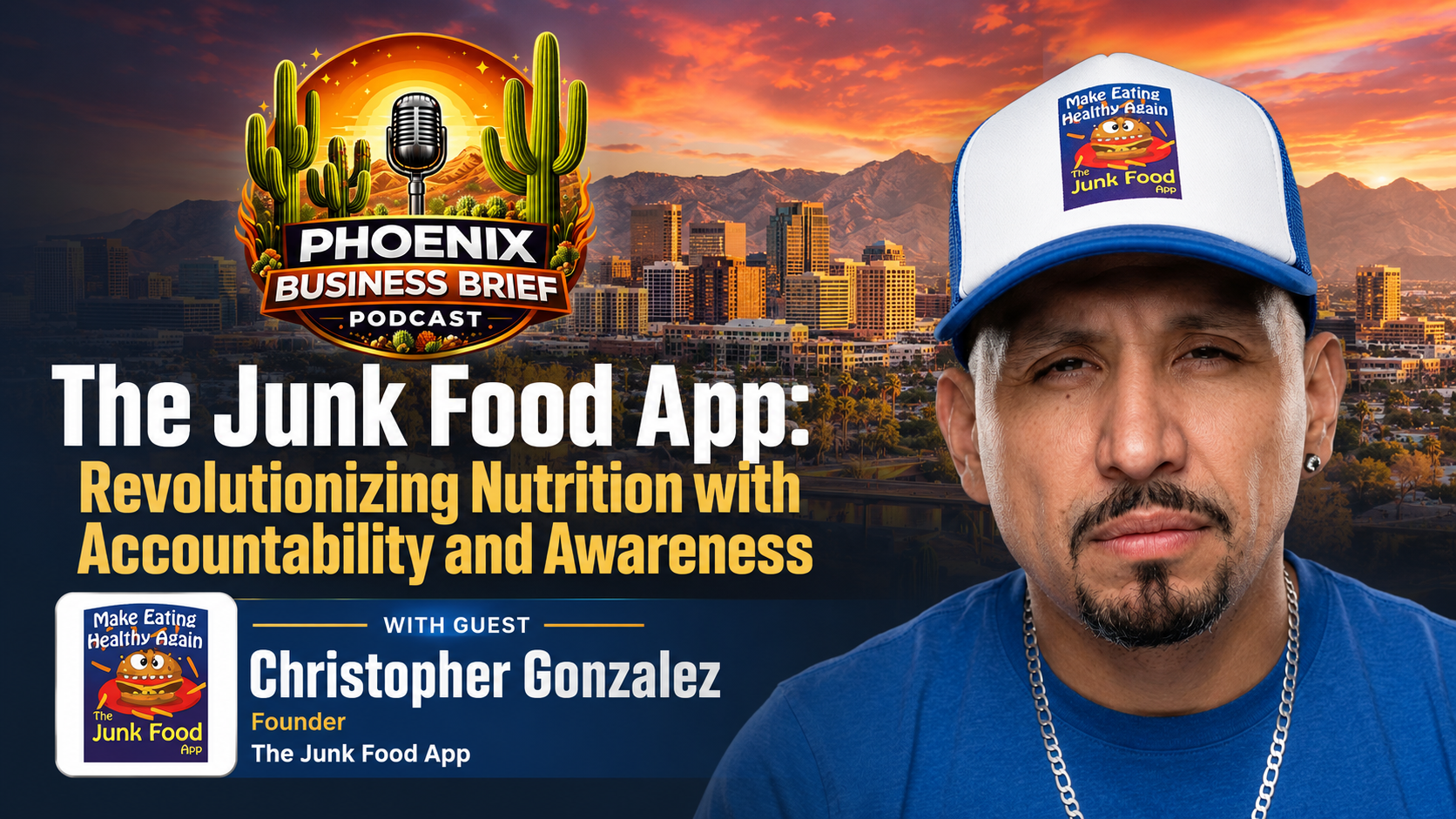
[00:00] Bryan Hyde: Welcome to the Phoenix Business Brief podcast. I'm Bryan Hyde. My guest today is Christopher Gonzalez, founder and creator of the Junk Food App. And Christopher, right off the bat, I gotta say, we— I've— this is, this is pertinent to my interests, but give us a little bit of background about yourself and then let's talk about the Junk Food App and, and what this is set up to do.
[00:20] Christopher Gonzalez: So, uh, I'm a fitness trainer. Uh, I've been a fitness trainer for many years. Uh, goes back to literally when I was a little kid. My mom started me in karate and I just have loved Fitness my whole life. I worked in medical research for over a decade, and I learned a lot during my time in medical research. And but I always loved fitness. So the junk food app, when I started training people, I I was very big on nutrition. I knew that that nutrition was really the key to changing people. But nutrition was also the hardest thing for people to adapt to, and it was the craziest thing to me because I would I would sit them down, and before I even talk about exercise. I would talk about nutrition. And, and sometimes I could tell if I was getting that wall where, where they just weren't— it was shut off— or if they were being receptive. And, and so I got a little bit of both. And for the people that were receptive, um, man, and they actually did it, they got such good results. You know, I took a girl from over 500 pounds to— she got down to 190 when we stopped training.
[01:29] Bryan Hyde: Wow. Wow.
[01:29] Christopher Gonzalez: Um, and, and this was over like a 4-year period. I had another guy, he went from over 285, and I think he dropped down to a solid like 199. Um, so over the years I worked with hundreds of people, and so I saw this firsthand. And the one thing that just boggled my mind was how people's emphasis on nutrition was so low, but the emphasis on wanting to exercise and do these things was so high, when, when really the nutrition is, is the fuel. You know, it's the fuel to giving our body what it needs to perform. So I couldn't fathom what was going on. And the one thing I noticed that is when people were accountable, like they were accountable to me, they would be more likely to do it. But when they lost that accountability, they would just fall off and then it was over with. So the idea became, I was actually training a gentleman who was a businessman and I was showing him the app that I was teaching people with, and he said, well, why don't you just create your own app? And I thought, huh, create my own app, right? This started 5 years ago. And, and so on the journey to creating the app, I started, uh, with a website called Fiverr just to create the designs, uh, got all the way into the design point and realized, um, I don't have a coder. Uh, so, so long story short, over the course of 5 years, I went through many, many, many hurdles to, to create the app, and we released it last week. We're having updates done on it today that's going to even make it better. Um, and I'm continually monitoring the app just to make it better. But let me tell you a few features about the app that are unique, that are not out there anywhere else. So it's very simple to use. Um, there's a little hamburger in the top corner that bounces up and down, kind of animated, and he's like, you know, tells you your percentage of food that you ate. Then there's like a wheel that goes around and it has a total number. So every time you eat, that number just starts to fill up a little bit. When you get full, the hamburger guy says happy and full. If you eat more, fine, but the hamburger guy will notify you and he will let you know, hey, You're overconsuming. It has more features than that. That's kind of cool. I think it's kind of fun because the user interface is a little bit more fun than just your average calorie tracker with a little hamburger guy. Well, you can take a picture of your food. We have a Gemini, Google Gemini, that powers the app. So it's not always 100% accurate, but we also have a very powerful search engine, the same engine that's used by MyFitnessPal and all these other big guys. So we can pull up anything. the user AI interface in it, it adapts to the user. So it's more like a nutrition buddy in your pocket. Let's say you have a certain type of genre of food that you like to eat. The app will recognize that, and within time it'll start suggesting more healthy alternatives of that same genre of food. So you can start to not, you know, 'cause food is very important to people.
[04:35] Bryan Hyde: Mm-hmm.
[04:36] Christopher Gonzalez: To some people it's very culturally important. Some people eat for like emotion, different things, you know. And so to take away what people like is not necessarily the, the, you know, you don't want them to overconsume that stuff, but, but just to take it away from them, it, it could kind of hinder their progress. So it's best that, in my opinion, from, from what I've been doing, is to let them learn as they go and develop on their own. And so I created the Junk Food app, uh, The app gives you an accountability partner. This is a really cool part. In the profile section, you have, for example, there'll be, um, me. And let's say me and you are partners, Brian. We're both partners. And if I'm tracking my food during the day, you can't necessarily see anything about what I'm eating, but you can see my number. And if you know I need 1,500 calories but my number's at zero, you can send me a message through the app the app will notify me that I need to start eating my food. Or if I overconsume my food, you can send me a message through the app that tells me, hey, you're eating more food than you should. And I know this is a very long-winded answer to your question, but, uh, you know, I'm very passionate about the app because, uh, I, I've worked with so many people, and, and that accountability factor, it just doesn't exist right now in, in that, in that particular genre of, of calorie tracking. But it does now through the Junk Food app. So I'm really excited to come on here and, you know, talk about it.
[06:03] Bryan Hyde: Christopher, you hit so many chords that just are so perfect to discuss here. You know, let's talk about accountability first. This is not about shaming people. This is not about guilt. This is not about we're going to break those bad habits. It's about managing how people eat through accountability as well as education. But let's, let's focus on accountability. You mentioned, you know, you've been a fitness trainer for a while. Why is it that when we are being held accountable, we tend to get stuff done versus when it's really up to us, there's always an excuse? Well, maybe tomorrow, you know, with that, that, that voice inside us that says, I'm just not strong enough to do this right now, and we kick the can down the road. Talk to me about what you have learned about accountability through your experiences.
[06:49] Christopher Gonzalez: Great, it's a great question. Uh, in my experiences, obviously, when you have somebody that you're accountable to like a coach or a trainer or a family member or somebody who you care about, you know, uh, you're definitely going to try harder, um, because you don't want to necessarily let that person down, um, and, and you feel like you're not alone, right? You create a sense of community within the app. You can have multiple partners. It could be a whole group together, um, so it doesn't limit to just one, um. But just the feeling of being supported, you know, and I think that helps people to tap into the natural ability that they already have. And that's to do the thing, you know, because there's so many times, like, for example, when I'm training people and they're really tired, I'll let them— I'll be like, hey guys, we're just warming up. We're going to get ready to work out. And it's not that they're not working hard or that I don't acknowledge that they're not working hard. It's to change their mind. to make them understand that, hey, you know what, I can't do it. And while they're doing it, you just said you can't do it, but you're doing it. And then, and then they're just like, oh, wow. So, uh, you know, there's, there's so many ways that, that, you know, you can go about it when you have support, um, that you can't when you don't have support.
[08:13] Bryan Hyde: And let's, let's also talk about part of, part of that accountability comes with awareness. And whether we're talking about our spending habits or our eating habits, Something happens when you start to track it. And, and, you know, it's easy to justify stuff when you're not tracking it because we forget, conveniently forget as quickly as we need to. But when you start really keeping count, um, suddenly it's like, whoa, I didn't realize that I was spending this much on, you know, whatever, or eating this much. Talk to me about, uh, about how, how that recognition of what, what we're doing helps to, to manage. You know, the way that we eat and the way that we consume?
[08:52] Christopher Gonzalez: Well, that's a great question. It allows us to do it guilt-free. It allows us to do it guilt-free. I'm a busy guy. I have a 21-year-old autistic son. I've been raising him his entire life. He's my life, you know. I built this app, you know, mainly a lot because of him. He tracks his food every day. If I'm busy or I have something to do, I can see that he's being accountable. And that he's on it, you know. So I get passionate about this when I speak about it just because I understand the power that it gives to people. But the ability to be guilt-free is such a powerful tool. Like, for example, we were busy yesterday and so we stopped and we grabbed something real fast. We got some McDonald's because he's always liked it as a kid. 740 calories. That's how much is in what I got just Just the hamburger, 740 calories. Well, out of my 2,400-calorie limit, it didn't do a huge dent. Now granted, it's gonna make my fat go up, but the calories are tracked within the app. So then I'll just eat some more protein or carbohydrate-rich foods so I can, I can kind of balance my macros. Um, but at least I'm not over-consuming. So I, I would— I had to eat that cheeseburger, but I ate it guilt-free. I didn't have to. I could have ate something else, right? But I'm just being real, you know, and, and in the real world for real people, things happen. And sometimes you just got to get a quick snack and a quick bite, but you still want to take care of your health. But what happens is you start— at least for me, I start knowing, okay, I, I've eaten, you know, X amount of calories and X amount of my macros— fat, carbs. Let me drink some more protein shakes or have some more lean, uh, lean meats that contain protein sources that will up that number and help balance me as a whole. And I've been doing this for, for years. I started tracking my food 20 years ago on paper. before apps even existed. And, and I've been able to keep a very low body fat percentage my whole life. I'll be 50 in 2 years. I feel great, you know, and, and I just want to, you know, kind of keep helping people understand that, that there's, there's a possibility for them to completely change themselves when it comes to food.
[11:13] Bryan Hyde: Something you were mentioning to me before we started the program was that one of the great strengths of this app is Um, when, when you, uh, scan whatever it is you're going to be eating, it will actually give you alternatives. So, you know, if, if you're, if you're trying to find a healthier alternative, but oh boy, this is really tempting, scan it and, and tell me about how, how this will, will recommend other things that may actually be healthier.
[11:38] Christopher Gonzalez: Of course, yes. Um, so I was, as I mentioned earlier, I have a bad habit in the mornings. I like to drink an energy drink. Uh, started years ago when I used to work the night shift, and I just kind of like it, to be honest. I know it's not the best thing for you, but I never consume more than one a day. But every time I scan it, it'll give me a list of healthy alternatives— sparkling lemon water, uh, green tea. And see, I even remember them, and, and it's because they're just there in my face every time I scan. And so I think I'm gonna try the one of the alternatives. Um, one of these days and see if I still feel that same, um, you know, people drink coffee and they drink caffeine because they like that feeling of being awake, you know, especially when they're just getting out of bed. And so, so I'm interested and, and just seeing it within my peripheral, it's like planting a seed, you know, uh, and, and it's so cool that the app, it allows you to, to do that. It allows you to, to scan and, and if you want to eat that food, that's fine. But it will give you alternatives of other things, you know, just to kind of help you learn on your journey.
[12:43] Bryan Hyde: I love too that you take the guilt out of it. I know we all have our guilty pleasures, but when it, when it comes to, uh, particularly if someone is trying to make some fitness goals or maybe some weight goals or just, you know, improve their overall healthiness of their diet, guilt seems to be a driving factor in so many different diet plans and and so forth. Talk to me, talk to me about how this app helps you enjoy the foods you love without having to hang your head in shame because, you know, I chose to eat some French fries.
[13:15] Christopher Gonzalez: Track it and track it and forget it, right? Track it and forget it. My motto was never diet again. So, so when you become accountable to yourself, you have a bigger sense of freedom. I always tell, I always do myself, and I always recommend to people to track it before you eat it. Right? Get your food, sit it down in front of you, and if you've made the decision that you're gonna eat it, track it. Once you track it one time, like I just said, 740 calories, um, you— in, in the sandwich that I ate from McDonald's, you're gonna start to know. My daughter used to work at Sonic, and, and so one day I went over there to get a Sonic slush, uh, 640 calories in a drink. Mm. A drink. I couldn't believe it. It blew my mind. I thought it was just like water, and and well, obviously there's sugar because it had the sweet taste. But my daughter was like, "Yeah, Dad, we have like a special machine." And I was like, "Wow, you know, I never knew." So so when I thought about it, and I thought, you know, people will have that just as a refresher, you know. But the thing about it is once you know something, you can never unknow it. And now you're making a conscious choice that could be detrimental to your health. And so maybe you still want that thing, but maybe you minimize the amount because now you know what you never knew before. And so the idea is to build that food consciousness within the minds of people who use the app in a way that's positive and productive for their overall longevity of life.
[14:48] Bryan Hyde: I love it. Let's talk about where people can learn more about the app. Tell me about your website, for instance.
[14:57] Christopher Gonzalez: So I have— there's 2 websites. There's www.thejunkfoodapp.app. That one is the website that's created through Google and Apple as a director to either platform to download the app. The other website is the one that I built myself. It's www.thejunkfoodapp.com. And on this website, I have just a couple of different little videos that explain more about the app. I have a contact section in there. So anybody that, you know, is listening to this and they want to contact me directly, uh, I respond to everybody within at least 24 to 48 hours. Um, and, and so it's, it's a, it's more of a kind of like a, a small business feel, you could say, my app, uh, my website. But then I also have the, the big, the big Apple Google, uh, website. But they both will give you information about the app that is going to hopefully be, uh, relatable to what you're trying to do it for. Uh, the content is the same on both of them. It's just presented differently on Because I have a couple of different little videos that I thought were pretty cool to kind of drive the— see, because one thing that I— when I created the Junk Food App and I called it the Junk Food App, I, I realized that that might confuse people, you know, not quite knowing what that means. But kind of like the reverse psychology, uh, I wanted to, to, in my personal website, to give them a real solid foundation of exactly what the app is. And then that way, you know, I— and, and I feel like the Apple and Google did a great job in translating it over, uh, to those websites.
[16:33] Bryan Hyde: And okay, one final question for you, and that is, um, I, I know one of the reasons why, why people like to put off making healthier decisions, whether it's about exercising more or eating better, is because these things can be confusing. Nutrition, um, you know, unless you're, unless you're in the habit of checking labels or, you know, counting calories, It can be kind of confusing. I'd love to hear of feedback you've received from people you've worked with over the years about what happens in their life when they start to train themselves to pay attention to those little details instead of just letting them slide. Do they— I'm sure they share their successes with you, but I'm curious about the mental transformation that takes place when that starts.
[17:17] Christopher Gonzalez: Confidence goes up through the roof. The, the, you know, the— I notice it, you know. I'll know these people. There's a guy I used to train, right? And he used to hunch his shoulders a lot. And I would say, hey, pick your shoulders up, put your chest up, you know. 10 push-ups if you do that every time. So he stopped. We got tired of the push-ups. And, and now, man, when he walks around, he walks around with his chest up high, you know, uh, really confident. Um, so confidence is, is Huge thing that people get when they start being personally accountable. You know, compassion. You know, you start to to to to not be so hard on yourself. You know, give yourself a little bit of room to grow because you you know education adaptability these are all things that when a person starts tracking and and they you know gotta have fun with it. I'm also a boxing coach, and and so when I train people in boxing. People are very tense, right? And so if you've ever seen the movie The Karate Kid where the snake does what he does, they adapt to the energy, right? So within the Junk Food app as opposed to other apps, the energy is out of a happy place to make the user feel that, you know what, it's okay to be me. And I think people need more of that. You know, they need to be okay with just being who they are. And it's just a way of helping you nutrition-wise get to that place.
[18:40] Bryan Hyde: Again, we are talking with Christopher Gonzalez. He's founder and creator of the Junk Food app. And I got to tell you, this, this is intriguing. I'm going to be paying a visit to your website. Thank you so much for visiting with us today on the Phoenix Business Brief podcast.
[18:54] Christopher Gonzalez: I really appreciate you. Thank you so much for having me. I'm very humbly grateful for the opportunity.