Show full transcriptHide transcript
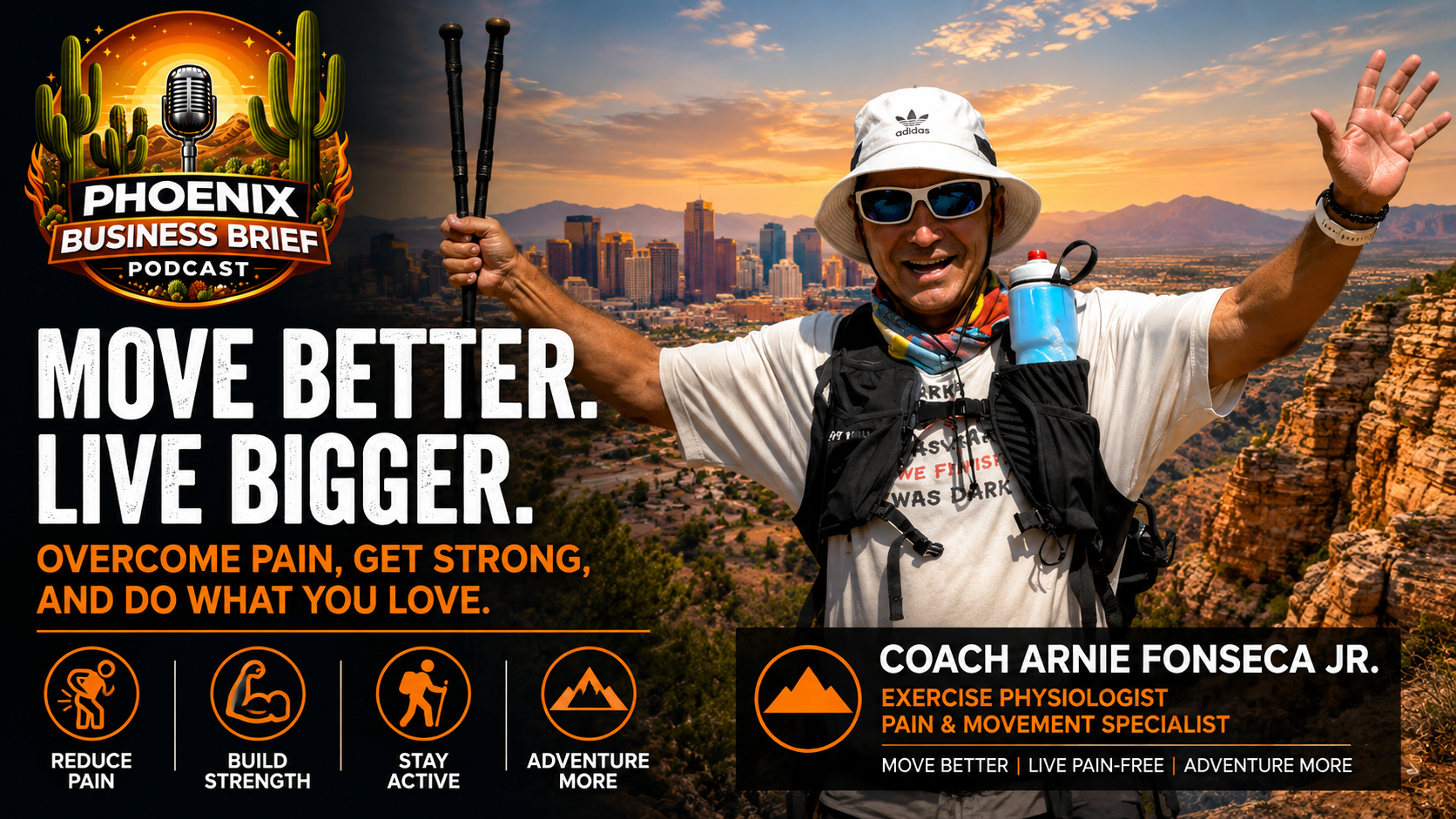
[00:00:00] Welcome to the Phoenix Business Brief Podcast. I'm Brian Hyde. Today I'm joined by Arnie Fonseca, Jr.. Or as I'm gonna call him, coach Arnie, welcome to the program. Hey, uh, for those who are meeting you for the very first time, take just a moment here to tell us a little bit about who you are and what you do.
Wow. That's, uh, just a few minutes. Okay. Or a few seconds. No, I, I'm, they call me Coach Arnie. I am a. Uh, almost 67-year-old exercise physiologist. Uh, I've been a, a, a, a teacher, a coach, um, a, a neuro rehab specialist with brain and spinal cord. Um, I've been an older adult. Um, specialist with dementia, Parkinson's, any kind of movement disorder, Alzheimer's, you name it.
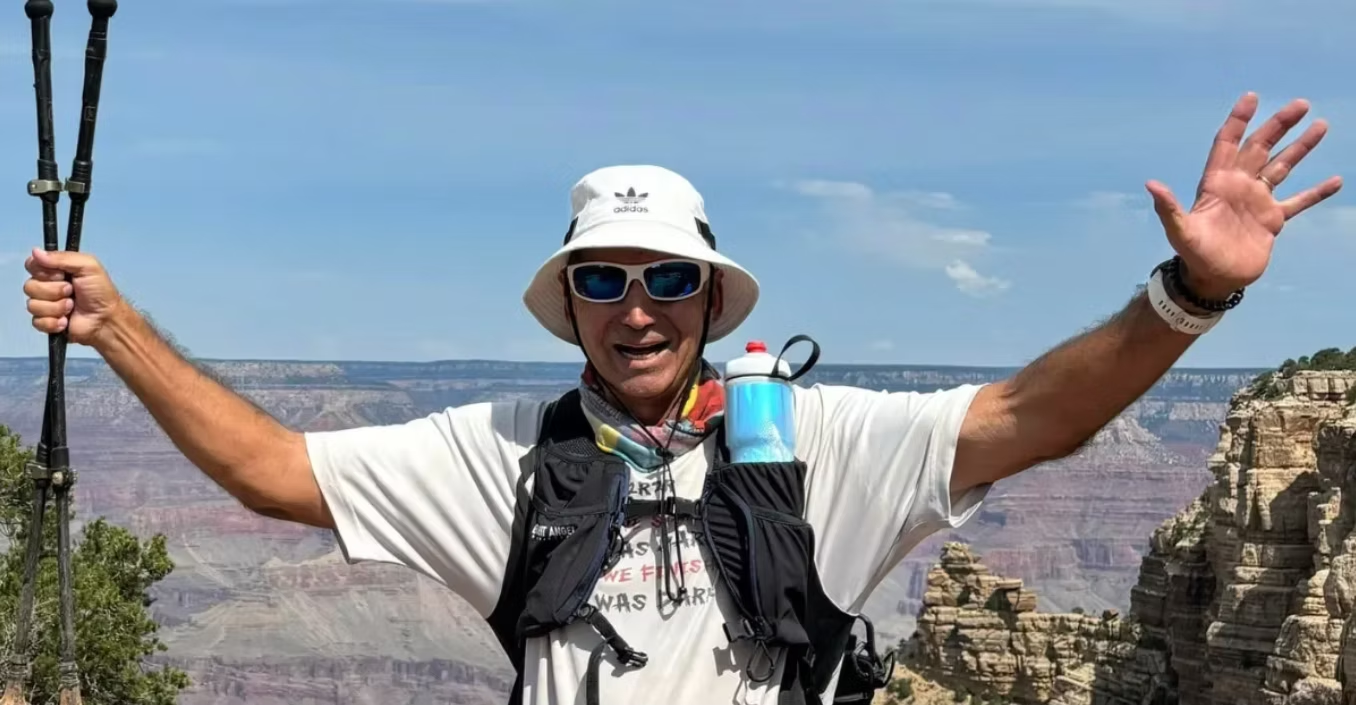
And now I'm a considered a pain and movement specialist as I've had my own issues and have helped, uh, a lot of individuals to feel better [00:01:00] at. Uh, and, uh, one of my specialties is to help them to, uh, hike. Or have an adventure in the Grand Canyon, um, safely, pain-free, and with a big smile on their face. So that's kind of where I'm, uh, that's, that's my current, uh, place in life that I'm at.
I was gonna say that's quite a setting too, in which to, to experience, you know, uh, PainFREE living. Absolutely. Um, let's talk just a little bit about, uh, about pain. Um, for people who have never experienced chronic pain or, or lasting pain, sometimes it's easy to think, well, people need to toughen up or they just need to quit being such a big baby.
Yeah. But people who've actually lived with, with chronic pain, um, understand it at a different level. What, what are we talking about when, when we talk about the kind of pain that, that you help people to overcome? Well, uh, we are talking about chronic pain. We're also talking about, uh, especially today, we're talking about a lot of people that are experiencing, uh, knee, hip, back, [00:02:00] shoulder pain that's chronic, which means it's longer than, you know, three to six months.
Uh, it's ongoing where a lot, uh, in today's world, um, they're not gonna really. Treat the way that I would do it as an exercise specialist because of mainly 'cause of liability, Brian. But, uh, so they're gonna replace it. They're gonna, they have a process. They're gonna give you some, um, some pain meds, some cortisone type things, anti-inflammatories.
They're gonna send you some physical therapy, um, which is my. Competition, even though I have owned and operated and trained physical therapists, so I know the world very, very well. And then at that point, you're gonna send 'em back to the specialist, the surgeon, and he or she is going to do what they do, which is remove the pain.
I had a long conversation with somebody this morning. They'll remove the pain and send you on your way and against, uh, uh, without really explaining to you that pain will move. Brian. It's tension in [00:03:00] your body. So chronic pain. If you have a knee that's killing you and you've been told your bone on bone, I hear that every day your bone on bone, you remove the pain.
Now that tension will either go up into your hip or down into your foot. Or ankle or some other place, it's gonna go somewhere. And instead of helping you to learn that and then come up with strategies to unwind yourself a little bit, you're gonna, and and, and I've had clients literally that their doctors have said after a knee surgery, they'll go, Hey, just come back in about six months and we'll take care of the other one.
And they'll go, oh, the other one doesn't hurt. Oh, we'll take care of it anyways. Don't worry about it. 'cause they know, they know. I'm not saying they're criminals or anything, but to me it's kind of where we're at in our society right now. Instead of educating people and giving them a little grace that, hey, these people might wanna learn how to take care of themselves.
We [00:04:00] assume they're not gonna do it. And that's why a lot of these, um, insurances now won't even pay for rehab 'cause they know people aren't gonna do it anyways. And so, so chronic pain is things that last longer than a few months, obviously and technically won't go away, like the arthritic bone on bone knee, or bone on bone hip.
And I get people to come in to me and come and see me, Brian, and they'll stare me in the eye. And as if I've got horns coming outta my head when I say to them they don't need to do the surgery, because I'm the last of the baby boomer generation that really believed and trusted the medical community. So we grew up trusting these guys.
And so for me to say he's wrong is, is really. A really tough one for for folks to understand. So then I have to convince them that, Hey, look, why don't we look at. Getting your body back in balance, we gotta untwist you. We gotta find out the [00:05:00] source of the pain. Why do you have a knee that hurts? Why is your knee bone on bone?
If it is, if it, it is. Why is your hip feeling like that? Why is your foot killing you? Why is your shoulder or neck like that? And if we can find the source of that pain and solve the problem. Maybe you'll feel better and if they give it enough time and they'll be open to it. I've had, I've had, rarely have I had anybody, Brian, that says it didn't work.
And I'll give you a quick little, uh, story. I'm working with a 72-year-old lady. She's chuckles Slovakian from P. And I'd been working with her a couple months and literally right into our program. She had gone over, we'd started less than a month. She had gone over to California to visit her friends. They were, they were walking around, you know, doing, you know, touristy things.
And she literally texted me and saying that she was gonna have to stop seeing me. Her knee was [00:06:00] killing her. She had gone to the doctor, I mean, this is I in California. She's from here. Had an x-ray, had this, had all these tests done, and she was probably gonna have the doctor said to rest it and she might have to have surgery on her knee.
I go, Hey, call me. So I said, so she calls me up and I remember we were going over this this morning. It's funny, and I, I know exactly where I was sitting. I said, Hey, try this. One of the things I had her doing was walking backwards and some other things, couple little things, and I go see how it feels, and then call me back and tell me, you know, which feeling this is like maybe nine o'clock in the morning.
So she literally calls me back around one. She goes, Arnie, I have no idea what happened, but I feel really good. She goes, do you think I can go hike, walk to the lighthouse today with my friends? I said. You can do whatever you want as long as it doesn't hurt. 'cause everything I do, Brian, [00:07:00] we have a rule. If it hurts, we don't do it.
So not only did she hike, did she go do the lighthouse and have the rest of her vacation? She comes back and she's like. Oh my God, this is unbelievable. I can't believe this, and she's totally into it. Now, fast forward about six weeks. She hiked up a very, very steep mountain this past Saturday. I mean, halfway up.
It was unbelievable what she was able to do, and she was telling the story this morning how she was told a month ago to rest her knee. You know, because she's got all this arthritis and all these problems, blah, blah, blah, blah. And she's like, she's floating around now because she's, she's now given me the chance in what I'm doing to unwind her, find the source of her pain.
Start the healing process, start getting healthy, get those muscles feeling better, lining up that joint so it feels a little better so it's not bone on bone. 'cause guess what? [00:08:00] When you're my age, Brian, you're gonna get, all of us are gonna have arthritis in our knees, and that's not always a bad thing, but they make it out that it's a death sentence.
It's not, but, but again, I'm not se, all I'm selling is a smile on your face. That's all I'm selling. I, you know, and that's the top, it's hard to profit from that. Arne you mentioned, um, earlier, you know, the, the institutional trust that a lot of us grew up with of the medical community. I mean, there was a time where, well, you need something, you know, you go to a doctor, he'll give you a straight answer.
But, uh, there has been, there, there's been kind of a breach of that trust in, in recent years. What are you seeing from, from your vantage point? Why is there mistrust in the medical community? Well, I'll use me 'cause I'm, I'm the worst. Brian, you know, I'm, you know, I'm an exercise and I work, I've been working in the medical community for 40 years.
I've owned licensed medical neurore neuro rehabilitation facilities doing brain and [00:09:00] spinal cord rehabilitation. I've worked hand in hand. I've had clients that were orthopedic surgeons. They came to me with shoulder, knee, hip, the same old nonsense stuff. Okay. I was working on them, and I tell you what it is, is that they, it, it's both sides.
I had a friend who's an or I have a friend who's an orthopedic surgeon in Atlanta, Georgia owns a clinic where they do a lot of replacement. He goes, Arnie, a hundred percent of the people that come through here in a year post-surgery have a 100 have an their, their BMI is is. Is increased, which means they've gone back to their normal behavior.
So they, there's no change in behavior that got 'em into the problem in the first place. So the trust then becomes, if I go, if I go to my doctor, why am I, why is he just bringing in a script pad and, and giving me pain medications versus giving me strategies on how to get better? Well, [00:10:00] one, the doctors are in a, in a tricky spot, Brian, because liability.
So if they told you to go out and do exercise and didn't give you that pain med, they're liable. Got it. So they're not gonna do that. Number one. Number two, on the therapy side, which is my side of the coin. Uh, and, and this is, this is my own opinion because I've trained them, I've worked with 'em. The PTs are lazy.
And if any PTs are hearing this, good for you. If they're lazy, 'cause they're not gonna do anything that's outside the bounds of what the surgeon is telling. Now. Not all, but there are some good ones out there. But the, the good ones are gonna be a little more radical. They're gonna look at some new innovative things that are being, 'cause there's a lot of information out there, Brian.
There's a lot of information. So what happens then with social media, which they all hate. People now are out there seeing, why can't I do this? Why can't I do that? What's wrong with this? Why? Why am I, why are you not teaching me about in inflammation in my food? Why are you not teaching me how to [00:11:00] do this movement pattern?
Why am I, why do you just have me in there with a hot pack on and a cold pack there and a massage? Why aren't I doing these? So there's so many questions, and what they're telling people is, Hey, look, I'm the pro. I'm the expert. You need to trust me. And then with c. COVID blew it all apart because that was what we heard.
I'm the expert, I'm the pro. Just listen to me. And we all went, no, sorry. Doesn't work anymore. And it doesn't work anymore. And they hate it. And the only way out, Brian, the only way out is now to get deep into the research and then start sharing it, which they haven't started to do yet. I'm doing stuff now 'cause I have a friend, he's a exercise FS guy in, uh, uc, Davis.
He's doing some phenomenal things with tendon strengthening and, um, tendon healing. That's only been around since 2000, 21, 22 right in there. Nobody is doing this. It's out [00:12:00] there. If they wanted to, they could. So that's where the mistrust comes. 'cause then they come see me now if they give me a chance, like I said.
If they give me a chance. 'cause usually people, Brian, that see me are desperate. They're the rejects. They've been in physical therapy for six months, no change except in their pocketbook. Okay? And so they're going, geez, I don't wanna live like this. So they hear some guy called pain-free, Arnie, and they're going, really?
Is it possible? But I've got bone on bone knee, but my hip is killing me. They said I need to have a hip replacement. And, and that's a tough lift for them. I believe that they can get better. I believe everybody that sees me, Brian can get better. You know, I've been told, you know that I'm full of false hope and all this nonsense, and I go, no, I'm full of HOPE, having only positive expectations.
And if I can get you to believe that, if I can get [00:13:00] you to believe that and do what I'm telling you to do, I've seen nothing but improvement. Nothing. Now is there, is there gonna be a case that somebody's not gonna get better? Probably I'm not. I'm not, uh, I'm not pie in the sky out here. But at the same time, if I think it's a legit, I mean, if I think for one second that somebody came to me.
Uh, I'll give you, for instance, somebody came to me that was in a car accident years ago and their bone was broken, and so the healing caused a misalignment. That's a different kind of a misalignment, Brian than, than overuse, or sadly, a overweight 50-year-old female that needs to lose 40 or 50 pounds that just wore her knees out.
Now, does she need hip replace or knee replacement? Maybe not. If I can get her to eat better, lose some weight, get stronger, learn how to walk better, use her, walk on her. Like I was working with a trainer [00:14:00] this morning and she even told me, she goes, I know I'm walking on the outside of my foot. I'm not using my big toe properly.
I know, I know. I know what you're saying. And I know where you're at because she knows what I'm doing. Get it. The point is she knows, but she's a trainer. How many people don't know and they go to their doctor and they put 'em in an orthotic and all they're doing is, is putting a, a bandaid on top of this really serious problem that maybe in another five years their knee's gonna kill 'em.
And they'll go, yeah, you, your bone on bone, let's replace it. This, I mean, what you have been describing thus far really sounds like, uh, you are much more focused on getting to the source rather than just here let's deal with the symptom, which, um, is, is, is unfortunately that's how a lot of traditional medicine deals with it.
Sure. Talk to us about how you developed your gut pain-free system. All right. First of all, it, it was 'cause of me. 'cause of me. And, you know, I am an exercise and I'm an ultra athlete. Uh, as I, you know, I stopped doing triathlons [00:15:00] and Joey's trying to figure out how to make Coach Arne better. So I was going through some serious problems probably in 2011, and my own staff at my clinic said, oh, you need a, you need, you just need a knee replacement.
If I was limping around my knee, I, it, it would, I didn't know what, what, what the cause was, right? And my staff didn't know people were stretching me and doing all this stuff. 'cause I was pulling my hamstrings. I had a trainer there that was doing all this stuff that you're supposed to do. And I'm limping around.
One day at, uh, at this event at Tempe Beach Park. This guy says, Hey, come over here. And I go, what's going on, man? He goes, God, I notice you're limping. He goes, I go, I know my knee is freaking killing me. He goes, listen, I know this guy get it. I know this guy. He's a guru. I go, gimme his number. I didn't even look.
He just gave me his number. I went back to my office on a Monday. It was a Saturday. I went to my Bo and I just called his office to get an appointment. It took me another week to get in. Again, I don't, I didn't ask any questions. I go to his office, [00:16:00] which is not that far from my office. I go in there, I'm sitting there, I find out he is a chiropractor.
I go, oh, okay. I've been a chiropractor. No big deal. I go in there. This guy did some stuff to me. First he explained to me what's going on with my knee, which was amazing. Okay. Here I'm thinking I'm smart. I'm 50 years. I'm 52, 53 years old. He's gone. He's explaining to me stuff about my knee and arthritis and all this stuff.
I'm going, holy crap. He goes, I don't need to see an x-ray. I already know it's wrong. He starts doing this technique on me called a RT, and, and then I, then he gets me, I, I get off this table after he about killed me. And my knee freaking popped like you wouldn't believe. And I go, holy smokes, what was that?
And I get down and, and I'm doing things I couldn't do when I walked in the office. He goes, now we're not done. We got a lot more to do here, but just don't do this and do this. That guy was, his name was Dr. John Ball. He taught me so much. I literally wanted to work with him. And then he said to me one day, he goes, look, you can keep paying me or I can [00:17:00] teach you what to do.
I go teach me what to do. So that kind of started, that was one part of it. Then I started just applying it to myself, Brian, and with, with my own training. 'cause I was still doing, I was getting into ultra events and I didn't even been to the Grand Canyon yet. Okay. I didn't go to the Grand Canyon until I was 55 and then, and I started just listening to other people trying to.
Put pieces of the puzzle together, whether it was foot, I became very obsessed with the foot, the big toe, and all these other issues. And so just by solving a lot of my problems and then listening to other people and putting these things together. So at the start of COVID, I was losing people 'cause I couldn't go into, I did a lot of work with neurological stuff then, and one of my friends, um, said, why don't you go back in the gym?
I go, oh man, I don't wanna do that again. So I did, but I went back in the gym and I go, you know, I'm gonna start this program on how to get pain free. And so, so that's what I started doing. I started teaching people about mobility and strengthening at the same time without [00:18:00] all the stretching, with all this other stuff.
And guess what? It just worked. It just worked. And, and, uh, I started with the, with the guy that ran the place. He was an eight. He was, at the time, he was 79 years old. He is now 85. And I still got him running circles and doing all kind of crazy stuff. He's, they call him Pap and everybody else that comes and finds me, whether it's online or in person, it doesn't matter.
I show him what to do. I'm actually putting a course together right now for a Grand Canyon training and stuff like that. I've been at the, since then I've been to the Canyon over 30 times. I'm the only person over 60 to do what's called an R five, which is a double R three, which is almost 90 miles. It's taken me.
The second time I did it took me about 47 hours to to do again. And I always tell people when they come see me with their bone on bone, knee, I go, oh, I've got a bone on bone, knee too. And they go, oh. So that kind of shuts it off right there. And then we start to have a communication, a, a conversation. So again, that's how it kind.
[00:19:00] That was the gist of it. It was for me, like a lot of these things come about, and then I just started sharing it, and now I'm obsessed with the whole medical community, joint replacement, being in pain, pain medication. I'm just obsessed with, with coming at that thing head on. So, one final question for you here.
Yeah. Again, we're, we're talking with Coach Arnie Fonseca Jr. How do people find you? What's, what's the best way to get ahold of you? Best way to get ahold of me if I may do. This is my phone number. You can feel free to call me and everybody thinks I'm nuts, um, to (602) 390-9144. Just call me or text me. Get a hold of me, I'll call you, but you, I'm also on Instagram, Pain-Free Arne on Instagram.
I'm on Facebook under my name, Arne Fonseca, Jr.. I'm on, uh, TikTok under Coach Arne. I'm on LinkedIn under Arne Fonseca, Jr.. Um, just Google or put me in chat, GPT, [00:20:00] coach Arnie, or Arnie Fon Jr. A bunch of stuff will come up. I'd love to talk to anybody about their problem and. I'm gonna give you some nuggets. No matter what, just, just get ahold of me and uh, I have people come in and visit.
I have people that stick with it, they love it, and it depends on your goal, but most people, Brian, just come see me 'cause they're frustrated. They're in a lot of pain and they don't know what to do. Whether it's tendon pain, pan plantar fasciitis, knee pain, hip stuff. And, you know, we'll talk nutrition, we'll talk whatever, um, to help you out because I don't know what the cause is.
You know, I don't. I really don't. But that's how you get ahold of me. Good to know that you have alternatives. Again, we're talking with Coach Arnie Fonseca Jr. Thank you for joining us on the Phoenix Business Brief Podcast.