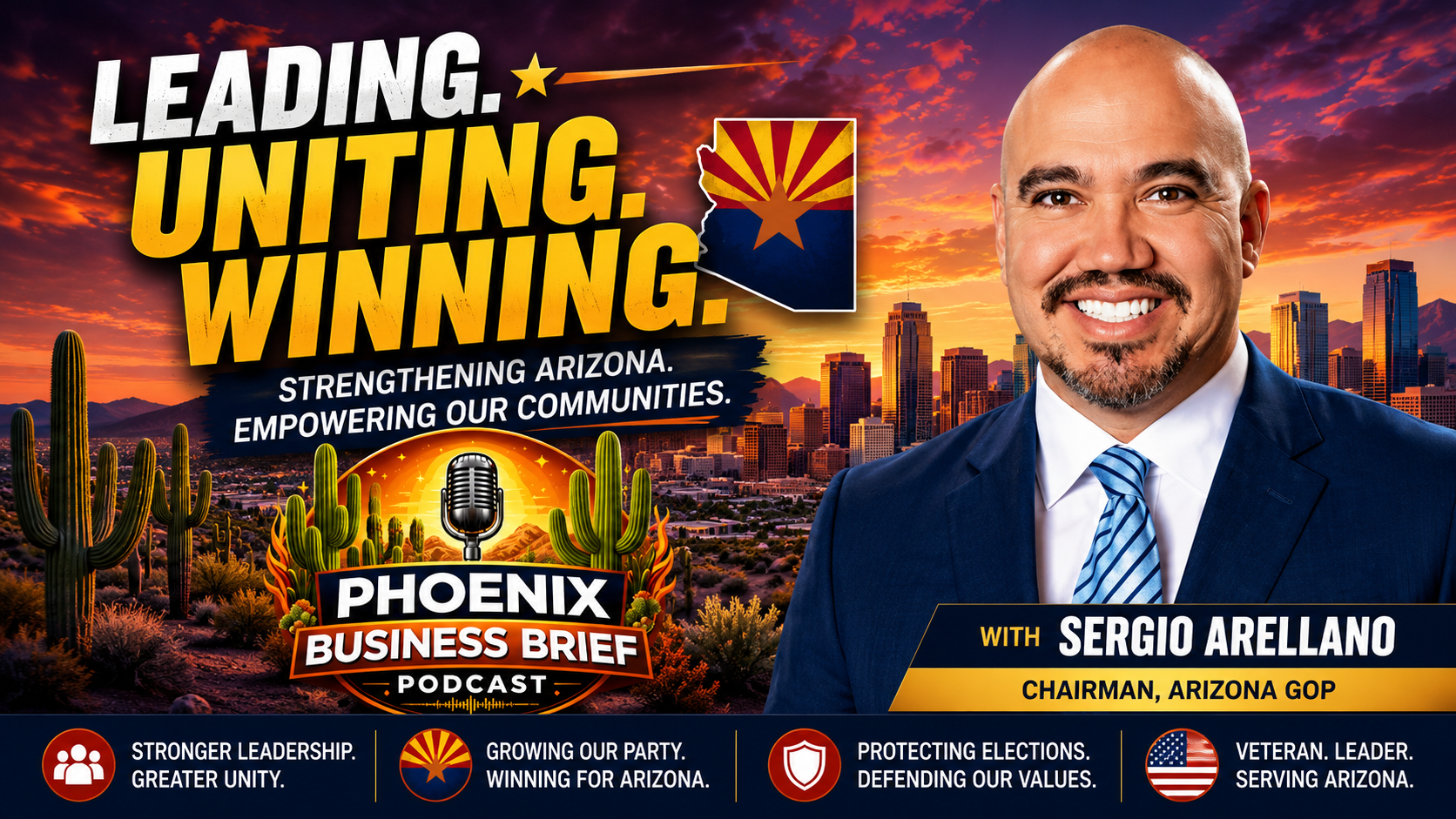
Phoenix Business Brief Podcast logo
← Phoenix Business Brief

The Brief · Arizona Republican Party

Sergio Arellano Discusses the GOP's Future and Economic Policy in Arizona

with Sergio Arellano, Chairman — Arizona Republican Party

Sergio Arellano Discusses the GOP's Future and Economic Policy in Arizona — Sergio Arellano, Arizona Republican Party

Sergio Arellano, Chairman of the Arizona Republican Party, discussed the GOP's future and economic policies in a recent episode of the Phoenix Business Brief podcast. Arellano emphasized the importance of voter registration, election integrity, and addressing affordability issues for Arizonans. He also highlighted the need for better communication within the party and the recruitment of new candidates to strengthen Republican representation in Arizona.

Arizona Republican Party Chair Sergio Arellano on the GOP’s Future and Economic Policy

0:00 / 0:00

Arizona Republican Party Chair Sergio Arellano on the GOP’s Future and Economic Policy

Arizona GOP Chair Sergio Arellano Discusses Party's Future and Economic Policy

PHOENIX (AP) — Sergio Arellano, chairman of the Arizona Republican Party, shared insights about the GOP's future and economic policies during a recent interview on the Phoenix Business Brief podcast. Arellano, a first-generation American from Tucson, Arizona, emphasized the party's commitment to unity and effective communication with voters.

Arellano, who served in the U.S. Army for over a decade, has a background in public service, particularly advocating for veterans. He was appointed as the state director for the Army Wounded Warrior program and has held various leadership roles within the Republican Party. His experience includes serving as a national advisor for Latino issues on Donald Trump’s national advisory board.

In the interview, Arellano outlined his priorities as party chair. He stated that the role involves registering voters, raising funds, and focusing on election integrity. "I wish they knew what we stand for and what our job is," Arellano said, referring to public perception of the GOP.

Arizona's Political Landscape

The political landscape in Arizona has shifted in recent years, leading to questions about whether the state remains solidly Republican. Arellano believes there is significant opportunity for the GOP, citing that Arizona is a center-right state. He noted that the party out-registers Democrats by approximately 300,000 voters.

"Communication is key," Arellano said. He emphasized the need for Republicans to effectively convey their message, particularly to the Latino community, which he believes is open to GOP ideals. Arellano criticized past party leadership for involvement in primaries that he argues has alienated voters.

Voter Concerns and Economic Policies

Affordability emerged as a primary concern among Arizona voters, according to Arellano. He pointed to rising costs of living, including housing and groceries, as issues that keep constituents awake at night. Arellano highlighted efforts by the state legislature to alleviate these burdens, including proposals to eliminate certain taxes.

He expressed frustration with vetoes from the current governor on tax relief measures that he believes would benefit middle-income families. "The everyday Arizonan cares about the same things that you and I do," he said, emphasizing the importance of addressing practical concerns over identity politics.

Arellano also discussed the need for policies that support entrepreneurs and small businesses. He mentioned ongoing efforts to create a favorable environment for business growth in Arizona, including tax reforms that aim to reduce the financial burden on business owners.

Encouraging Political Participation

Arellano acknowledged the challenges of encouraging individuals to run for office. He noted that many potential candidates hesitate due to the difficulties associated with public service. To address this, he advocates for building a strong bench of candidates and keeping them engaged beyond election cycles.

"We do a poor job on the party side in building a bench," Arellano said. He emphasized the importance of mentoring and supporting new leaders within the party to ensure a continuous flow of talent.

Reflecting on his own journey, Arellano spoke about the perseverance required to overcome personal challenges, including his transition from military service to civilian life. He believes that such experiences enable leaders to inspire others to take on difficult tasks.

Conclusion

As the Arizona Republican Party prepares for upcoming elections, Arellano's focus remains on unity, effective communication, and addressing the concerns of everyday Arizonans. His leadership aims to strengthen the party's presence in a state that has seen significant political changes in recent years.

Interview Q&A

Q&A: Arizona Republican Party Chair Sergio Arellano on the GOP’s Future and Economic Policy

Arizona Republican Party Chair Sergio Arellano on the GOP’s Future and Economic Policy

Q: Can you provide a brief overview of your background?

A: I am a first-generation American born and raised in Tucson, Arizona. My parents are from Sonora, Mexico. I joined the Army at 17 and served in the infantry, participating in major conflicts in Iraq. After my military service, I became involved in civic activities, focusing on veterans' issues and eventually leading to my role in the Arizona Republican Party.

Q: What do you wish more people understood about your position as chairman of the Arizona GOP?

A: I wish people understood what we stand for and our priorities. A chairman should focus on not playing in primaries, registering voters, raising money, regaining statewide offices, and ensuring election integrity.

Q: How do you view the current political landscape in Arizona?

A: Arizona is a center-right state with significant opportunities for the GOP. We out-register Democrats by about 300,000 voters. The key is to communicate effectively and target the Latino community, which is open to our message.

Q: What issues are keeping voters in Arizona awake at night?

A: Affordability is a top concern. Many people struggle with housing costs, gas prices, and groceries. The state legislature has attempted to alleviate this burden, but some tax relief measures have been vetoed.

Q: Are there specific policies under consideration that could benefit entrepreneurs in Arizona?

A: Alleviating the tax burden is crucial. Arizona is proposing to conform to federal tax reforms that could help reduce taxes for business owners. We also aim to create a supportive environment for growth and attract new businesses.

Q: What challenges do you see in getting people to run for office?

A: One challenge is the fear of putting oneself out there. The party has not done enough to build a bench of candidates and retain engaged volunteers after election cycles. We need to empower and keep people involved in public service.

Q: How do you plan to encourage participation in the political process?

A: We need to actively recruit and mentor individuals interested in public service. This includes engaging them in local commissions and providing opportunities for growth within the party.

Q: How has your military experience shaped your approach to leadership?

A: My military service instilled discipline and perseverance. Having faced hardships, I understand the importance of resilience, which I apply to my political work and leadership style.

Q: What role does communication play in your strategy for the GOP?

A: Effective communication is essential. We need to convey our message clearly and ensure it reaches the voters. This includes addressing misconceptions and presenting our platform positively.

Q: How do you perceive the current state of the Democratic Party in Arizona?

A: The Democratic Party is currently facing internal discord and funding issues. They lack a cohesive identity, which presents an opportunity for us to capitalize on our strengths and promote our candidates.

Q: What are your thoughts on the importance of grassroots efforts?

A: Grassroots efforts are vital for building a strong party. We need to elevate local candidates and issues that resonate with everyday Arizonans to foster a sense of community and support.

Q: How do you see the future of the GOP in Arizona?

A: The future is promising if we focus on unity and effective communication. By addressing the needs of our constituents and promoting our platform, we can strengthen our position in Arizona and achieve electoral success.

Q: What message do you want to convey to potential voters?

A: I want voters to know that we are committed to addressing their concerns and providing practical solutions. We are focused on creating a better future for all Arizonans through responsible governance and community engagement.

Key takeaways

  • I think people are tired of division and infighting, and the focus is on the bigger prize, and that is winning.
  • We out-register the Democrats by quite a bit. I think it's 300,000 registered voters.
  • Affordability is one of the top things on our minds.
  • The worst feeling in the world is to get paid time and a half, and then that time and a half is actually full-time because of all the taxes that come out.
  • I think that we've done a poor job on the party side in building a bench and recruiting and holding onto those hard workers.

About the guest

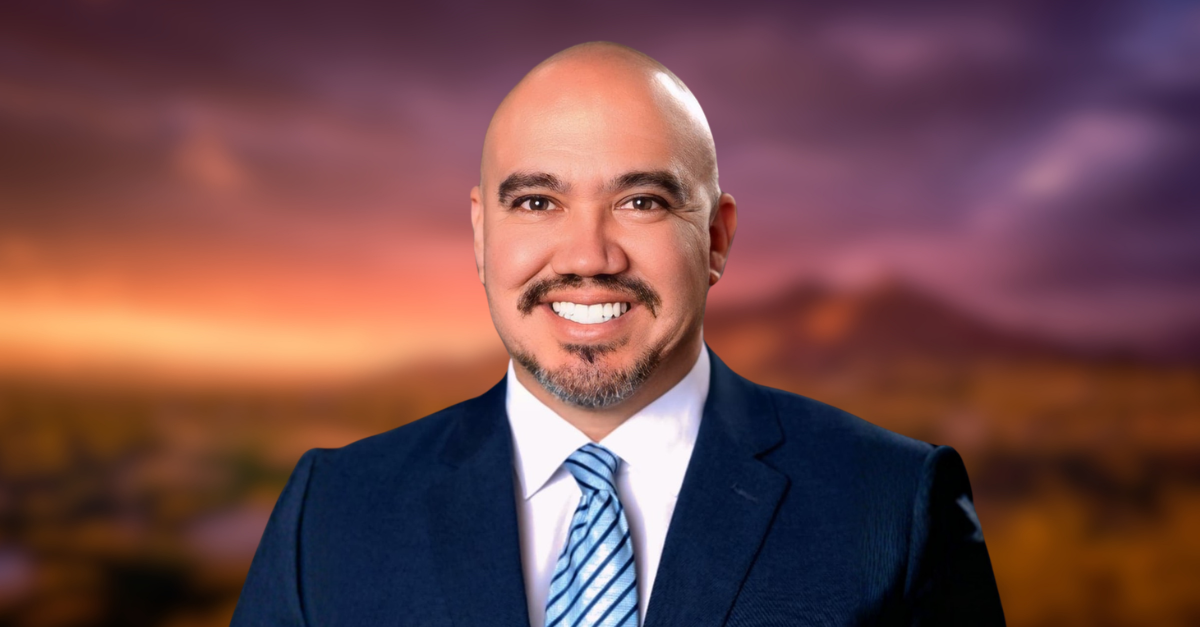
Sergio Arellano

ChairmanArizona Republican Party

Full transcript

Show full transcript
[00:00:00] Welcome to the Phoenix Business Brief. I'm Brian Hyde. Today, I'm joined by Sergio Arellano. And, uh, thank you so much for joining us. I, I'm gonna introduce him as the, uh, chairman of the Arizona GOP, but Sergio, that doesn't begin to scratch the surface of who you are as a person. Take a moment, if you would, and just kinda give us a synopsis of, uh, of who you are and what you do. Yeah. Uh, well, thank you for having me, Brian. It's really an honor to be on this, you know, broadcast. It's... Uh, I think it's very important that mediums like yours, uh, allow us to be on and share our points of views and our platforms and our history. I'll go pretty quickly into my background. I'm a first-generation American. I was born and raised in Tucson, Arizona. Uh, my parents are from Sonora, Mexico, so I do have a Mexican heritage. And, um, you know, went to high school, decided to join the Army when I was 17. I [00:01:00] joined April 4th of 2001. I ended up joining the infantry, and when I came back to all my friends back in the neighborhood after I signed up and enlisted, I told them I joined the infantry, and they looked at me like I had, like, three sets of eyes or something. And, uh, they said, "Well, Sergio, you know, uh, the infantry goes to war." And, you know, all I was told was I was gonna get to play with guns legally, right? So you take a 17-year-old kid, and you tell him he's gonna play with guns and make college money. So I called the recruiter. Recruiter said, "Oh, yeah, uh, they do go to war, but nothing's happened since Desert Storm, so we don't anticipate anything else happening." Uh, and then fast-forward September 2001, Twin Towers get hit, and I find myself boots on the ground. We had just secured Baghdad September of 2003, and my unit ended up Black Hawking in in the dead of night, kind of like the movies. Uh, got into Ramadi, [00:02:00] Iraq, under the cover of night, and we were stationed in Ramadi. And the First Infantry Division, which is the unit I was with, we participated in all those major conflicts: the fight for Fallujah- Habbaniyah, Al Asad. Uh, but we were stationed in Ramadi. And so from there, uh, I was involved in a lot of conflicts as an infantryman and involved in an IED blast, which therefore ended up, uh, cutting my career short after 10 and a half years in the Army. I, uh, ETS'd out of Sierra Vista, Fort Huachuca, and then got to work in being very active civically. And, uh, my passion has always been veterans. I got involved very early on in helping homeless vets, and rose the ranks, and was even the state director for the Army Wounded Warrior program. That's where I got a love and a passion for public service, and I got involved right after Gabrielle Giffords was shot down in southern Arizona. Ended up helping a fighter pilot woman named [00:03:00] Martha McSally. Uh, and, you know, my network opened up and I became more involved. And as I got more involved, I realized that, uh, we had a big communications problem and the ability to really share, uh, what we stand for as conservatives, as Republicans, with other Latinos. And so the career was wide open. I ended up serving in great roles as district chair and county chair, vice chair. Uh, worked for, uh, Donald Trump. I was his national advisor for Latino issues on his national advisory board. There was 22 of us around the nation, and, you know, I, I like to really broadcast that it's not about an individual as much as it is a party and our platform. So here we are today. I ran on a coalition, uh, to bring unity to the party, given all the division and infighting, and I think people are tired of it. And, uh, the focus is on the bigger prize, and that is winning, and [00:04:00] I feel we need to bring back a little bit more Republican representation to this state. So my job is to help lead that effort. I wanna lead by example and, uh, you know, adhere to the rules and the campaign platform that I promised everybody I would run on and stick to that. Hopefully we'll be victorious here in November. Sergio, I have to ask, I mean, I know you condensed a lot of life history into a very short time here, but, um, what do you wish more people understood about the position you hold as chairman of the Arizona GOP? You know, I think it's not as much, uh, what people should understand about the position as much as it is What the leader stands for and, and what he's looking to implement. Uh, I think that a chairman has a few priorities that they should focus on. Number one, don't play in primaries. Number two, register voters. Three, raise money. And four, you know, regain [00:05:00] our, our sta- statewides that we missed, and then retain our majority in the House and Senate legislature, and also be a hawk for election integrity. You know, whether you feel the elections were stolen or not, um, we can all agree that there were abnormalities in how the elections were conducted, and just be more hawkish and a presence there. So I think, uh, to answer your question is, I wish they knew what we stand for and what our job is, and not what the, uh, legacy or more liberal media would say about us. There's more to us than just rhetoric and extremism that you hear on TV. No, that's, that's a great answer. And it- the reason I ask is because, um, Arizona, um, i- in some people's minds you think, "Arizona, oh, yes, that's a solid red state." But there, there have been some times here, especially in the last few years, where is it red? Is it, is [00:06:00] it purple? Is it in danger of flipping blue? And I'd, I would just love to get your take on, um, where does it stand right now? Um, d- does the GOP have a good, solid position in, in Arizona? Or is there good opportunity for the party? I believe there's a huge opportunity. If you look at Arizona as a whole, we're a center-right state. If we get the right type of candidate that runs messages well and really has the best interests of the residents in mind, you know, they're more apt to get voted in. You know, uh, in the past, unfortunately, a lot of the leadership on the party side has really delved into primaries and trying to tip the scales for one candidate or another, and it leaves a bad taste in people's mouths, right? It's you're being unfair with the way you sway your effort, your grassroots. Um, secondly, we out-register the Democrats by quite a bit. [00:07:00] Um, I think it's 300,000 registered voters. What it comes down to, I think, is really taking that aspect of communication and disseminating the message. One of the critiques that we all get as Republicans is that we're not as good at communications, and that's one of my strong points, and so I look to implement that on a statewide basis. Also target the Latino community more because they're more open. They're not monolithic. I think we've proven that time and time again. And, uh, make sure that our message gets out there and doesn't get drowned out. So it's gonna take a really, uh, concerted effort and unity on behalf of all of us. And then it also takes the discipline to go out And advocate for the people wanting to represent you. We have the pulpit as a state party to promote and lift up our people, and I feel we haven't done that. So there are a lot of congressional races, a lot of district races, even little school board races that I feel should [00:08:00] be elevated and noticed because they're the ones that are really wanting to make a difference. And so my philosophy is every Republican that's running that's adhering to our platform should be lifted and promoted. And I think the more people hear from them, they'll realize that not only are we the right choice with our platform, but the other side doesn't have an identity right now. They don't know whether they want boys in girls' bathrooms. They don't know what they wanna do to kids in order to ch- change their orientation, uh, to adapt. Uh, they wanna eliminate the school choice program, which in a lot of areas, like the one I grew up in, South Tucson, I didn't have a choice in which school I went to, so I was stuck under a failing school district with unhappy teachers, and my parents couldn't afford to send me to a better school district. And what we're seeing right now is Arizona and the legislature and its electeds are making it so that we [00:09:00] have more options. And this current other side, uh, they're vetoing everything that actually alleviates the everyday Arizonan, uh, the burden on the everyday Arizonan. So I think we are poised to really capitalize on our pluralities, plus the fact that they're in discord right now. They have no funding. They're arguing, they're infighting, and now they're playing in primaries while we're disciplined, working hard, registering voters, raising money. And we're gonna put boots to the ground and, uh, really focus and laser-focus on getting that mission done, and that's winning. You know, you mentioned earlier, it's... There's a bit of an uphill battle, uh, fighting the, the media narrative, and it seems like the media really thrives on, "Oh, let's keep the conflict going and let's make sure that, you know, there's, there's plenty of drama going on." But there are issues that I'm sure cut through whatever narrative is, is being promoted by the mainstream media. Talk to me about what you are hearing from constituents or, or voters [00:10:00] in your state, you know, regarding what are the things that are keeping them awake at night? Affordability, Brian. It is one of the top things on our minds. Look, as an entrepreneur, business owner- I do okay with my lifestyle, but even me as a millennial with a full family, I can't upgrade homes. I have to wait till the house, you know, till it's affordable. Um, gas, right? Unaffordable groceries. And so that's at the top of mind, y- you know, the affordability. I like to point to the legislature here in Arizona that has put together a budget bill and has put together a lot of legislation where we're trying to alleviate that burden from families. Currently, they've sent no, you know, uh, no gas tax, w- was vetoed by the governor. They've sent no tax on tips, vetoed by the governor. No tax on overtime, vetoed by the governor. And so [00:11:00] these are things where are the middle income, the working class, they rely on that. Uh, what's... The worst feeling in the world is to get paid time and a half, and then that time and a half is actually full-time because of all the taxes that come out. So I like to point to the common sense reforms that we're trying to do, and that is one of the... I think one of the more priority things here. As business owners and as entrepreneurs, we're also suffering. So, um, the fact that we're working hard, we have to highlight that. Public safety, school choice, these are all issues that matter to the Republicans here in Arizona that are really trying to fight to keep that in place. And I think the everyday Arizonan, the everyday average citizen here, you talk to them, and they care about the same things that you and I do. Um, they don't really care as much about identity politics as they used to in the past. You had mentioned a, a couple of times, you know, entrepreneurs and business owners. Um, are there any [00:12:00] policies that are currently under consideration in Arizona that, uh, that you feel would be, you know, helpful to those who, who are in business or, um, who, who want to become entrepreneurs? Alleviating the tax burden is at the top of all of us. As a business owner, I've signed the front of the checks, not the back, and, uh, you know, there's a huge tax liability on the money we're making. I think what's being put forth, uh, from Trump's big, beautiful bill, uh, once it gets implemented, right, I think it's gonna be... Uh, Arizona, by the way, in their budget, they're proposing for us to be the first state in the entire nation to conform to that big, beautiful bill. Um, and by doing so, we can help bring a lot of... You know, alleviate a lot of the burden and the taxes on the business owner, but we're also trying to promote an environment for growth, where we're trying to stimulate and bring in organizations, companies, corporations to [00:13:00] invest, reinvest. And then we're also working to create a workforce around those types of businesses that wanna come in. We have to have more incubators im- implemented into our cities and our municipalities, and this party is aware of what it has to do. So the more that we broadcast that and put it forward, I think we'll be able to see more help. Uh, and of course, a thriving economy means thriving small businesses. And once we alleviate the burden and we bring the consumer, um, the consumer... What's it called? Um Confidence? Confidence, yes. My apologies. I'm, I'm in Latino mode still from another interview. Um, once consumer confidence comes back, then we all start opening our wallets and spending. But one of my businesses is, you know, we do jewelry. That's a luxury, and right now it's tough for people to really reach in and, and spend on luxurious items. So we really gotta work [00:14:00] together. I think Arizona is very poised to lead us into that next step for growth and for prosperity. We just need to have elected a governor, uh, that's willing to work with this legislature, and right now we're not seeing it. Talk to me about, uh, people participating in the political process, and I'm not necessarily just talking voters. Um, when it comes to getting people to step up and run for office, i- is- is that hard to do, or th- do people have reservations about, uh, you know, becoming a part of, of, uh, you know, public service? And, and if so, what, what are you doing to, to encourage them to, you know, to step up? I think one of the most difficult things is to actually put yourself out there and run for office. I have ran in the past. I've ran for Congress in a district that was unwinnable for Republicans. I've also ran for school board and been a, a school board member. Um, I think that we've done a poor job on the party side in building a bench and recruiting [00:15:00] and holding onto those hard workers. Um, the most frustrating thing to me as a grassroots guy, but also as a, as a volunteer and as a leader, is watching great talent come through on election years, and volunteer, and call, and get involved. And then the cycle ends, and then we say, "All right, thank you. Bye." Right? And then they're left like, "Well, what the heck do I do now?" And so to remedy that, I- I'm a big believer in backfilling, and recruiting, and building a bench. I've done it in the past. I've done it with, uh, some attorneys. And there's a guy that's running for secretary of state here who I brought on, uh, very early as he was leaving law school. I started an election integrity committee in Southern Arizona, brought him on. He didn't know anything about it, but got to learn from experts. Won his case, uh, against a municipality, a county, and then moved [00:16:00] on and, uh, I introduced him to, like, the party leaders. They brought him in, the GOP attorney taught him, and then he eventually became the GOP attorney, went on to be a legislator. Now he's running for secretary of state, and it's just empowering keeping those people engaged once you're involved. And, and, and I will tell you, Brian, we do a poor job about it because there are a lot of electeds in municipalities and city councils, board of supervisors, corporation commission, water districts, school districts, whatever, where there are positions for us to continue putting people to be involved. Whether it's, uh, the Parks and Recreation Commission or the Planning and Zoning Commission, they all have that, and I think that our remedy is to push that forward. Well, you, uh... your- your life story is one of, of perseverance and, you know, um, sticking through it even wh- when it's tough. I mean, you mentioned your military service and coming back from, uh, you know, [00:17:00] combat injuries and so forth, and it sounds like those same principles apply to, uh, to getting things done politically as well. Yeah. Um, it's a lot of perseverance, Brian. I faced a lot of hardships when I was growing up and, uh, you know, the military got me out of- The neighborhood that I grew up in. And, but, and it instilled some discipline. And with that came some issues. Obviously, the war in Iraq brought me, uh, back as a different person. I was one of the first returning combat veterans in '06. So I was there from '03 to '05 in combat. '06, I'm back here, civilian world, and I'm just struggling to adapt. And so I think that, um, s- having gone through homelessness, having gone through the hardships and not knowing what's out there, has really shaped, uh, my ability to persevere and move forward. But God has always been there, good mentors in my life [00:18:00] that have looked out even when I wasn't looking, right? And it's allowed me to really grow and come into a position where I can chase my dreams, achieve that American dream, and eventually represent the party as its leader, as the first Latino elected as chairman for the State of Arizona. Is it easier to ask people to do hard things when you've done hard things yourself? Actually, it's harder. Fair enough. But that's why I say we lead by example. Again, we are talking with Sergio Arellano. He is the chairman of the Arizona Republican Party, and thank you so much for joining us today on the Phoenix Business Brief Podcast. Thank you, sir.

Filed under

Related episodes