Phoenix Business Brief Podcast logo
← Phoenix Business Brief

2026-06-03 · EOS Worldwide

Unlock Business Success: Rick Benton on EOS Implementation for Entrepreneurs

with Rick Benton, Professional EOS Implementer — EOS Worldwide
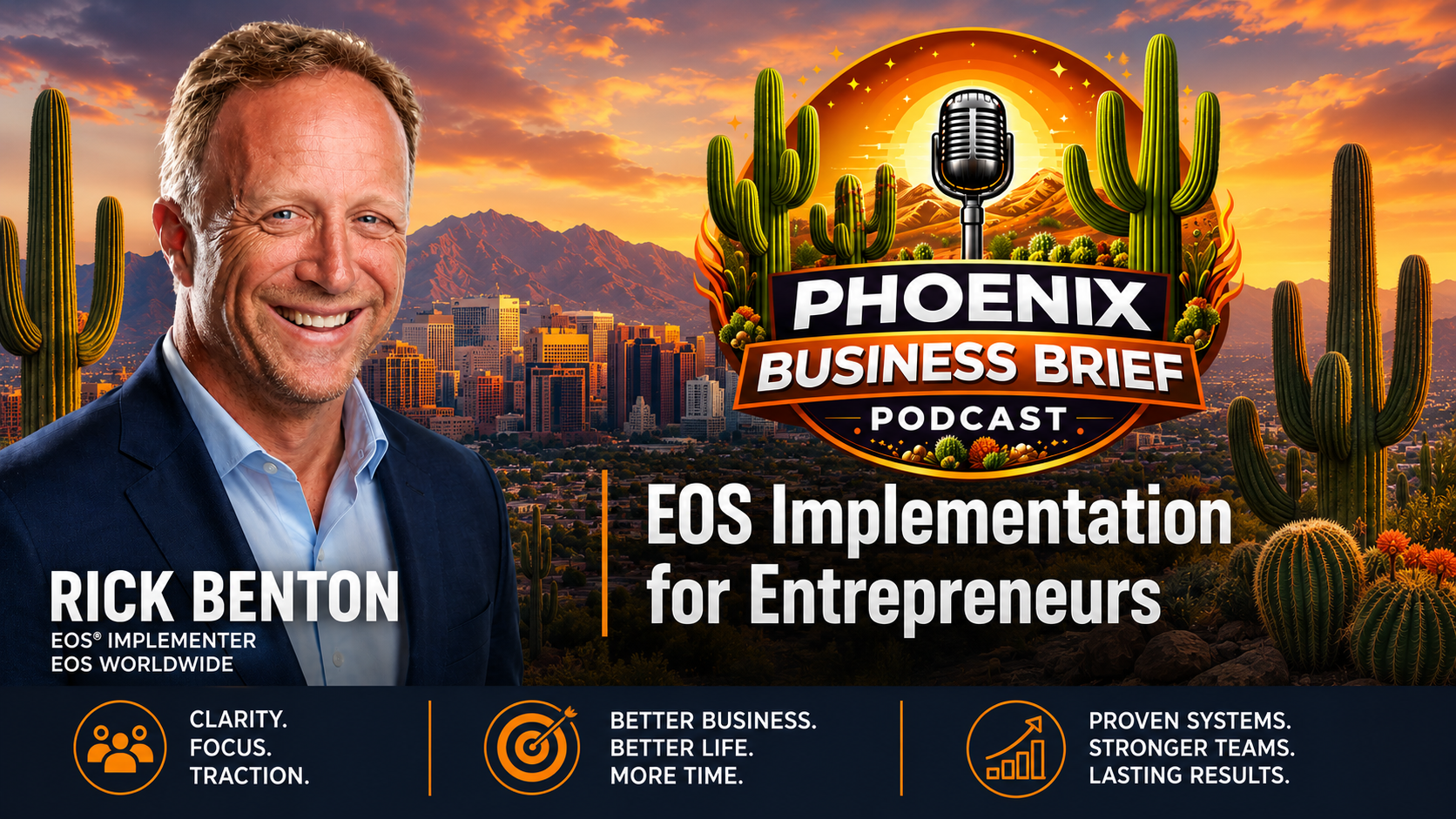
Phoenix Business Brief Podcast episode featuring Rick Benton discussing Unlock Business Success: Rick Benton on EOS Implementation for Entrepreneurs

In the Phoenix Business Brief podcast episode, Rick Benton, a Professional EOS Implementer at EOS Worldwide, discusses the Entrepreneur Operating System (EOS) and its benefits for entrepreneurs. Benton shares insights from his own entrepreneurial journey, emphasizing the importance of accountability, structure, and effective leadership in overcoming business challenges. He also highlights the core components of EOS, which include vision, traction, and healthy team dynamics, aimed at helping businesses achieve their goals.

Phoenix-Based Professional EOS Implementer Rick Benton Discusses EOS Implementation for Entrepreneurs

0:00 / 0:00

Phoenix-Based Professional EOS Implementer Rick Benton Discusses EOS Implementation for Entrepreneurs

Rick Benton Discusses EOS Implementation for Entrepreneurs

Phoenix-based Rick Benton, a Professional EOS Implementer at EOS Worldwide, shared insights on the Entrepreneurial Operating System (EOS) during a recent episode of the Phoenix Business Brief podcast. Benton, who helps entrepreneurs and leadership teams implement the EOS framework, emphasized its potential to improve business operations and personal well-being.

Benton's journey into EOS began after he sold his own business, a multi-state event planning company. Reflecting on his past experiences, he noted, "I could have run a better business and lived a better life." His transition to EOS was motivated by a desire to assist other entrepreneurs in avoiding the challenges he faced.

Starting his entrepreneurial career in high school, Benton co-founded a DJ company that eventually expanded into a larger event planning business. He described the intense demands of managing operations, logistics, and personnel, saying, "It is eight days a week, 365 days a year." After selling his business in 2018, he encountered various successes and failures before discovering EOS.

Benton explained that EOS is not just about managing stress but about creating a structured environment that helps leaders navigate challenges. He stated, "If you have goals and things that you want to achieve, you're gonna have issues." He emphasized that issues are a natural part of growth and that addressing them is crucial for success.

The EOS framework focuses on three key components: vision, traction, and healthy leadership. "Vision means getting crystal clear with where you're going and how you're going to get there," Benton said. He stressed the importance of ensuring that all team members understand and engage with the company's vision.

Traction refers to the execution of that vision, ensuring that everyone is accountable for their roles in achieving it. Benton highlighted the need for a cohesive leadership team that can communicate openly and honestly, stating, "As goes the leadership team, so goes the rest of the company."

Benton acknowledged that many challenges faced by leadership teams stem from people issues. He emphasized the importance of having the right people in the right positions, saying, "You gotta have both." He outlined a method for evaluating team members based on whether they "get it," "want it," and have the "capacity" to fulfill their roles.

Uncertainty is another significant challenge for entrepreneurs today. Benton noted that leaders must focus on what they can control, particularly in a climate of unpredictability. "What can we control? Well, break it down," he advised. He encouraged entrepreneurs to identify leading indicators that can help stabilize their businesses.

For those new to EOS or looking to implement its principles, Benton recommended several resources. He pointed to the Entrepreneurial Leap Academy, designed for businesses with fewer than ten employees, as a starting point. He also suggested reading "Traction" by Gino Wickman, which outlines the EOS framework.

Benton concluded by inviting entrepreneurs to reach out to him or other EOS professionals for guidance. "If there's anything that we love, it's talking about EOS and how it truly helps you live a better life," he said.

The EOS framework offers a comprehensive approach for entrepreneurs seeking to enhance their business operations while maintaining a healthy work-life balance. By focusing on accountability, structure, and clear vision, Benton believes that leaders can navigate challenges more effectively and achieve greater success.

Interview Q&A

Q&A: Phoenix-Based Professional EOS Implementer Rick Benton Discusses EOS Implementation for Entrepreneurs

Phoenix Business Brief: Rick Benton on EOS Implementation for Entrepreneurs

Q: What is your background and what do you do?
A: I am an EOS implementer, which means I help entrepreneurs and their leadership teams implement a proven system that helps them run a better business, live a better life, and reclaim their time. I came to this after selling my business and realizing I could have run it better with EOS.

Q: How did you start your entrepreneurial journey?
A: My entrepreneurial journey began in high school when a friend and I started a DJ company. Over the years, it grew into a multi-state business, managing various events and operations, which eventually became overwhelming.

Q: What challenges did you face while running your business?
A: I faced numerous challenges, including managing operations, quality control, logistics, and payroll. It became chaotic, and I often felt like I was losing control.

Q: What is the Entrepreneurial Operating System (EOS)?
A: EOS is a holistic system designed to help businesses execute their vision effectively. It focuses on three main components: vision, traction, and healthy leadership teams.

Q: Can you explain the three components of EOS?
A: Vision involves getting clear on where the business is going. Traction ensures that everyone on the team is aligned and accountable for achieving that vision. Healthy leadership means fostering open communication and trust within the team.

Q: What are some common frustrations leadership teams face?
A: One major frustration is creating a culture that encourages identifying and addressing issues. Many teams struggle with people issues, such as having the right people in the right roles.

Q: How do you define the "right people" and "right seats"?
A: The "right people" are those who align with the company’s core values and culture. The "right seats" refer to ensuring that individuals are in roles that energize them and match their skills.

Q: How should entrepreneurs handle uncertainty in their businesses?
A: Entrepreneurs should focus on what they can control. This includes identifying leading indicators in their business operations and making proactive decisions based on those metrics.

Q: What resources are available for entrepreneurs interested in EOS?
A: Entrepreneurs can explore the EOS ecosystem, which is designed for businesses with 10 to 250 employees. For those with fewer than 10 employees, the eLEAP Academy offers resources for startups.

Q: What is the best way to start learning about EOS?
A: A good starting point is to read the book "Traction" by Gino Wickman. The first 10 pages include a quiz that helps assess how a business is running.

Q: How can entrepreneurs reach out for more information about EOS?
A: Entrepreneurs can contact me or any EOS colleagues. We are always eager to discuss how EOS can help businesses thrive.

Q: What is the significance of accountability and structure in entrepreneurship?
A: Accountability and structure are crucial for overcoming bottlenecks in business growth. They help leaders break through ceilings and enable teams to execute their vision effectively.

Q: How does leadership impact uncertainty in a business?
A: Steady leadership can mitigate uncertainty by establishing clear policies and controls. When leaders provide direction, it allows teams to focus on what they can influence in their operations.

Q: What is the importance of a healthy leadership team?
A: A healthy leadership team fosters trust and open communication, which is essential for addressing issues and ensuring the entire organization is aligned toward achieving its vision.

Key takeaways

  • I help entrepreneurs and their leadership teams implement a proven system that helps them run a better business, live a better life, and quite honestly, reclaim their time.
  • I could have avoided so much stress and heartache and broken glass that I see now I was the bottleneck.
  • If you don't want any issues, then guess what? You're happy and you're content to just coast.
  • Having the right people for your organization, for your culture, that's what we mean by right people.
  • The more leading indicators that you can control, that you can identify, that you can measure every week, the more stable your business is gonna be.

About the guest

rick-benton-eos-phoenix

Rick Benton

Professional EOS ImplementerEOS Worldwide

Rick Benton is an EOS Implementer with EOS Worldwide who works with entrepreneurs and leadership teams to help them build more disciplined, accountable, and scalable businesses through the Entrepreneurial Operating System, known as EOS. He focuses on helping business owners gain clarity, improve execution, strengthen leadership teams, and create healthier organizational cultures. Benton’s entrepreneurial background began in high school when he co-founded a DJ and event production company that eventually expanded into a multi-state operation serving corporate events, weddings, school functions, and large-scale productions. Over the course of several decades, he managed the operational, staffing, logistics, and growth challenges that come with scaling an entrepreneurial business. After selling his company in 2018, Benton discovered EOS while working with a company already implementing the system. He has said reading the book “Traction” by EOS founder Gino Wickman helped him recognize how structure, accountability, and defined systems could have reduced stress and improved the long-term value of his business. That experience ultimately led him to become an EOS Implementer focused on helping other entrepreneurs avoid similar operational bottlenecks and leadership challenges. During an interview on the Phoenix Business Brief Podcast, Benton said EOS helps entrepreneurs “run a better business, live a better life, and quite honestly, reclaim their time.” He also emphasized the importance of identifying issues early, building accountability within teams, and ensuring organizations have “the right people in the right seats.”

Full transcript

Show full transcript
[00:00:00] Welcome to the Phoenix Business Brief podcast. I'm Brian Hyde. Today I'm joined by Rick Benton. Rick is with EOS Worldwide. That stands for Entrepreneur Operating System, and Rick is a, uh, an implementer as well as a few other things. Now, we're gonna use the term EOS as we refer to this, but Rick, first of all, welcome to the podcast, and let's learn a little bit about you. Tell us about, uh, your background, who you are, and what you do. Well, thank you for having me here. Um, I am an EOS implementer, which means I help entrepreneurs and their leadership teams implement a proven system, a holistic, proven system that helps them run a better business, live a better life, and quite honestly, reclaim their time. Um, I got into this through a series, a series of adventures and misadventures. But, um- Came, came to it almost backwards. Um, found it after I sold [00:01:00] my, uh, sold my business and, uh, wish, wish I had this way of running my business. I c- I could have run a better business and lived a better life, that's for sure. Um- Well, the beauty here is you, you have walked a path that, uh, that other entrepreneurs are just beginning on, and I would guess by your experience, uh, you've seen what works, you've seen what doesn't work, and now they get to benefit from all of your experience. I've, I've seen a lot. I think we- w- anybody who goes down this path, they see a lot more of what doesn't work before they see what works. Um, so my entrepreneurial journey started when I was in high school. A friend and I started a DJ company. Um, I, we, I was... We were committed to this vision of creating concert-like experiences for w- whoever would book us. Homecomings, proms, uh, birthday parties, bar mitzvahs, graduations, eventually weddings and larger events as we went on. And I'll say to you and to anybody [00:02:00] else, any other Gen X'ers out there, were there any better concerts than those of the late '80s- ... early '90s? I mean, that was just- Not a chance. Not a chance at all. So fast-forward a couple decades and the business is multi-state, and we are working corporate events during the week, audiovisual planning, production, coordinating between all the different vendors and room blocks and everything like that, as well as on the weekends I'm still sending DJs to bar mitzvahs and high school dances. It is eight days a week, 365 days a year, and you can imagine the levers I'm pulling between just managing, managing office admin and, and labor on top of entertainers, which are their own unique, unique characters. And the usual business operations, quality control, logistics, depreciation, equipment, technology, warehousing, the whole gambit, on top of trying to pay the rent and make payroll. It is driving me [00:03:00] crazy. I'm losing control, going mad, and I love it. In 2018, somebody decided, decided that they loved it more, so I took the exit, and since then had a string of mild successes and some utter train wrecks. And everyone knows we learn a lot more from train wrecks than we do from successes. And I found myself working for a company that was running their business a particular way, a very systematic, routined, disciplined, focused way, and I was like, "Oh, my gosh. What is this?" "Well, it's EOS." "Well, what is that?" "That's, that's the book Traction." "Oh, I have a copy of Traction sitting right over here on my desk. It's been here for 10 years." Did I ever read it? No. Flicked through it, and was just like, "Oh, my gosh." I could have avoided so much stress and heartache and broken glass that I see now I was the bottleneck. [00:04:00] I was the one bringing it. It was my fault. I am the problem. I could have ended up selling my business for another zero. And I kind of knew at that point I have to help other entrepreneurs avoid that same stress, run a better business, live a better life, and maybe help them sell their business for another zero as well. And ever since then, since I made that switch, um, I found something I love doing even more than the multiple decades I spent in the events industry. So when we talk about EOS, I, I, I first want to address, um, maybe, maybe it's just kind of a myth or it's just, it's one of those, uh, things out there. When I think of entrepreneurs, I think, boy, if you wanna be an entrepreneur, you better be well-acquainted with stress, or you better accept that stress is going to be a part of your life because, uh, being an entrepreneur means you, you don't work the 40-hour week. You work as long as it takes. Now, does it have to be stressful like that? Is... I guess what I'm asking is did you [00:05:00] find a, a better way than, than simply you've just gotta grind? Um, there's a couple things you mentioned there. So first, I don't think that there's anything that you're going to be doing that isn't stressful, that is... doesn't have a challenge, that doesn't have... I- and having issues, having challenges, having issues as, as we will call them and identify them, issues simply means you have goals. If you don't want any, if you don't have any goals, then guess what? You're happy and you're g- content to just coast. Hmm. You know, sit on the raft, be in the pool. You're fine. But if you have goals and things that you want to achieve, you're gonna have issues, because an issue is only the distance between the ideal state and the current state. So how do we bridge that? And bridging that is gonna take some work. It's gonna take some effort. It's gonna change things the way, change the way we- we're doing things to improve, and that's just a constant part of life. We are, I, I... different f- [00:06:00] different philosophy, but we are human becomings, not human beings. And I heard that, I don't know if it was sapiens or, or something like that, but I... it always stuck with me. We are on this path of constant evolution. So, so that, that's kind of what we're drawn towards, at least I- most of the people I meet. So we're gonna have some sort of challenges and stresses and things, and if we're, and if we don't, then we're not reaching high enough. Secondly, that, that it doesn't have to be debilitating, but there is going to be challenges when you are the leader. Lead- leadership is lonely. You are going to be... You're gonna have to make the call. You're gonna have to make a decision. And I remember a, a politician once said, "Look, being, being elected means half the people are gonna hate you." That's just, that's just it. Being in leadership means half the people are not going to like you, but you're gonna [00:07:00] have to make that call, and you can't lead by consensus. That just doesn't work. Eventually, you have to make the call. It's lonely, and sometimes it's not gonna work out The last thing is that entrepreneurs generally start their business because we hate accountability and we hate structure. I did. I didn't wanna work for anybody. I didn't wanna be accountable to anybody. I just wanted to go out there and do what I wanted to do. You reach a point, you grow, you, you, you have successes. You're, you're, you're building, building your company on just sheer will and duct tape, and, and as, and sometimes hopium, as we like to call it. And, and you get to a point where, where suddenly you hit the ceiling. That's as far as you can go. This is me- your... Whether it's your finances, your experience, your abilities, the people, whatever it is, there's a bottleneck that you reach the ceiling, and the only thing that's gonna allow you to break through [00:08:00] is accountability and structure. And that is what EOS brings, is accountability and structure to a clear, unified vision of where we wanna go. So let's talk about some of the pillars of, of EOS as to- Sure ... uh, what, what is it that, that this system is, is built upon? So w- EOS brings... It, it... Like I mentioned, it's a holistic system. It is a complete system for how to run your business. It's about execution. It, it's not designed to... We assume you're in the right market with the right product for the right client. If, if you're not, this isn't gonna help you. You gotta, you gotta find that first. But this system is about how you execute, and, and it, it allows teams to achieve three things that we call vision, traction, and healthy. Now, vision, vision simply means [00:09:00] getting crystal clear with where you're going and how you're going to get there. As if you don't know where you're going, you know, the team's gonna end up somewhere else, and that's never where you want it to be. Traction means that once we get that vision out of the visionary's head, down on paper, it is clearly mapped out where we're going, how we're gonna get there. Now we wanna make sure that everybody on the team is engaged with that vision, accountable, disciplined to that vision. They know what their part is in helping the company achieve it. They become masters of execution towards that vision. Everybody on your team, all 10, 50, 250,000 people, unified, focused all that human energy towards achieving that vision And healthy means that I work with the leadership team to make sure that they are open, honest, vulnerable with each other. They're cohesive. They, they can say what needs to be said without the fear [00:10:00] of politics or retribution or, or, or just shaming inside. It's, we can say it, it needs to be said, and we have healthy conflict that builds trust instead of erodes it. 'Cause as goes the leadership team, so goes the rest of the company. And pretty soon, all those people on that team focused in the same direction, accountable to the same vision, moving in the same direction, same lockstep beat, North Star, all the cliches you can think of, everybody focused, the, the chance that that team's actually going to achieve that vision just goes up exponentially. I love that you point out- That- ... that, that issues are part of the process. It, it's not like there's, there's a way that you can do this without ever encountering them. Um, tell me about- Oh, yeah ... some of the frustrations that, that these leadership teams are likely to encounter. Well, the first one is actually having a culture that recognizes that it, that discovering issues, flushing them out, bringing them to the table is [00:11:00] the first step of growth. Because, you know, uh, you, if you can't identify the problem, you can't solve it. And hiding behind... I mean, when w- when was the last time... Uh, any time you ask an entrepreneur, "How's business?" What are they gonna say? "Business is great." They, uh, uh, uh... No, business is challenging. Business is, business has issues. We're trying, we're growing. We want to grow. We want to achieve the bigger, better things than we did last year. We want to impact more people. We want to deliver more, more products or more services and help solve other people's problems. I mean, a business that doesn't offer value doesn't deserve to exist. And so- So the challenge is, is first that culture. Let's bring up the issues. Let's, let's say, "Hey, we got an issue here, s- and now we can solve it." Now, that said, most of the issues that end up on the table, I think 80 per- 80-plus percent of them are all gonna be people issues. [00:12:00] Having the right people in the right seats, you gotta have both. And, and by that, what do we mean? We mean the right people for our organization. How many times has your favorite sports team gone out, spent a quarter of a billion dollars on some MVP? They come on over, we have all the expectations in the world, and then they're... they kind of fall flat. Or flip it around, we have a number one draft pick. They're supposed to be amazing. They kind of falter with our organization, so we finally make a trade, and suddenly they're superstars, and they win a championship. Having the right people for your organization, for your culture, that's what we mean by right people. People we love working with, people we get along with. They see and live the same values that, that our team does. Same core values. And the second piece is the right seat, making sure that these people are s- are doing the w- the things that give them energy every day. We've all done [00:13:00] tasks that, that just naturally align to what we love to do, and we've been in situations where we have to trudge our way through the mud, and it's draining, and we go home exhausted. So how do we make it so most of the people live their day-to-day life working in things that give them energy most of the time? That's in their unique seat of genius. Well, you have to define what the roles are for each seat. First, we have to know what the seat is, and then we have to know what are the skills and the unique abilities and, and, and just the things that these people love to do, and try to align those, so that way we have the right people sitting in the right seats. You have to define what the core values are of the company, define what the seat is, and identify the skillsets of the people. And we ask three simple questions. Does this person... We say... We, we ac- we have the initials GWC, the seat. Do they get it? Do they want it? [00:14:00] And do they have the capacity to do it? And you gotta have yes on all of them. So majority of the issues are gonna center around people. Not all of them, but that's usually the biggest challenge, managing, leading, and holding people accountable and, and just making sure you have the infrastructure to s- to support that What about uncertainty? It seems like there are a lot of things going on around us over which we don't really have direct control. Are- do, do you see a lot of entrepreneurs dealing with uncertainty to- today? And if so, what should they do about it? I think there's, you know, uncertainty today is more prevalent than it's ever been in my lifetime, in that I think uncertainty in any organization, whether it's, uh, in a business or even nationally, internationally, starts from leadership. What is the calm... What are the things... Identifying the things we can control and making sure we focus on that. From a national standpoint, we don't h- we don't individually have [00:15:00] control, but we've always seen prosperous times when we've had steady leadership. Knowing what the policies are gonna be allows us to take risks. When it's uncertain, hey, you know, and, and what- whatever personal politics are, people are not gonna make investment deci- or people are going to make decisions on whether we know what the costs are gonna be. What are tariffs gonna be? Are we going to a war? Where are interest rates heading? Having steady policies and solid leadership from a national and international standpoint trickles down to, what can we do in our business? What can we control? Well, we are pretty confident that interest rates are gonna... This is our policy. We are pretty confident we know what the, what the costs are gonna be for imports, and fuel prices are gonna stabilize. Whatever those international things. But we can't control that. What can we control? Well, break it down. The uncertainty, we can't predict, we can't... We don't know. You know, I don't know if Brian's gonna buy from me, but I know he won't buy if I don't [00:16:00] pick up the phone and call him And chances are he won't buy on the first call. So maybe he'll buy on the third, the t- sixth, seventh, whatever the stats are in my particular space, how many times do I know I need to call Brian until we increase the chance that he's gonna buy? So I can control the number of outbound calls or proactive calls. I can't control whether he's gonna buy, but the more calls that my sales team makes, the more I can control what our income's gonna be. And you can f- find those leading indicators in every aspect. What can you control? You can control the quality of your product. How much are we going to invest in the manufacturing of it, in the, in the quality controls, in the safety elements? And we can control where we invest our money on the finance side. We can control the sales and marketing on the marketing side. How many people are we gonna reach out to and let them know that we exist? So zeroing in on [00:17:00] the things we can control. When you look at your scorecards and your metrics, and we call them measureables, some people call them KPIs, whatever it is that you want to be measuring. The more leading indicators that you can control, that you can identify, that you can measure every week, the more stable your business is gonna be. Let me, let me ask you this. Let's assume that there is an entrepreneur, whether seasoned or maybe brand new, um, that's hearing about EOS for the first time. Um, let's give them some action to take. Where can they go to, to tap into this? Okay. There's a couple different things. Um, and it- there's opportunities within the EOS ecosystem for no matter what size you are. EOS is... Its sweet spot is designed for entrepreneurial businesses that are 10 to 250 people in, in size. That doesn't mean that we [00:18:00] have not worked successfully with leadership teams of one, including the exe- and then, then the execution s- side of one, um, all the way through Enterprise, where they have entrepreneurial divisions that need that structure, and there's elements and there's tools in EOS that can apply to businesses of all size. But the sweet spot, hit the ball on the center of the club or the racket, is that 10 to 250 entrepreneurial in nature and growth mindset, ready to run their business a certain w- a better way. If you're smaller than that, if you're just starting out, there's a brand new thing that Gino Wickman, the author of, um, of Traction and, uh, a couple other colleagues and like... They- it- it's called the, the eLEAP Academy, Entrepreneurial LEAP Academy. Um, and that's for companies that are n- under 10 people- that are just kind of getting started, that really want to quiet... You know, they're looking on t- just [00:19:00] entrepreneurial leap. You're taking that leap. You're jumping off the cliff and hoping to build the parachute on the way down. All right, let's go. That's for you. Um, on top of that, there's, there's so much content in here that applies for businesses of any size. And the best way is, um, you know, whether you reach out to me or any of my colleagues in the EOS community, grab a copy of Traction, flip through it. Um, and honestly read the first 10 pages, um, because on page 10 there's a quiz. There's a quiz about how you're running your business, and it's also available online as an organizational checkup. Um, I'll send you a link. You can attach it to the comments here, and we can get some of those up, and, um, take that quiz. And lastly, of course, if you're curious, call me or any, any of my colleagues in the EOS community. If there's anything that, that we love, it's talking about EOS and how it truly helps you live a better life. Again, we are talking with [00:20:00] EOS implementer Rick Benton. Rick, thank you so much for joining us today on the Phoenix Business Brief podcast. Absolutely. My pleasure. Thank you for having me

Filed under

Related episodes