Show full transcriptHide transcript
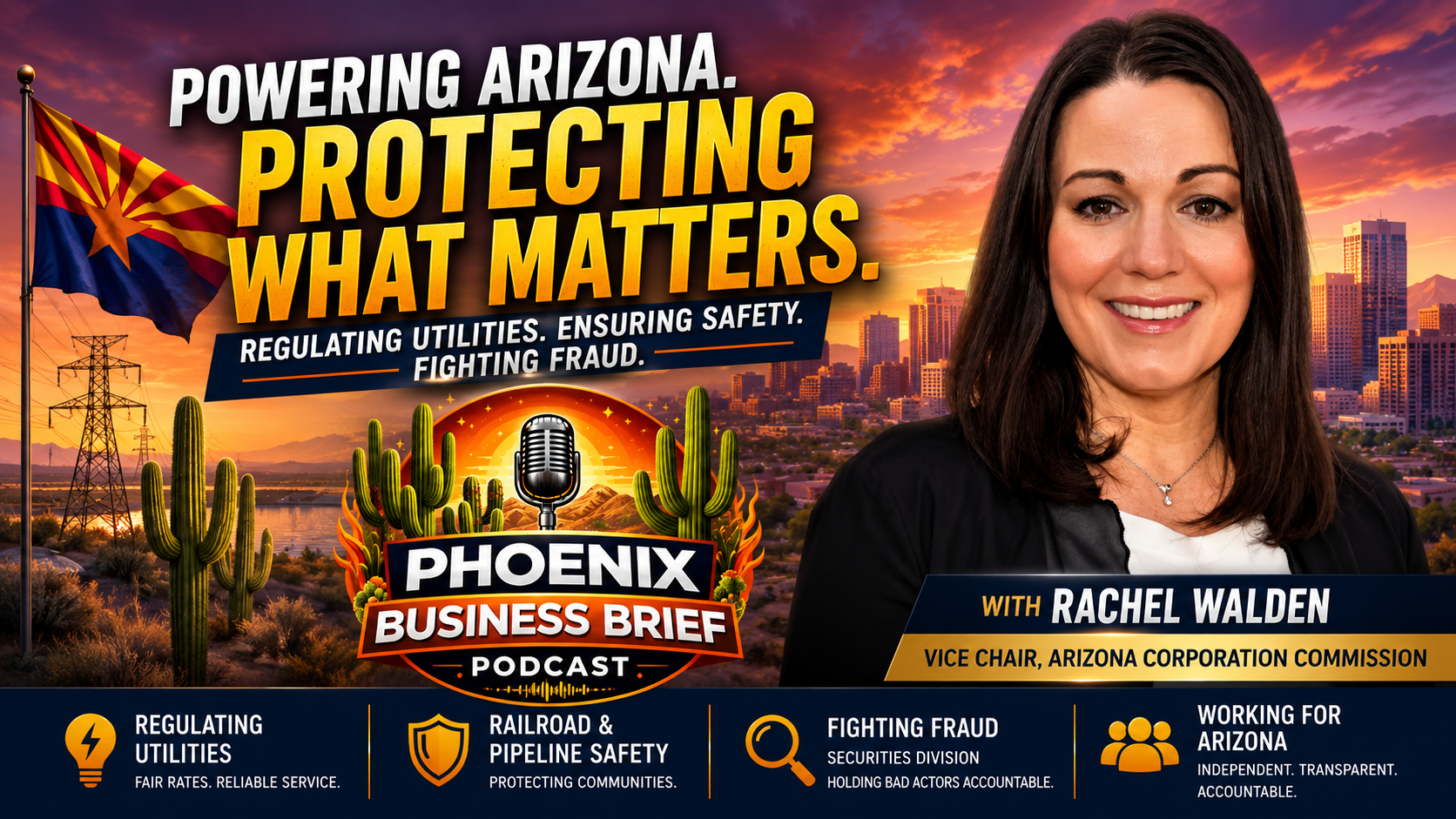
[00:00:00] Welcome to the Phoenix Business Brief Podcast. I'm Brian Hyde. My guest today is Rachel Walden. She is the current vice chair of the Arizona Corporation Commission. And Rachel, I'm gonna have to ask you to first of all tell me, I'm, I'm, I'm learning for the first time, tell me a little bit about what the Arizona Corporation Commission is and, and what your job entails.
Sure. A lot of people work with the commission for their filings for the corporations and LLCs, but I think we're most known as the people that regulate the rates for utilities. About 60% of the water, natural gas, and electric utilities are regulated by the commission. We also have railroad and pipeline safety, and my favorite division is the securities division, where we go after fraud for, uh, in, in investment advisors and securities-related fraud.
And I have a financial background, and I was at Vanguard for 12 years, so I have the most experience in, in that arm of the commission. And, and I'm gonna come back to, to what you're doing [00:01:00] with the commission. Um, tell me a little bit more about your story, though. What, what is your background? What led you to where you are right now?
Well, becoming a mom had a lot to do with it. I, I had left my career at Vanguard to be a stay-at-home mom. And around 2020, like a lot of other moms, I started to get more and more politically engaged. I did have a pretty political upbringing with my mom. She was a staunch constitutionalist. She was a single mom but started her own business, never took money from the government, and she was very adamant that we become self-reliant people, and that's the best way to preserve your freedom, is not to have to rely on the, on the government.
So I did have more of that political upbringing, but a lot of the stuff that happened in 2020, uh, led me to then become a precinct committeeman in my legislative district. And I ran for the school board for Mesa in the largest school district in Arizona, and I was elected to that in '22, November 2022.
And then I ran for the Arizona Corporation [00:02:00] Commission and was elected to that in November of 2024. I'm able to hold both offices because school board is unpaid. Wow. You definitely are staying busy then. I am staying busy, yeah. And I'm, uh, not working at Vanguard anymore, so stay-at-home mom slash politician.
Let's, let's talk a little bit about what you do with the Arizona Corporation Commission. I'm particularly interested when it comes to, um, setting rates for, for utilities. Um, talk to me a little bit about the process that goes into that and, and, uh, you know, I'm, I'm sure, I'm sure it, it can be as complicated or not, but tell me the gist of, of why, why does the commission exist in the first place?
Why was it called into existence? Yeah. Thank you for that question. It's so important. It was... The commission was set up when Arizona became a state, and sort of the, the founders of the state constitution were concerned about monopolies because of the railroad, and they saw that utilities would become a naturalized monopoly, [00:03:00] and that's...
When I say naturalized, they, they weren't a monopoly 'cause they cut out the competition, there just wasn't competition. No one really wants to start a utility company, and a lot of them started because they were very small, and they just grew and grew. Like APS used to be the people that lit the oil lamps in Phoenix.
They... And, and, and that's how they started. So they sort of became a natural monopoly by the absence of, of having competition, and they wanted the, the commission to be that regulatory body. Now, all 50 states do have a public utility commission that regulates rates. Only 13 states have an, uh, an elected, uh, commission.
And, and what... In the rate cases, what happens is that, you know, the utility is the one that says that they need a rate increase. They see that they're, they're operating at a deficit or operating in the red, and, and they have to file for a rate increase, and it's a pretty lengthy process. It takes about 18 months, which is actually pretty on the slow side of things.
Uh, but they have public hearings, and in most rate [00:04:00] cases, it's a fully litigated rate case where they're having hearings with the administrative law judge who's the commissioner's proxy, and that's currently going on with Tucson Electric Power. They're in the middle of, uh, public, uh, the public comment, and then they're in the hearings where there's testimony being given and people that, in organizations that intervene in those rate cases ask questions of the experts in the company as they haggle out and establish what is, what's prudent, what rates, uh, what expenses are allowed in the rate case.
The judge writes up a recommended order and opinion, and then that goes to the commission, so we're actually the final stop in the rate case process. Then we can take that recommended order and opinion, and we can amend it, we could revise it or flat out reject it. It's pretty hard to just reject a recommended order and opinion.
There are laws and in the state constitution, you know, guarantees that the company, you know, as, as a private company that provides service, has a right to recover the [00:05:00] cost of providing that service. And so when those expenses and the revenue requirement to operate the company's been set, by the time we get the recommended order and opinion, it's pretty clear that, that the company is not operating in a way that's at the best interest of the public, in a sense that if that company goes under, then we lose services.
That's, that's a big problem. So usually there's, there's been enough burden of proof that there's gonna be some kind of a rate increase, and, and then the commission can decide if there's things we wanna- Continue to cut out of the expenses, which we've done in things like board of director fees, uh, subsidy programs, th- things along the line that aren't directly related to, you know, what is the cost of making sure the lights stay on, we'll cut those expenses out, uh, at the commission level.
Rachel, talk to me about, uh, unregulated markets or rather deregulated markets. I, I'm just trying to get, uh, kind of a mental picture [00:06:00] of the, of the difference between, uh, regulated ones versus deregulated ones. Yeah. Um, where, for instance, where, where would you see deregulated markets? We're seeing them back east.
Like PJM is, is the big one, and PJM is in the news like almost every day in the industry news, like in Utility Dive or some publication like that because it's such a mess. What we've seen from deregulated markets is that they absolutely cost more money, which doesn't make sense 'cause you'd think competition would, would be a good thing.
Right. When you look at Arizona, what's hard about competition is that all of the, the transmission and the distribution to get that power from generation to your home, all that infrastructure's already been built. And so when you talk about competition, no one's gonna come in and build new poles and wires, right?
You don't wanna live in a neighborhood that has four sets of utility poles coming down the street. Right. So what happens in c- in a competitive market is that everybody's using the same poles and wires that have already been built, and so you get a [00:07:00] lot of congestion on the line. Y- and it's also kind of a
It's not really a free market because let's say, you know, like I'm in SRP's territory, and as ratepayers, we've, we've all paid within our rates the cost of providing the infrastructure of that distribution and, and transmission. And you let another company come in and use that infrastructure. Well, they didn't pay for it, and they're really just riding off the backs of what the ratepayers paid for.
So that's the first problem with, with deregulation, is you are gonna have those issues with, with your lines and with the congestion. And so you start to pay congestion fees, and we kind of see that in the cellphone industry where they have that shared infrastructure, and so you get issues there. And then what's happening in, in the f- in the free market is that demand drives up costs.
And so now you've got different independent power producers, and they're buying power from different places. But the more that that demand goes up, the more that the cost goes up. And so you are [00:08:00] buying power on the free market. But instead of the free market creating competition that drives prices down, the demand makes prices go up.
So our utilities in Arizona, they're called vertically integrated, and that means that they are both like providing the service but generating their own power. Now they do have some contracts where they, they buy power out- outside of their own generation, and they do that because it's, it's very cost-effective in some of these contracts.
But they're not trying to buy power at the same time that everybody else is trying to, to buy power, where the, it's really high. So like in, in APS or in SRP, they can generate their own power at, at 20 to $80 a megawatt hour. We saw in PJM this winter, especially with the, with the data centers driving up demand, the megawatt hour was $1,600.
Hmm. $1,600 versus we're gonna generate it at $40 a megawatt hour. So we're seeing that it, it is [00:09:00] genuinely costing ratepayers more money to have that deregulated market. And because of that, when, when people do talk about things like data centers and they say they drive up costs, you have to be careful saying they drive up costs because it's gonna be in the deregulated market that that happens.
When the utility's providing their own power, they're gonna generate it at the same price, whether it's for you or for s- for somebody, somebody else. I gotta tell you, based on your explanation, I don't think I will take it for granted the next time I go flip a light switch and- ... wait for the lights to come on.
I, I just didn't understand, you know, the, to, there, there are layers of complexity here. There are. And you actually have within your rates, you have both the federal costs and, and the, the state costs. So we have the Federal Energy Regulatory Commission, and they set the rates for the transmission because we are all incon- interconnected within the country.
And so you have the, the fed- the federal agency for the transmission, and then you [00:10:00] also have, you have the rates set, set by the utility. It's not a cheap business, and when you look at all the components involved, you'll start to appreciate the cost a little bit more. You know, a lot of people get really upset at their bills, and I get it.
I've had summer bills that are $800. I'm in the SRP territory. Their rates aren't regulated by the commission, but I mean, I've, I've opened that $800 bill and I'm like, "What did I do?" Like, "Wow, $800." You know? But we use a lot of power. So you have to look at, okay, well how much, how much is a kilowatt, you know?
And, and you're averaging out kilowatts by the pennies. You know, two cents a kilowatt, six cents a kilowatt. We have lower prices in Arizona than a lot of the other states. We're, we're down in the lower price range, but we use so much of the power that that's why our, our bills are so high. Our rates are still beating inflation.
Rachel, how, or I guess I should ask [00:11:00] who, uh, provides the oversight that, that keeps, um, your commission working in the interest of, I guess it's the consumers? Are, are they the ones that are, that are ultimately being, uh, protected by, by the work that the commission does? Yeah, you know, it's interesting because we talk all the time on the commission about protecting the ratepayer, but it doesn't actually say that in the state constitution.
It's, it... The state constitution says that you're there to provide the, the recovery cost in just and prudent rates, and we interpret that as just and prudent as protecting the ratepayer. But that has become the mantra of the commission, is that we have to look out for, for the residential ratepayer.
Because in, in all these decisions and, and development and, and growth, like, th- you know, they're saying it is up to the elected officials on the city council or the board of supervisors and then at the commission level. And I think because we're one of the states that has an elected commission versus appointed by the governor or appointed by another body, we [00:12:00] do feel more of a sense of responsibility as a representative government to speak for the people.
Now, the legislature also created, uh, the office called RUCO. It's the Residential Utility Consumer Office. So they intervene in a lot of the class A rate cases and participate in the meetings, and we do hear from them a lot. I feel like I'm on the same side of, of RUCO mo- it, it, you know, most of the time, in a sense that I'm trying to, to argue to kind of help bring costs down and, and bring the return on equity down.
There's a, a few points where I've disagreed with them in meetings. Like I've, I've met with the office that talked about income-based rates, and I'm, I'm opposed to income-based rates. Um, so there's some things that I'm, I'm not for, but overall, you know, we're both trying to do what we can to keep costs down for, for consumers, and that's, that's about it in terms of oversight.
I mean, we have the Federal Energy Regulatory Commission that, in a sense, [00:13:00] oversees, uh, some of the, the work that the Public Utility Commissions are doing. We work with a group called NARUC. It's the North American Regulatory Utility Commissioners. They meet a few times a year, and we'll go to conferences and, and talk with commissioners from other states and, you know, stay informed of what's, what's going on in the country.
A lot of our issues are, are the same issues that we have a- a- across America with energy, like the need to create more power, hardening the grid, uh, the, you know, renewable timing issues where there's more renewables that have come online, but they're not base load, so you're kind of having to, to work with that, working around the, the renewable problem of, uh, like for example, a cloud or a dust storm comes along and then the solar goes offline, and batteries, batteries have a place, but they only provide power for maybe four hours.
You know, those k- those kinds of issues in [00:14:00] energy are the same for all 50 states. And that actually raises a question that I wanted to ask you about. Um, by what means does Arizona generate most of, of the power that, that is used? Yeah, we, we are generating pretty much the utilities 'cause it, you know, it's done by service territory, and it's up to that utility to provide that service in their territory.
So it's, there's not really like a, a, a state involvement there. But they're pretty much all vertically integrated and generating their own power, but do have the ability to get power elsewhere, and we benefit from that because when we're getting power from other states, it's because it's saving money. So like California's a good example.
They have a lot of solar in California, and so they're generating more energy during the day than what they need because peak demand is 6:00 PM, right? It's after 3:00 PM peak demand starts, and so as the demand goes [00:15:00] up, that's when solar stops producing. When they get too much solar during the day, they're giving it away.
And we've had situations where California's paying Arizona to take the power off their system. And, and those costs get passed down in real time in your bill, like where the solar goes into negative pricing and it's sometimes negative 16 cents a kilowatt. I mean, it can get really, really low. And so when there's cost savings and, and benefits and that option exists, our utilities will, will pull in power from, from other states, and then we'll also sell power when it's at a, a cost benefit.
If there's excess power that we can, we can unload, that happens and, and that's, that's stuff that gets analyzed too in, in the rate cases. Um, one thing I'll bring up real quick is with Palo Verde 'cause a lot of people are always asking me, "Why do we give power to California?" And we don't give power to them, but Palo Verde's owned by [00:16:00] seven utility companies, and some of those utility companies are in California and Nevada, and so they do have ownership in that power plant and have a share of the power.
And I wanted to ask you about, uh, nuclear as, as far as- Yeah ... uh, what, what's happening in terms of nuclear development in Arizona? Yeah. Nuclear's exciting because it's, it's got bipartisan support, and so no one's really fighting about it. It's more about how are we gonna get it here as soon as possible.
And people like it for different reasons, but ultimately, it's, it's emission-free, and it's very, very powerful. What we're finding that with nuclear is everyone's interested in the small module reactor route. There's like five or six, like, different methodologies where they can achieve power through nuclear.
So like SRP had a nuclear workshop last year. They're having another one this year that I'm going to, and they talked about some of the different ways that they can get to that point. What, what- [00:17:00] Sort of everyone's waiting on is, is one, the supply chain management. So based on the materials that, that you need to, to achieve the nuclear power is gonna decide, you know, when that nuclear comes, because nothing that we need is readily available right now.
So we're kind of like the private sector's working on it. We're kind of waiting for them to see w- which one emerges as the clear winner that we get that supply chain set up so that when people need the materials, the materials are available. And like one of the things they talked about at the SRP workshop, what a lot of utility companies are afraid of is that they're all gonna build nuclear at the same time.
They all go to the shelf, so to speak, to get a product off the shelf, and that product's not available, and then maybe it's not available for another year or two years. So those are some of the supply chain issues they're worried about. We also have a problem with the skilled labor force, where we don't have...
Because America stopped doing nuclear, we don't [00:18:00] have that many people that know how to work in, in that arena. And so there is a workforce shortage as well that is, is getting addressed. I'm trying to address it on the school board, um, but that has to happen, too. And we saw in Georgia, they built a nuclear power plant, Vogtle, and they presented in our workshop last year when we did a nuclear workshop.
We've got another one coming next month. They had so many lessons learned from one reactor to the next that, that it was millions of dollars in savings based on the lessons they learned when they went from reactor two to reactor three, I think it was, uh, just because no one had done a nuclear power plant for so long.
And you know that, that plant was supposed to be $16 billion or something. Wow. It's like th- it's like $34 billion. Oof. It more than doubled. One of the utilities went bankrupt along the way. That does scare off investors and [00:19:00] scare off people from, from doing projects like that. And especially if you're waiting to get a return on your investment, you know, of 15 years, 20 years, that's a, that's a long time to wait.
So I don't know that we're gonna see a lot of large nuclear plants like a Palo Verde or a Vogtle. Definitely, though, everyone's interested in, in the small module reactors. Um, and it's, it's good for Arizona that it's got so much bipartisan support. And several of the utilities like APS and SRP have joined forces to apply for federal grants for siting those locations, and, um, that's something that APS was looking at with Cholla.
Uh, one is, you know, we can always convert that one to a natural gas plant, but that could also be a future site for nuclear, and ultimately the feds determine and give approval for where nuclear can go, which is why they're, you know, have to involve them and, and And [00:20:00] get a grant on siting these locations.
So we're at least 10 years away from nuclear, for more nuclear, if not longer. So in the meantime, one of the best resources that Arizona's been using, really the whole country, is natural gas. And fortunately for us, it's really cheap right now. Again, we are talking with Rachel Walden. She is the current vice chair of the Arizona Corporation Commission.
Uh, is there a website where people can go to learn more about your organization? Yes, azcc.gov. And on, on that website, there's a Meet the Commissioners, and you can look at all five of the commissioners. And in our profile is our bio and then links to our press releases or, or opinion pieces. And then I have a website for myself, electrachelwalden.com, that has, uh, information about, about me and my philosophies and work on the commission and on the Mesa School Board.
Rachel, thank you so much for joining us today on the [00:21:00] Phoenix Business Brief podcast. Oh, it's been great. Thank you so much for having me.