Sunday, May 24, 2026 · Phoenix, AZ
Phoenix Business Brief Podcast logo
← Phoenix Business Brief

2026-03-04 · Juniper Speech Therapy

Unlocking Speech Development: Julie Mercadante on Myofunctional Therapy

with Julie Mercadante, Founder — Juniper Speech Therapy

Unlocking Speech Development: Julie Mercadante on Myofunctional Therapy — Julie Mercadante, Juniper Speech Therapy

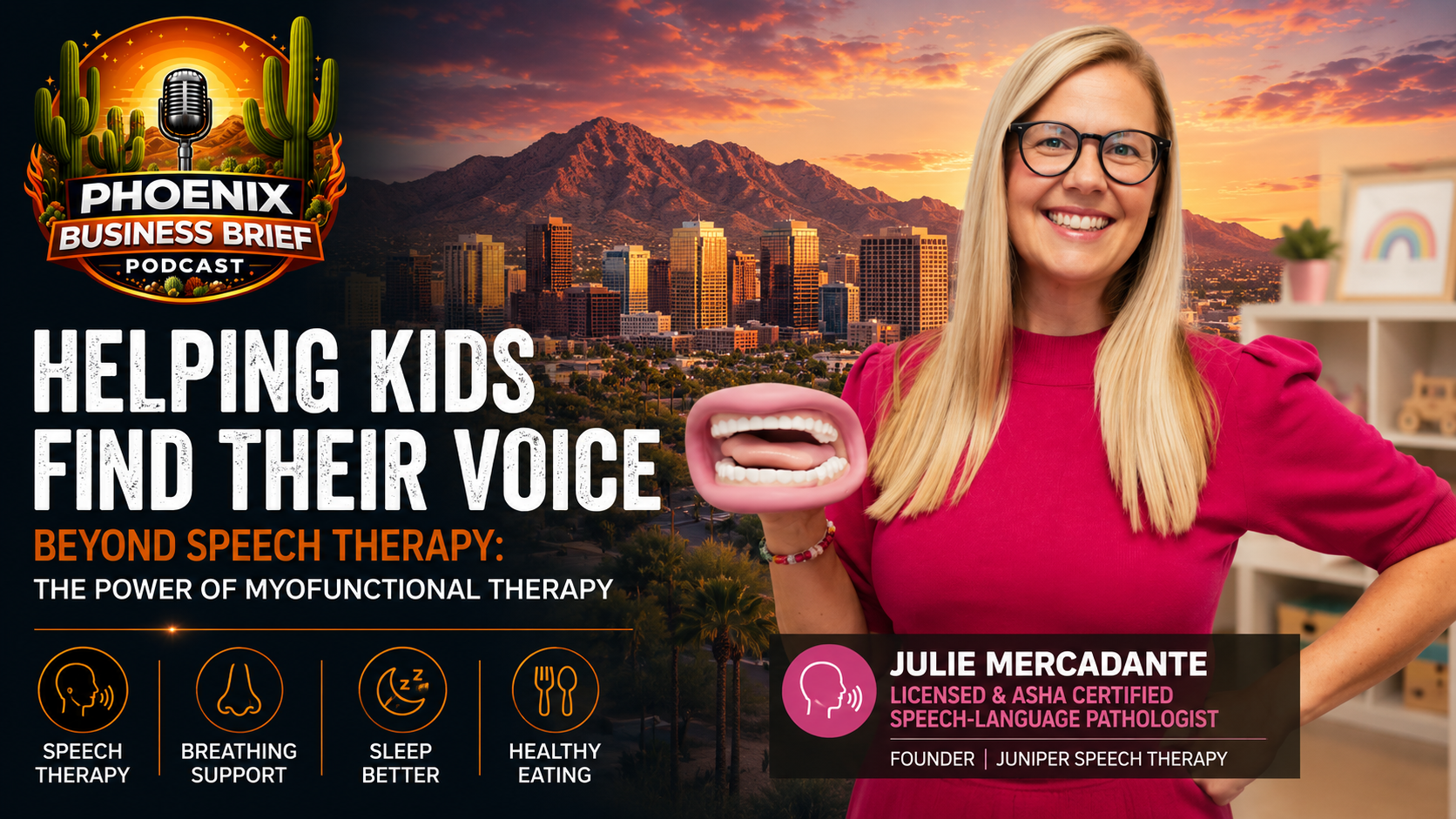
In the Phoenix Business Brief podcast, Julie Mercadante, founder of Juniper Speech Therapy, discusses myofunctional therapy, which focuses on how tongue function, breathing, and oral posture affect speech development in children. With over 25 years of experience, Mercadante emphasizes the importance of early intervention for issues like mouth breathing and picky eating, which can lead to long-term speech difficulties. Juniper Speech Therapy offers services in North Phoenix and surrounding areas, including virtual consultations.

Phoenix Speech Therapist Julie Mercadante of Juniper Speech Therapy Discusses Myofunctional Therapy

0:00 / 0:00

Phoenix Speech Therapist Julie Mercadante of Juniper Speech Therapy Discusses Myofunctional Therapy

Phoenix Speech Therapist Discusses Myofunctional Therapy

Julie Mercadante, a licensed and certified speech-language pathologist, is the founder of Juniper Speech Therapy in Phoenix. In a recent episode of the Phoenix Business Brief podcast, Mercadante discussed her 25 years of experience in the field and her specialization in myofunctional therapy, a practice that extends beyond traditional speech therapy.

Mercadante explained that her practice focuses on the relationship between oral function and speech development. "Myofunctional therapy looks at how a child’s tongue functions, how they breathe, how they sleep, and how they eat," she said. These factors can significantly influence a child's speech development, particularly in cases where traditional speech therapy has not yielded results.

Mercadante's team at Juniper Speech Therapy includes three other therapists who provide both in-home and in-clinic therapy options. The practice has been operating for nearly six years and has seen a growing interest in myofunctional therapy as parents become more aware of its benefits.

Many parents arrive at Juniper Speech Therapy unaware of myofunctional therapy. "A lot of them come in with the concern that their child has been in speech therapy for years without progress," Mercadante said. She emphasized the importance of looking beyond surface-level speech issues to identify underlying causes, such as improper tongue posture or mouth breathing.

Mouth breathing, in particular, is a significant indicator of potential myofunctional disorders. Mercadante noted that children who snore or breathe through their mouths at night may experience various developmental challenges. "Snoring is never normal for a child," she stated, underscoring the need for parents to pay attention to their children's sleep patterns.

Signs of myofunctional disorders can include speech errors, picky eating habits, and difficulty with oral motor skills. Mercadante explained that these issues often stem from improper tongue function, which can affect a child's ability to chew, swallow, and articulate sounds. "If a child has a tongue thrust swallow, for example, it can impact their speech sounds," she said.

Early intervention is crucial. Mercadante advised parents to seek professional help if they notice symptoms such as mouth breathing or persistent speech errors. "I don't love the wait-and-see approach," she said. "The sooner we can create new habits, the better."

Mercadante's therapy sessions typically begin with posture exercises and breathing techniques. Children are encouraged to practice nasal breathing and proper tongue posture through engaging activities. "We work on creating new muscle patterns that support proper oral function," she explained.

Juniper Speech Therapy offers services not only in Phoenix but also throughout Arizona, including virtual options. Parents interested in learning more can visit the practice's website at juniperspeechtherapy.com. Mercadante emphasized her commitment to helping families understand the importance of myofunctional therapy and its potential benefits for their children.

In summary, Julie Mercadante's work at Juniper Speech Therapy highlights the significance of addressing underlying oral function issues in speech therapy. By focusing on myofunctional therapy, she aims to improve not only speech clarity but also overall health and development in children.

Interview Q&A

Q&A: Phoenix Speech Therapist Julie Mercadante of Juniper Speech Therapy Discusses Myofunctional Therapy

Phoenix Business Brief: Julie Mercadante on Myofunctional Therapy

Q: Can you provide a brief background about yourself and your practice?

A: I have been a speech language pathologist for about 25 years, working in various settings including schools, nursing homes, and private practice. I founded Juniper Speech Therapy nearly six years ago, specializing in speech therapy with a focus on myofunctional therapy.

Q: What is myofunctional therapy?

A: Myofunctional therapy examines how the tongue functions, including its resting position, breathing patterns, and the impact on speech development. It addresses issues like mouth breathing, snoring, and tongue posture, which can affect speech clarity.

Q: How does myofunctional therapy differ from traditional speech therapy?

A: Traditional speech therapy often focuses on sound production, while myofunctional therapy looks at the underlying causes of speech issues, such as tongue posture and breathing habits. It integrates these factors to improve overall speech and communication.

Q: How common is it for parents to be aware of myofunctional therapy before seeking help?

A: Many parents are unaware of myofunctional therapy when they first come to us. They often seek help due to persistent speech issues despite years of traditional therapy. Awareness is growing, partly due to social media.

Q: What signs or symptoms should parents look for that may indicate a need for myofunctional therapy?

A: Parents should watch for signs like mouth breathing, snoring, restless sleep, picky eating, and specific speech errors. These can indicate underlying myofunctional disorders that may affect their child's speech and overall health.

Q: At what age should parents consider seeking professional help for potential myofunctional issues?

A: Early intervention is crucial. If parents notice signs like mouth breathing or feeding difficulties, they should seek help as soon as possible. Waiting can lead to more complex issues later on.

Q: Can you explain what a typical myofunctional therapy session looks like for a child?

A: Sessions typically start with posture exercises and breathing techniques. We engage in activities that promote tongue elevation and lip closure, and we may incorporate games to make the process enjoyable while addressing feeding and speech skills.

Q: What is the main takeaway you want parents to have from this conversation?

A: Early intervention is vital. Parents should be proactive about their child's breathing and speech issues and seek help rather than waiting for problems to resolve on their own.

Q: How can parents find Juniper Speech Therapy and learn more about your services?

A: Parents can visit our website at www.juniperspeechtherapy.com. We offer in-person and virtual services across Arizona. Information is also available on our social media platforms.

Q: What types of services do you offer at Juniper Speech Therapy?

A: We provide speech therapy and myofunctional therapy, with a team of specialists available in various locations. We also offer virtual sessions to accommodate families throughout Arizona.

Q: How do you approach communication with families who are new to myofunctional therapy?

A: I prioritize clear communication, providing resources and explanations about myofunctional therapy and its connection to speech. I aim to address any concerns and help families understand how this approach can benefit their child.

Q: What is the significance of nasal breathing for children?

A: Nasal breathing is essential for proper oral posture and overall health. It helps prevent issues like snoring and mouth breathing, which can lead to developmental challenges if not addressed early.

Q: How do you assess for tongue ties or other structural issues in children?

A: During assessments, I evaluate the child's oral function, including tongue posture and movement. If I suspect a tongue tie, I refer families to specialists who can confirm the diagnosis and discuss potential treatment options.

Key takeaways

  • Myofunctional therapy is looking at how the tongue functions basically.
  • Finding the overlap between how a child breathes, eats, sleeps, you know, can really affect how they ultimately speak.
  • I always think, you know, 'cause I feel like I hear that a lot. I get a lot of kids at a point where I think it might be not too late, but I wish they would've come in sooner.
  • I feel very strongly about the early intervention and learning about how important it is to breathe through the nose.
  • A little snore might look cute or a little drool seems normal, but after a certain age, you know, may it might not be.

About the guest

Julie Mercadante

FounderJuniper Speech Therapy

Full transcript

Show full transcript
[00:00:00] Welcome to the Phoenix Business Brief. I'm Brian Hyde. Today I'm joined by Julie Mercadante . She is a licensed and a SHA certified speech language pathologist. But Julie, as, as we were talking before we, we started the program, this actually encompasses a lot more than just simply teaching people how to speak. Would you mind giving us a little bit of your background and, and tell us a little bit about who you are as well as what you do? Sure. Yeah. Um, so I've been a speech language pathologist for, uh, probably about 25 years now. Um, I've worked in all sorts of settings, um, schools, nursing homes, clinics, uh, home health, private practice. Um, and I've had my own private practice, uh, for about, um, almost six years now. And, um, you know, we provide mostly speech therapy, but with, uh, kind of, um. A specialization in something called myofunctional therapy. And so that is, uh, looking at how a child, uh, how their tongue [00:01:00] functions, how they breathe, how they sleep, how they eat, um, and how that affects their speech development too. Um, so here in Phoenix we have, um, a team of three thera, three other therapists besides myself, and we provide in-home therapy and, um, in clinic therapy too. So, so we have a couple different options, but, um. But my, my experience, um, professionally but then also with, um, our own children kinda led me to this, um, interest in this very, not really, it is been around for a long time, the myofunctional aspect of, um, development, but, um, led me to really want to do more research and become specialized in this. And it's really made all the difference in how I practice. Let's differentiate between myofunctional therapy and, and I'm guessing what most people think of in terms of, when I think of a, a speech language pathologist, oh, well a child has a hard time sounding out their R's or S's or something. And, and, and, um, it sounds like this goes far beyond just [00:02:00] simply mm-hmm. You know, how they sound and, and correctly forming words. What is myofunctional therapy? So myofunctional therapy, um, is looking at how the, the tongue functions basically. So where is it at rest? Um, how does someone breathe? So are they breathing through their mouth or through their nose? Um, it looks at how they sleep at night. So does someone snore? Does it, does the child snore? Um, do they, uh, drool? Do they, um, wake up stuffy? So we really look at that, how the mouth functions can also affect how they produce. Um, certain sounds. So, um, for example, like a lisp. So if the tongue is, is consistently staying low in the mouth right when someone's breathing, when they're, when they're chewing, when they're swallowing, um, if they have a tongue thrust swallow where the tongue pushes out, that will also affect their speech sounds. So, so there, just take one step back, um, in terms. Speech, speech, sound disorders. There's different, uh, types of speech, sound, sound disorders. Some are developmental, some are motor, [00:03:00] and some can, um, you know, really have this root cause of the tongue is just not working the way it should. And so finding the overlap between how a child breathes, eats, sleeps, you know, can really affect how they. You know, ultimately speak, you know, so, so working on the tongue, being able to rest up in the palate the way it's supposed to. Um, teaching the child, uh, how to breathe through the nose and making that a consistent habit helps to improve the, the oral, the rest, state of their mouth, um, which just helps them speak more clearly, helps their tongue be able to work more efficiently. And so we take that sometimes. That's almost the beginning stages where we work on these myofunctional skills. We look at their feeding, we look at their breathing. We work on that. And then we, we eventually transition into working on their speech too. Um, and I've seen so much, so many, so many kids make progress after they've gone through speech therapy for many years. That's where we actually get a lot of kids that are, um. [00:04:00] Uh, you know, older elementary, 8, 9, 10, 11, 12, sometimes teens who have these residual persistent speech errors like you mentioned, RS you know, sometimes, um, you know, like the lisps, you know, different kinds of lisps and. Nothing's worked. Speech, traditional speech therapy hasn't worked. Um, and that for me, wants me to, you know, I wanna look deeper and find out what is the root cause? Why, why, why is this child not progressing with a traditional approach that works for some kids? But not for others. Um, and so that's, you know, myofunctional therapy and so I say I practice speech therapy with a myofunctional therapy lens, you know, because I'm always bringing that into my therapy sessions to make sure. Um, we're looking at that also now as the owner of Juniper Speech Therapy in Phoenix. Um, you primarily work with, with children. Mm-hmm. How common is it that, uh, people before they come to you are, are aware of myofunctional therapy? I, I'll admit, I've, I've. [00:05:00] Orbited, you know, I have friends who are speech language pathologists. I don't think I have ever heard that phrase before. Talking with you. Yeah, yeah. No. A a lot of them come in, um, with the, um, the concern, like I just mentioned, like the, you know, my child's been in speech therapy for many years, nothing's working, or they're, they've kind of plateaued. They kind of just can't get past that. That last step of making it, um, making them more intelligible in conversation. And sometimes they're not even aware of that. So they're not always finding us as that specialty area, you know, looking for that. But then we start asking questions about sleep and, um, picky eating and, you know, trying to find, um, you know, other. Symptoms that can relate to maybe why the, the child hasn't made this progress, um, even in terms of orthodonture and their teeth and their palate and everything. And so sometimes it's a, we have to go slow. It's, it's a pretty deep rabbit hole to jump down and to really present to a parent who's never heard of it. [00:06:00] There's this whole area that, you know, this old whole different type of therapy that they've never done before. And let's try it. Others are, you know, starting to hear, I think it's becoming a little more, um, popular, you know, through social media, just, you know, other people sharing this information. 'cause it is super important to, you know, um, not just to make progress. Faster in therapy, but you know, when it comes to just overall health right. You know, so it's, it's, um, orthodont or teeth, um, but breathing like that, sleeping and snoring, you know, snoring is never normal for a child to snore, so to, you know, um, look at the whole picture of overall health too. But, um, but I would say I would agree, not very common that people are hearing about it. Um, and so definitely wanting to spread the word that there might be. Something out there, a different approach that could help children in, in all areas, not just the speech itself. When you mention children snoring, I have to admit. Mm-hmm. Okay. If, if I heard my kid snoring, I might think it's just kind of a cute [00:07:00] thing. Oh, listen, you know, he sees, you know, sleeping in a position where he is snoring. But are there other, um, are there other symptoms or signs of those myofunctional disorders that that might clue a parent into, Hey, there might be something bigger going on here. Oh, definitely. And so to start with, with sleep, that's, that's a big one. You know, how is your child sleeping? So do they, um, do they snore? Do they, do they even just breathe with their mouth open at night? Um, because our, we want our mouths to always be in what I call proper oral rest posture. So your, your lips are closed, your teeth are almost together, and your lips are closed and you're breathing through your nose. So everything is. Gently and comfortably closed. Um, so if a child's sleeping with a mouth wide open, um, if they, um, are restless at night, if they wake up early, um, if they, um. They, um, you know, have the next day, you know, maybe some, uh, attention difficulties behavior, which would indicate they weren't getting enough sleep. So sleep is a big [00:08:00] one. And sometimes, you know, like I said, they come in for speech and then it's like, well, they're actually, they've been horrible sleepers their whole life. It's like, okay, let's look at all of this. Um, but then, you know, some, um, looking at the different areas like. Speech. So some specific speech errors, like r and s and um, l and th there could be like the more complicated sounds, you know, as children get older, um, when talking about feeding, you know, they could be messy eaters. Um, picky eaters. Um, picky eating is interesting because, you know, you just kind of think it's kind of a power struggle sometimes. You know, when kids get to a certain age. But usually there's some sort of underlying reason why they don't want to eat something. Um, whether that's, um, it's difficult for them to manage and they just don't even know if they're little, you know? And then they just develop these, you know, routines where they don't wanna try new things because it might be hard to chew. So basically their tongue isn't working the right way, their jaw isn't working the right way. Um. And, you know, [00:09:00] really the, the main one to look for is mouth breathing, you know, so if you see your, your child have an open mouth posture and they're breathing through their mouth versus their nose, um, you know, more of the time. Um, that's a big thing. We wanna make sure that the tongue is where it should be, um, that the tongue's able to lift. Um, so all those, those. Areas that we look at all the symptoms within those areas, we look at even what could be causing those, what's the root cause of that? Sometimes there's a tongue tie. So that's something that, that I assess and then I refer to someone else that can confirm that. And we, you know, we're kind of plan. Um, there could be, um, you know, other reasons like muscle tone, um, sometimes oral habits, so like. Thumb sucking, um, fingers sucking things that they did when they were little. But you know, it's really just for me trying to figure out how do we get to the root cause? How can we fix that if, if it's possible, and how can we build development from there? So if they miss certain steps in feeding [00:10:00] or, or speech, you know, we start working on how to teach the tongue how to do those things if it missed those steps. So let's say that a parent is hearing this and realizing, oh, you know what? Now that I think of it, maybe my kid is exhibiting some of these signs. Mm-hmm. We don't wanna jump, you know, of course at every little thing. Oh, I better get to, I get better, get my kid in for therapy right away, but mm-hmm. At what point should a parent say, you know what, this deserves a closer look. Or, I, I need to, to, to seek some professional help. Yeah. And I think thing there would be definite, um, age ranges where. You know, if, if they're, if they're really young and you see, um, a lot of mouth breathing, you know, it's really trying to create new habits as soon as possible and, and look at the tongue and see is there anything we can do. If there is a tongue tie or anything that's causing the tongue to stay low and not be able to breathe through the nose, you know what? If there's something that we can do, like a tongue tie release or something to help the development get back on [00:11:00] track and improve and strengthen those skills as they get older, um, I'm not, um, I don't love the wait and see, you know? So I always think, you know, 'cause I feel like I hear that a lot. I get a lot of kids. Um, at a point where I think it might be not too late, but I wish they would've come in sooner. You know, um, looking for things like crowded teeth and small, really small mouths or small palettes, um, you know, kind of, um, you know, consulting with dentists or, you know, if, how does everything look as far as development? Um, you know, so things, signs, like that would be important to start to discuss with, you know, other professionals, dentists with SLP. Um. You know, the, um, yeah, just, you know, for me it's, it's really the more preventative too, um, not for every child, but if you start to see some of these signs we're talking about getting in to start to create these new habits and make sure that development's on the right path. Now, correct me if I'm wrong, but, but what you're [00:12:00] describing sounds like, um, these are the kinds of things that the longer you allow them to, to go on the, the harder they are to, to correct. Is, is it something. Mm-hmm. The, the quicker you catch it and start working on it. Yeah. The, the, the more likely you're gonna see it taken care of. Oh, I think, I think so. Definitely. And, you know, children that, you know, young children that are breathing through their mouths, you know. They become teenagers that have lots of orthodontia, that have small mouths. Um, uh, you know, I won't get on my soapbox about different orthodonture treat orthodontics, but you know, sometimes teeth are removed, sometimes mouths are made smaller, and then they become adults that snore and end up on CPAP. There's this, you know, that's not to be scary, but there's just, it's a progression that's hard to. To backtrack on, as you get older now, you can always, as adults create new habits and, you know, um, you know, even myself, new breathing habits, um, you know, [00:13:00] trying to, to, to work on that at, at any age really. But it's just really trying to intervene as early as possible to create those habits. So I see lots of. Information online, you know, how to, you know, encourage, um, you know, nasal breathing in kids. I actually have lots of free resources out there that I give families, you know, just games, just to encourage closed mouths, breathe through the nose as early as possible. So would you mind walking us through just, you know, some of the basics of what, what does a myofunctional therapy session look like for a child? Mm-hmm. Yeah. So we work, we work on, um. We start off, usually we do some, just some like warmups. We work on posture, sitting up nice and straight, standing against the wall, breathing through our nose. Um, we do that for, um, for a time, amount of time. So we start, you know, maybe even 10 seconds. And if it's difficult for a child to breathe through their nose with their mouth closed in a nice posture with the, their back nice and [00:14:00] straight, they might just collapse after 10 seconds. They're not used to that. Their, their, their whole, it's a whole body. Issue because when you're breathing through your mouth, your head naturally starts to go forward, which causes tension in your neck and your back and your, and your whole body is off. Um, so we're trying to create that new muscle structure and pattern where they, they sit up nice and straight and they breathe through their nose. Um, we do games with breathing. Um, we do whistles, we do straws. We, you know, try to get just that air flow through the nose. Uh, we work on the tongue elevating. So we do some, um, exercises to facilitate that. So, um, you know, tongue clicks. Um, so, and I also do, um, a program with younger kids that I call mini myofunctional therapy. So we're just doing more fun. The older kids can kind of sit and do more exercise kind of activities. Um, we work on lip closure. Um, if there's any goals with feeding, we work on that. Um, a lot of how a child is [00:15:00] chewing and swallowing affects their speech, which is interesting because, you know, I. There's a definite separation in speech therapy and feeding therapy. And for me it's speech feeding and malfunctional, creating this little diagram where they all overlap and when a child can better chew and swallow and breathe and you know, sit straight up, everything affects their speech. So I, you know, working through all those skills in one session and then sometimes we start to ease into the actual sound. So that's something I tell the parents. You know, we're not gonna start working on the sound right away. This is a, this is a process of getting to, making the sound as easy and making the child as successful as possible by working on these things first. So that comes naturally at the end. Now, I, I want to ask you a little bit about, uh, Juniper's speech therapy. Before I do though, for the sake of parents who are listening, um, what is the main takeaway you would like them to, to carry away from the conversation that we're having? [00:16:00] Um, I definitely, you know, I feel very strongly about, um, the, the early intervention and, you know, learning about how important it is to breathe through the nose and that that's what our bodies were meant to do. And, you know, just to, to know that, that they are able to get help and to not be told, oh, let's just see if they grow out of it, kind of thing. That's where I, that's where I find most of my, um. My concern with families that come in that they, they hear that things were normal for a long time. That's just, and like you said too, you know, you a little snore might look cute or a little drool seems normal, but you know, after a certain age, you know, may it might not be. Or, um, you know, knowing that something like picky eating is not their fault and that there could be an underlying reason for why things are difficult for your child, and then it, you know, to not, um, to kinda stop that before it becomes. A, a, a bigger [00:17:00] family struggle in the home, you know, to, to work on meal times. Um, and you know, even for old parents with older children, to know that there could be something that hasn't been explored yet as far as speech progress, if there's a, especially our asks, those are a lot of errors I see that are really hard for older kids, and to know that there might be another answer, another approach. So let's talk a little bit about Juniper speech therapy and, uh, for, for those who are listening who are like, you know what, I wanna look into this. How do they find you? How do they get ahold of you? Tell us a little bit about mm-hmm. Your, your practice. Um, so I have an office in North Phoenix, and like I said, I also have a few, uh, speech pathologists who also specialize in feeding therapy and myofunctional therapy. Um, they're in the East Valley and the West Valley. Um, so there's different options for services as, as well as virtual. Um, we all provide virtual, so you know, we have, um, some kids throughout Arizona. Um, and, um, we have our website, so it's juniper speech therapy.com, [00:18:00] www.juniperspeechtherapy.com. Um, also on Instagram, Facebook, um, you know, all the information's on my website. But, um, you know, I, you know, there's a, a, a form to submit and I try to get back to families right away. Because, um, it's always, it's like I said earlier with sometimes it's new and I get that feeling a lot. Like, I, maybe this could help. I feel like maybe this could help my child. I've never heard of this before. So it's, you know, a lot of conversation and explaining and providing resources to explain kind of what it is and, you know, um, how it's connected to speech. But, um. But yeah, so that's usually what I, I give out as my website again. We've been visiting with Julie Mercadante Dante. She's the owner of Juniper Speech Therapy in Phoenix. Um, Julie, thank you so much for being our guest on the Phoenix Business Brief Podcast. Oh, you're welcome. Mm-hmm. It's been great. Thank you.

Filed under